In Over Die-cut conditions documented by Avery Dennison, the die ruptures the silicone layer, adhesive forms bonds with the liner, adhesive bleeding occurs, label dispensing issues arise, and frequent matrix breaks and/or liner breaks occur. Adestor Self-Adhesives states that an overly rapid release can result in ruptures in the paper during die-casting or errors in the automatic dispensation of labels that do not separate smoothly from the substrate.
In Under Die-cut conditions documented by Avery Dennison, the die does not cut the adhesive completely, causing adhesive string formation and the label following the matrix. Adestor Self-Adhesives notes that if the release process is too slow, the labels can fly (separate from the silicone substrate during application) or be removed with the matrix during matrix stripping. Use the labeling equipment section and the custom roll labels unwind direction and core sizing guide to keep roll converting parameters aligned with applicator dispensing stations.
| FINAT method code | Official test method title and speed scope |
|---|---|
| FTM 3 and FTM 4 | FINAT Test Methods define FTM 3 as Low speed release force and FTM 4 as High speed release force (10 - 300 m per minute). |
| FTM 7 | FINAT Test Methods define FTM 7 as Silicone coat weight by energy-dispersive X-ray fluorescence spectometry. |
| FTM 10 | FINAT Test Methods define FTM 10 as Quality of silicone coated substrates for self-adhesive laminates: release force (300 mm per minute). |
| FTM 11 | FINAT Test Methods define FTM 11 as Quality of silicone coated substrates for self-adhesive laminates: subsequent adhesion. |
| FTM 23 | FINAT Test Methods define FTM 23 as Die strike (a. paper; b. filmic paper). |
| FTM 25 | FINAT Test Methods define FTM 25 as Evaluation of silicone coverage of coated papers by use of a water based stain test. |
| FTM 28 | FINAT Test Methods define FTM 28 as Evaluation of bleeding through paper (NEW). |
Rotary die-cutting damage vs silicone barrier rupture and stain testing
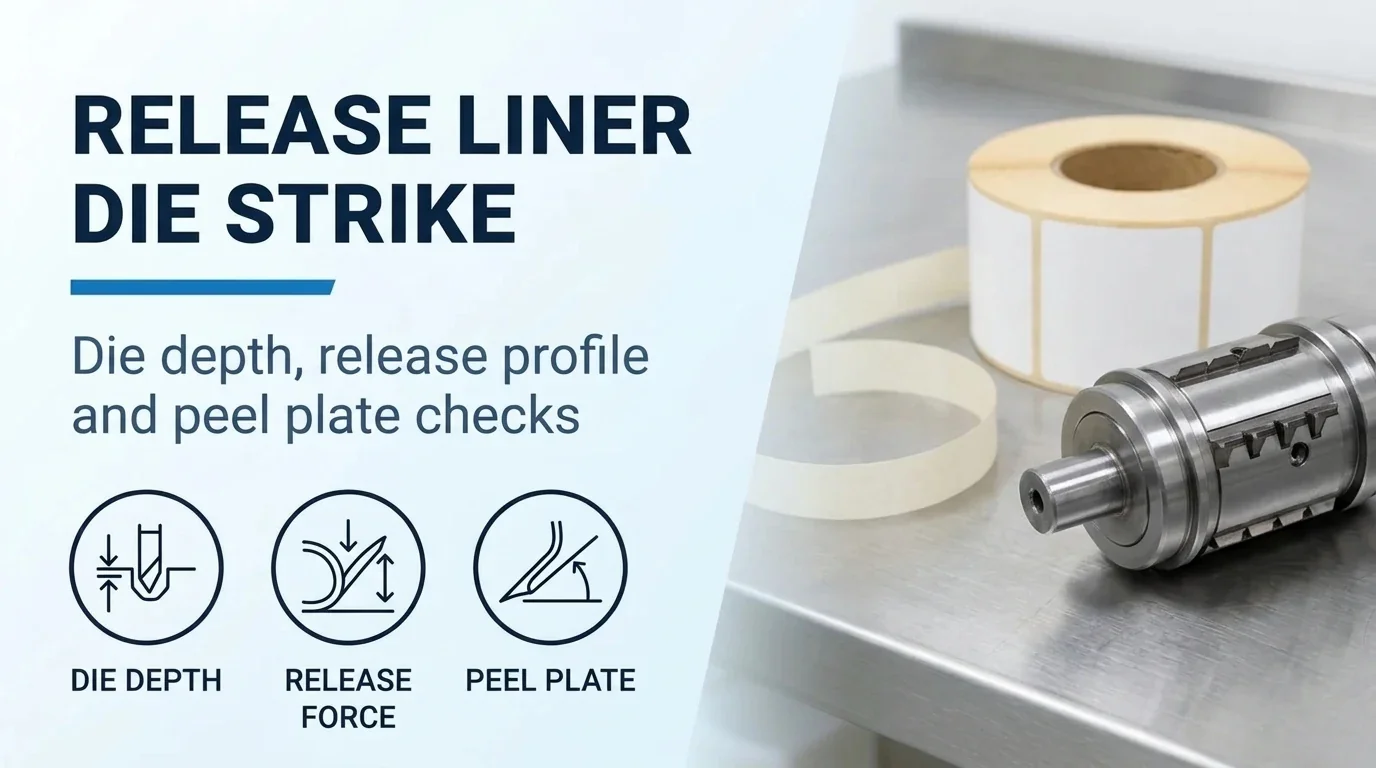
In Avery Dennison’s label converting guide, rotary / flexible die cut station components include Pressure Gauges, a Flexible die plate, an Adjustable Anvil, a Magnetic Cylinder, a Bearer, and an Anvil. In Over Die-cut conditions, the die ruptures the silicone layer, adhesive forms bonds with the liner, adhesive bleeding occurs, label dispensing issues arise, and frequent matrix breaks and/or liner breaks occur. In Under Die-cut conditions, the die does not cut the adhesive completely, causing adhesive string formation and the label following the matrix.
In the Die Cut Depth Simple Test described in Avery Dennison’s label converting guide, a heavy die strike is indicated when ink penetrates through to the rear of the liner. In the Die Cut Depth Simple Test, a light die strike shows no ink penetration to the rear of the liner. According to Avery Dennison’s dissolvable products technical bulletin, a quality die strike would enable the operator to see a faint image of all die cavities on the liner after wetting with marker or die stain solution.
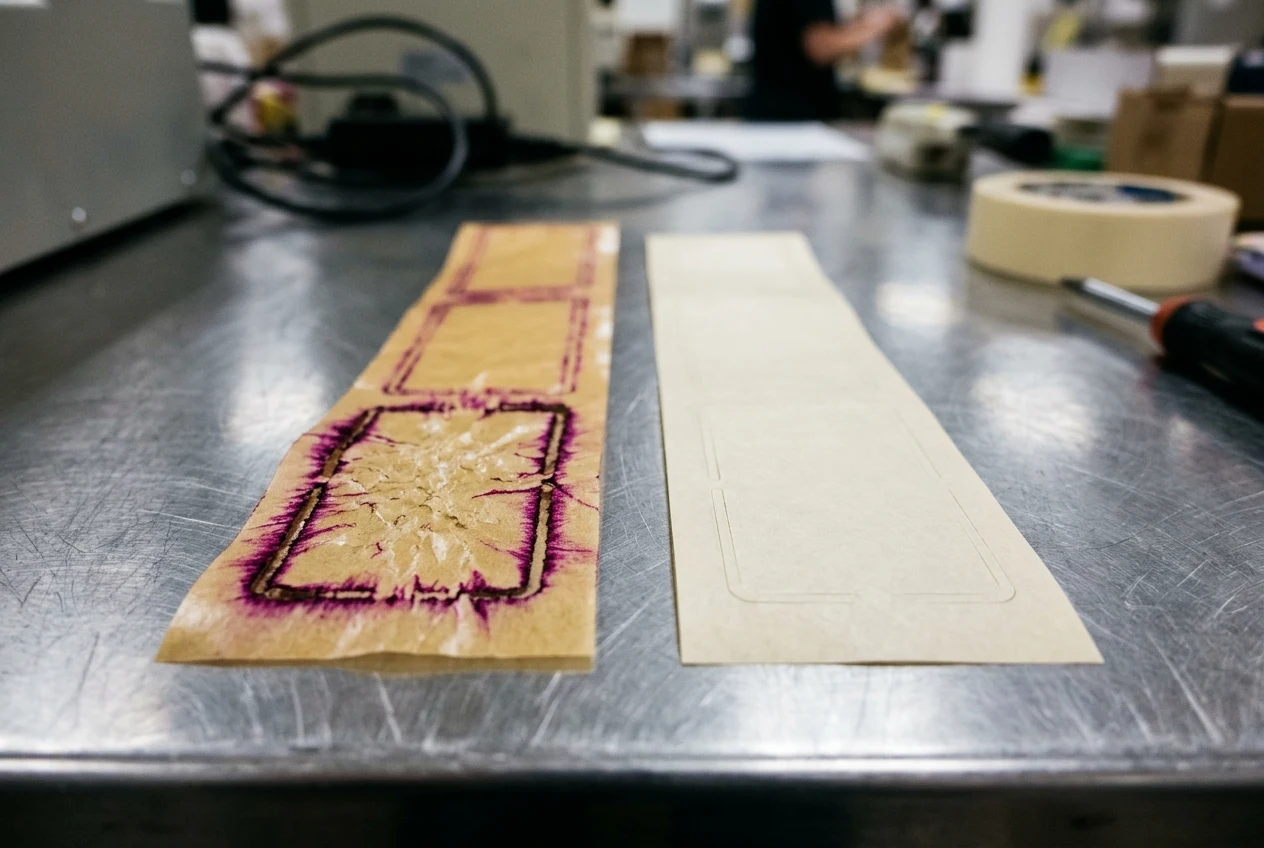
When die cutting dissolvable paper facestocks under Avery Dennison’s dissolvable products technical bulletin, operators must ensure the die is tooled correctly to the construction, the die station and anvil are clean, and the die is within manufacturer’s tolerance for roundness. Rewind pressure on press should be kept as low as possible to prevent adhesive bleed. Avery Dennison recommends storing dissolvable label materials in cool and dry conditions at 72°F with 50% relative humidity and kept wrapped in a relatively nonporous material.
For matrix stripping optimization with rubber O-rings documented in Avery Dennison’s label converting guide, the O-rings should be 1 mm smaller than the diameter of the stripping roller to ensure a tight fit. When the treatment level of a film is too low, dyne pens are used to check the dyne level of the film surface. To separate die-strike adhesive bleed from bulk viscoelastic edge ooze in storage, consult the label adhesive cold flow and roll storage temperature guide.
Glassine vs PET release liner specifications and adjustable anvil control
In Avery Dennison’s Fasson Global MDO Next Generation Technical Guide, compared to paper liners, lower press tensions and web temperatures have been found to minimize potential stretching of the PET liner to maintain registration. Dies are recommended to be tooled specifically for Global MDO Next Generation and the liner thickness because dies designed for paper liners are not suitable. Flexible magnetic steel dies are suitable for Global MDO Next Generation, and laser hardened dies have been found to provide the longest life.
To verify acceptable die strike for a PET liner on Global MDO Next Generation, a Snap Test may be used. Minimal tension on press upwinders and label rewinders is recommended to minimize winding impressions or other defects in the face or liner. The combination of film MD stiffness and release force off of the PET liner allows Global MDO Next Generation to peel cleanly from the liner at the peel tip. Compared to paper liners, a PET liner is susceptible to static buildup during processing, which can result in print defects, dust issues, and registration problems.
| Liner or laminate parameter | Published Avery Dennison datasheet specification |
|---|---|
| AG323 basis weight | Avery Dennison AG323 siliconized polyester film release liner has a basis weight of 42 g/m² under ISO 536. |
| Clear polyester liner caliper | Fasson clear polyester film release liner has a caliper of 30 µm under ISO 534. |
| LINER PET30 LR 1S subsequent adhesion | Fasson LINER PET30 LR 1S specifies an adhesion force (subsequent adhesion) of > 80 % under FTM11 Tesa 7475. |
| Clear polyester liner elongation | The clear polyester release liner specifies a cross-direction (CD) elongation of 105 % (ASTM D882) and a machine-direction (MD) elongation of 105 % (ASTM D882). |
| Clear polyester liner tensile strength | The clear polyester release liner specifies a machine-direction (MD) tensile strength of 19 kg/mm² (ASTM D882) and a cross-direction (CD) tensile strength of 19 kg/mm² (ASTM D882). |
| Clear polyester liner thermal shrinkage | The clear polyester release liner specifies a machine-direction (MD) shrinkage of 1.5 % and a cross-direction (CD) shrinkage of 0.8 % at 150 °C and 30 minutes. |
| Clear polyester liner high-speed release level | The clear polyester release liner specifies a high-speed release level of 10 g/cm under FTM4 Tesa 7475. |
| Clear polyester rPET23 liner composition | The clear polyester rPET23 liner gives optimum smoothness to the adhesive layer and contains 30% Post-Consumer Recycled (PCR) content. |
| Clear polyester rPET23 basis weight and caliper | The rPET23 clear polyester liner has a basis weight of 32 g/m² (ISO 536) and a caliper of 23 µm (ISO 534). |
| Total laminate caliper on rPET23 construction | The total laminate caliper on the rPET23 liner construction is 102 µm±10% under ISO 534. |
| Supercalendered glassine liner basis weight and caliper | The BG40WH FSC supercalendered siliconized white glassine paper liner has a basis weight of 59 g/m² (ISO 536) and a caliper of 50 µm (ISO 534). |
| Total laminate caliper on glassine construction | The total laminate caliper on the BG40WH FSC glassine liner construction is 147 µm±10% under ISO 534. |
For automatic application on the Avery Dennison AP515 rPET23 construction, the robust film liner allows for consistent, snap free application on high speed lines. In Avery Dennison’s AP515 (MC PRIMECOAT FSC S2000N-rPET23) datasheet, flat bed die-cutting performance is good while solid and magnetic rotary dies need additional care, and die bearers must be adjusted to the polyester liner.
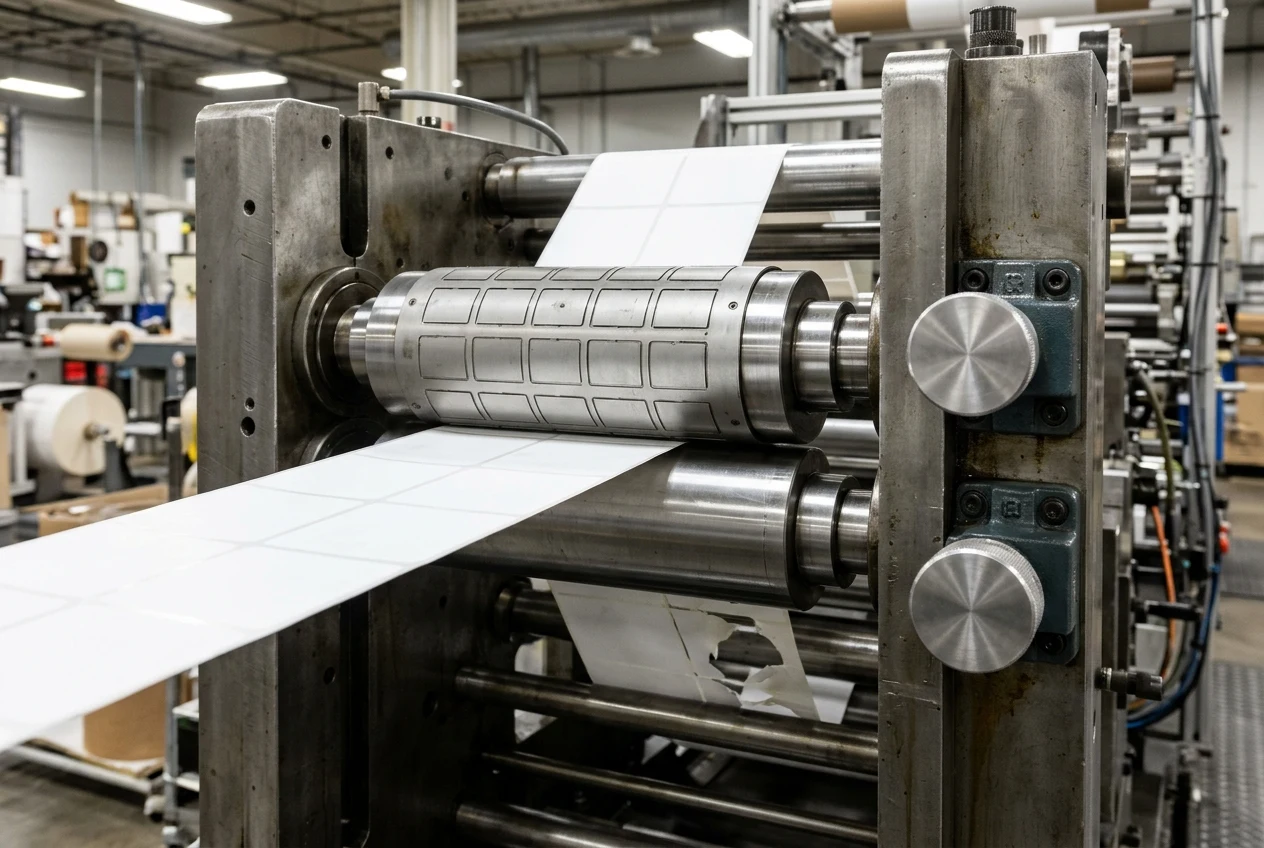
Controls on the RotoMetrics AccuStrike adjustable clearance anvil enable the operator to adjust bearers independently or together for control over die strike on various liner thicknesses. The RotoMetrics AccuStrike Anvil features dial controls with 0.001mm / 1.0 micron adjustment units. The RotoMetrics AccuStrike Anvil provides a standard total adjustment travel to +0.001”(0.025mm) / -0.004”(0.10mm), and the design can provide an alternate travel range if desired.
Low-speed vs high-speed release force testing and silicone coat weight
In low-speed release force testing under FINAT FTM 3 documented by Mecmesin, the laminate is peeled apart at an angle of 180° with a separation speed of 300 mm per minute. For low speed release force sample preparation, strips are cut 50 mm x 175 mm in the machine direction, with at least three strips prepared from each sample. In low speed release force conditioning, strips are placed between two flat metal or glass plates and kept for 20 hours at 23° C under a pressure of 6.86 kPs to ensure good contact between the release material and the adhesive. In low speed release force testing, the load is measured in at least 5 positions at 10 mm intervals from the centre section of the test strip to calculate the average load for these 5 readings. Low speed release force is expressed as the average load for the test strips in centinewtons per 50 mm width of sample.
For a high-speed release test under FINAT FTM 4 documented by Adestor Self-Adhesives, the strips should be 30 mm wide and at least 300 mm long, and the measurement is made at an 180º angle and at a constant detachment speed of 150 mpm. Detachment at high speed simulates the process of die-casting and behavior during matrix stripping.
In Dow’s SYL-OFF Silicone Release Coatings selection guide, the release profile denotes the change in release force with changing peel speed, and it is important to match the release profile to the speeds at which the final laminate will be delaminated. Dow states that silicone coat weight can have an even greater impact on silicone coverage than it does on the performance of a release coating. Release modifiers are additives included in the silicone formulation that can increase the release force, which is important for double-sided release applications.
| Silicone coating technology or additive group | Published Dow SYL-OFF specification |
|---|---|
| Solventless delivery systems | Solventless silicone delivery systems are 100% solids blends of silicone polymers with a typical viscosity of 200 – 800 cPs. |
| Solvent-based delivery systems | Solvent-based silicone delivery systems are dispersions of silicones in organic solvents whose initial viscosity of ~40,000 cPs may be reduced by adding more solvent. |
| Emulsion delivery systems | Emulsion silicone delivery systems are dispersions of silicone oils in water with a typical viscosity of ~40 cPs, usually further diluted in water to coat. |
| Typical silicone coat weights | Typical silicone coat weight is 1.0 - 2.0 g/m² for Solventless Platinum and Solventless Rhodium systems, 0.5 - 1.3 g/m² for Solvent-based Platinum and Solvent-based Tin systems, and 0.5 - 1.1 g/m² for Emulsion Platinum systems. |
| Low-speed paper coatings | For platinum solventless coatings on paper, Dow specifies SYL-OFF™ SL 200 Coating for lower release force at lower peel speed and SYL-OFF™ SL 400 Coating for intermediate release force at low speed. |
| High-speed converting paper coating | For platinum solventless coatings on paper, Dow specifies SYL-OFF™ SL 181 Coating for a flat release profile for high speed converting. |
| Silicone anchorage additives | To improve silicone anchorage, Dow specifies SYL-OFF™ SL 9176 Anchorage Additive for PET films and SYL-OFF™ 297 Anchorage Additive for general purpose use. |
Peel-plate label dispensing failure modes and applicator troubleshooting
In automatic label dispensing documented by Diagraph, an extreme dispensing failure occurs when the label does not separate from the liner at all and follows the liner over the peel blade so no label is separated. In automatic label dispensing, trailing-edge hinging occurs when the trailing edge remains connected to the edge of the liner so the label hinges or rotates about this edge and is not applied to the product.
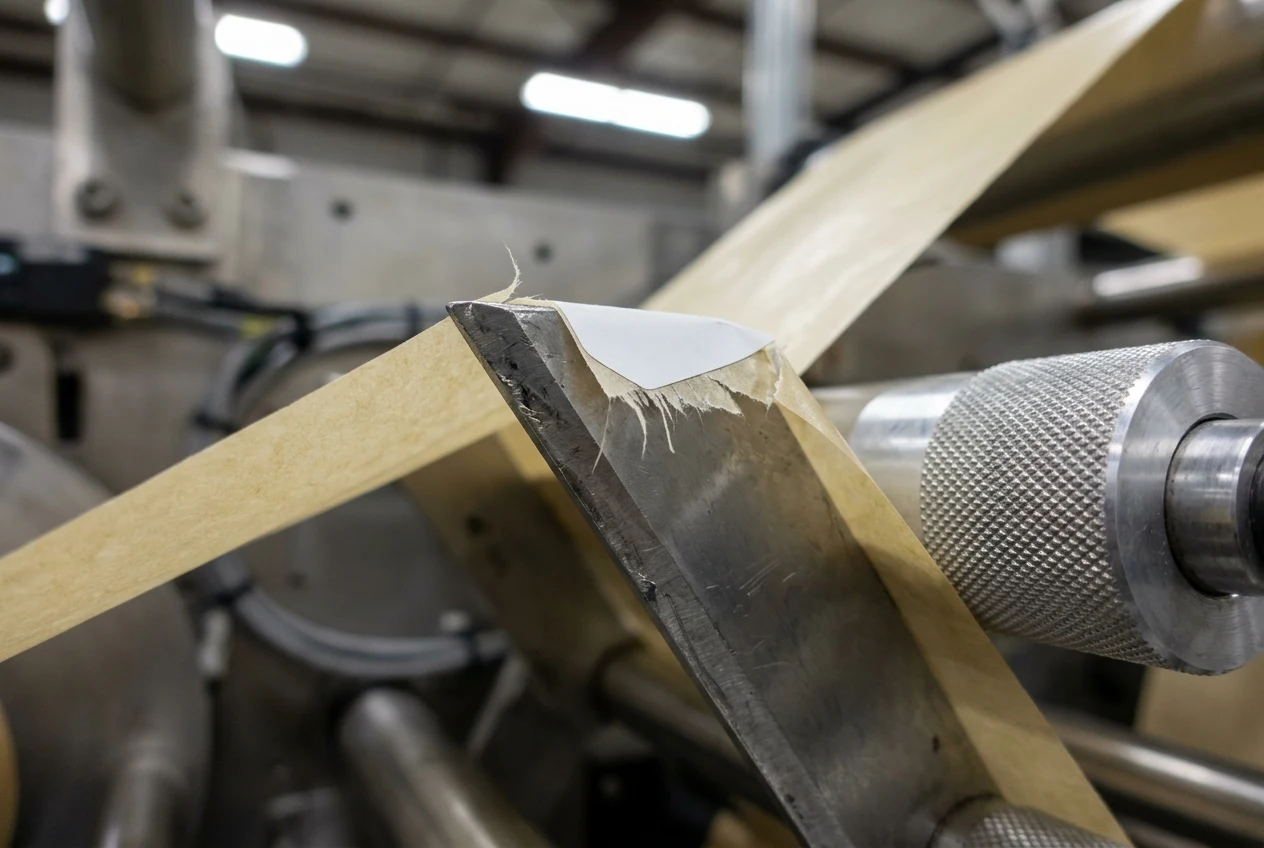
Quadrel Labeling Systems states that label tearing at the peel tip often comes from excessive web tension, a sharp or damaged peel edge, poor release, liner damage, label stiffness, or incorrect unwind resistance. According to Quadrel Labeling Systems, early stepper motor failure in a labeling head may show up as missed steps, unusual heat, vibration, grinding noise, inconsistent label feed length, intermittent stalls, or rising drive faults.
For complex or functional labels, HERMA’s applicator with movable peel plate specifies label dimensions of 15 - 160 x 10 - 100 mm (W x L), a labeling tolerance up to 0.2 mm, and a capacity up to 70 products/minute. HERMA’s applicator with movable peel plate requires a power supply of 100 - 240 V AC, 400 W, 50 - 60 Hz, and a compressed air supply of 6 bar. When matching dispensing stations to container geometry and line transport, review the inline versus rotary labeling container requirements guide.
Release liner and peel-plate troubleshooting verification checklist
Use the verification items below to record liner substrate, rotary die clearance, stain testing, and dispensing head parameters:
- Rotary die-cut station component check: Rotary / flexible die cut station components include Pressure Gauges, a Flexible die plate, an Adjustable Anvil, a Magnetic Cylinder, a Bearer, and an Anvil.
- Die stain cavity impression check: According to Avery Dennison’s dissolvable products technical bulletin, a quality die strike would enable the operator to see a faint image of all die cavities on the liner after wetting with marker or die stain solution.
- PET liner die strike verification: To verify acceptable die strike for a PET liner on Global MDO Next Generation, a Snap Test may be used.
- Adjustable clearance anvil micrometer setting: The RotoMetrics AccuStrike Anvil features dial controls with 0.001mm / 1.0 micron adjustment units.
- Laboratory release profile and silicone coverage standards: FINAT Test Methods define FTM 3 as Low speed release force and FTM 4 as High speed release force (10 - 300 m per minute).
- Stepper drive and web path check: Early stepper motor failure in a labeling head may show up as missed steps, unusual heat, vibration, grinding noise, inconsistent label feed length, intermittent stalls, or rising drive faults.
Sources
- Avery Dennison — Label Converting and Printing Watchouts
- Avery Dennison — Material Handling Notes for Dissolvable Products Technical Bulletin
- Avery Dennison — Fasson Global MDO Next Generation Technical Guide
- Avery Dennison Materials Group Europe — Product Data Sheets for Self-Adhesive Release Liners and Laminates
- RotoMetrics — AccuStrike Anvil With Dual Adjust Technology
- FINAT — FINAT Test Methods Overview
- Mecmesin — FINAT Low Speed Release Force Standard
- Adestor Self-Adhesives (Lecta) — Adhesive Properties and Testing Methods According to FINAT Regulation
- Dow — SYL-OFF Silicone Release Coatings: Films, Tapes and Release Liners Selection Guide
- Diagraph — The Art of Automatic Label Dispensing
- Quadrel Labeling Systems — Labeling Machine Troubleshooting Questions: Peel Tips, Motors, Rollers, PLC Errors, and Maintenance
- HERMA — Applicator with Movable Peel Plate Technical Documentation