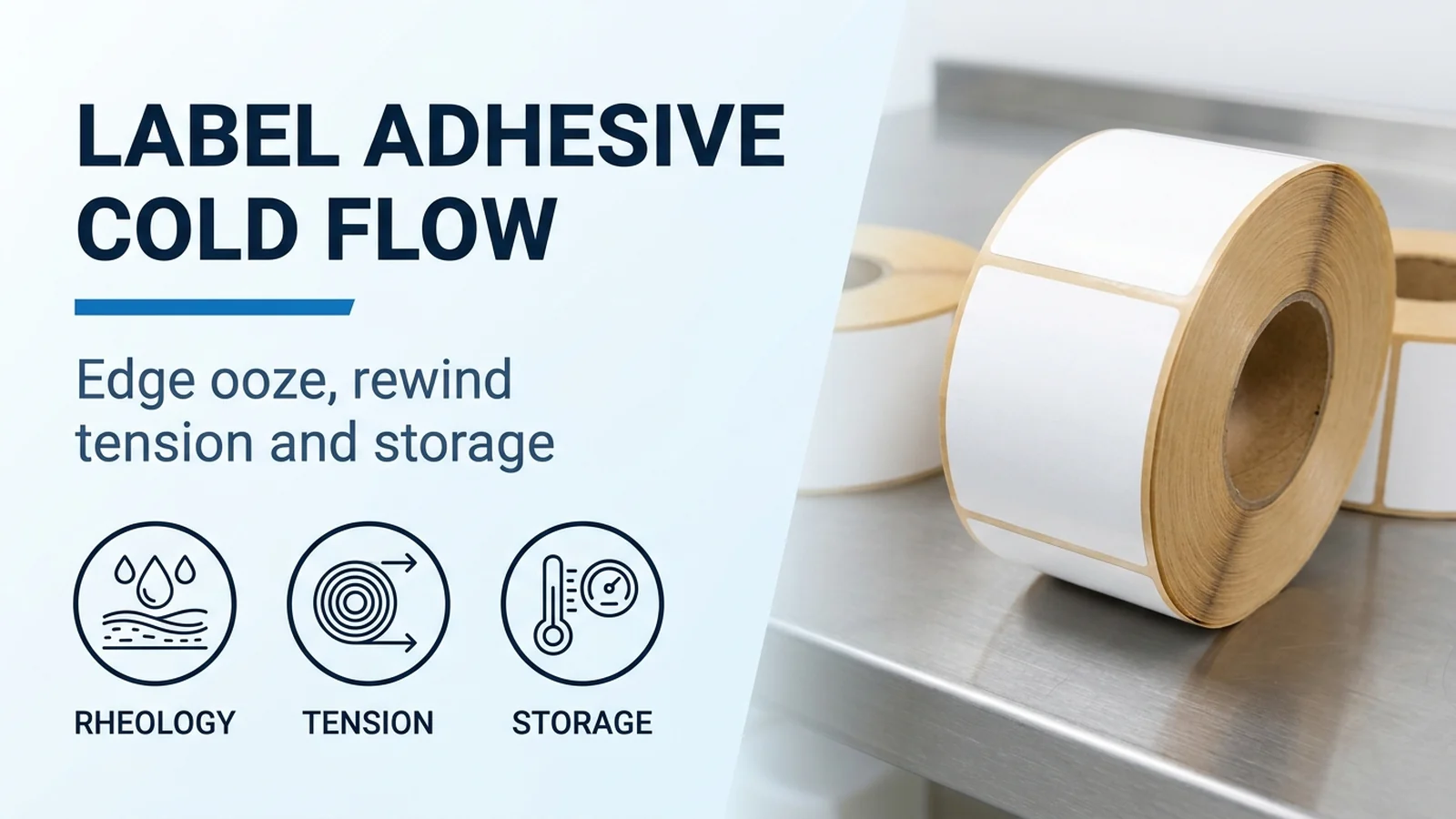
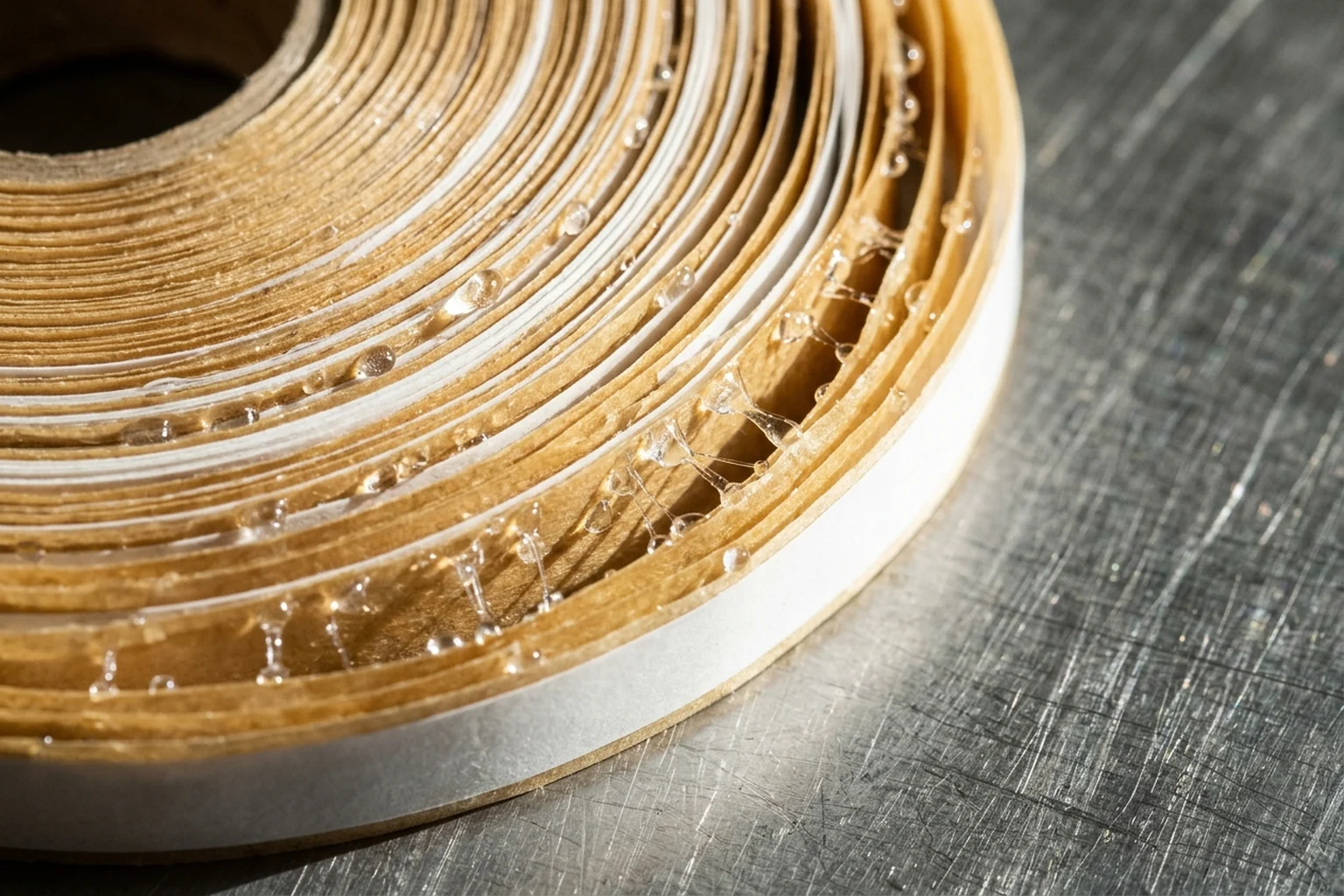
Chemsultants International defines Cold Flow as the viscous flow of a pressure sensitive adhesive under stress, and distinguishes it from Bleed/Bleed Through, which is the migration of components from the adhesive or substrate onto the face material resulting in a mottled appearance. Cattie Adhesives states that when roll edges get sticky and labels stick together after slitting or die cutting, the likely cause is a soft PSA, a heavy coat, or high rewind tension—worsened by warm storage—and the fix is to lower coat weight in small steps, lower rewind tension, store rolls cool and flat, or ask for a firmer grade for converting.
Fox IV Technologies states that in high-heat environments, tacky roll edges and inter-label gaps transfer oozed adhesive to printer/applicator rollers, sensors, print heads, or applicator pads, and recommends storing most pressure-sensitive labels at 55-85°F (12.8-29.5°C) with 40-50% relative humidity while avoiding prolonged exposure above 60% RH. Use the label materials hub and the three-layer pressure-sensitive construction guide to keep facestock, adhesive, and release liner specifications separated during root-cause analysis.
Viscoelastic cold flow vs bleed-through and cohesive shear strength
According to Solventum’s Pressure Sensitive Adhesive Basics Whitepaper, very flexible polymers, generally having softening points below 0 °C, are used to make pressure sensitive adhesives (PSAs). For comparison with PSA polymers, the acrylic polymer from which plexiglass is made has a softening point over 100 °C. The softening point of a polymer is the glass transition temperature (Tg), above which a PSA polymer exhibits both squishy (viscous, energy dissipating) and rubbery (elastic, energy storing) viscoelastic behaviors. At room temperature, PSA polymer chains are well above their softening point. At the application temperature, PSA polymer chains are bending, twisting, and sliding past one another, while chain entanglements prevent the PSA layer from flowing like a liquid.
If half the adhesive remains on the substrate when a tape is peeled away, the adhesive lacks internal cohesive strength, whose major contributors are polymer chain length and chain-chain interactions. Longer polymer chain lengths, polar and acid-base chain-chain interactions, and chemical crosslinks that tie chains together reduce the mobility of adhesive polymer chains and aid cohesive strength, though reducing mobility too far produces a poor PSA. In PSA formulations, tackifiers make adhesives tackier to the touch (though in pure form most are solids at room temperature), while plasticizers are mobile small molecules that make adhesives softer. A thicker adhesive coating can absorb more energy and aids in wetting rough surfaces, but thicker adhesive layers have greater cohesive strength challenges and are more likely to split.
Chemsultants International states that shear is a measure of the internal or cohesive strength of a pressure-sensitive adhesive rather than the bond between the adhesive and a substrate, and tack and adhesion performance usually decreases as shear strength increases. Peel adhesion measures bond strength between an adhesive and a substrate after pressure and wet-out dwell, and generally continues to increase for a period of time from application, typically 24 hours.
FINAT Test Methods define standard tests for self-adhesive laminates including FTM 1 (Peel adhesion 180° at 300mm per minute), FTM 2 (Peel adhesion 90° at 300mm per minute), FTM 3 (Low speed release force), FTM 4 (High speed release force), FTM 5 (Accelerated ageing - Extended storage), FTM 8 (Resistance to shear from a standard surface), FTM 9 (Loop tack measurement), and FTM 12 (Adhesive coat weight). FINAT Test Methods also include FTM 18 (Dynamic shear), FTM 23 (Die strike), FTM 24 (Mandrel hold), FTM 25 (Evaluation of silicone coverage of coated papers by use of a water based stain test), and FTM 28 (Evaluation of bleeding through paper).
Hot-melt rubber vs acrylic and modified acrylic adhesive behavior
In hot-melt PSA manufacturing processes described by Chemsultants International, thermoplastic rubbers are compounded with tackifying resins, oils and antioxidants, and coated onto a web of material at temperatures up to 300° F during production. Synthetic rubber-based adhesives formulated with tackifying resins, oils and antioxidants provide good to excellent initial tack and adhesion to low-surface-energy olefin plastics, but do not demonstrate good temperature resistance (typically <150° F) or resistance to solvents, sterilization, chemicals or ultraviolet rays. In Chemsultants’ adhesive classification, general-purpose permanent rubber-based adhesive has an application temperature of +25° F and a service temperature range of -65° F to +220° F in service.
Acrylic adhesives based on acrylic polymers provide good resistance to solvents, UV light, elevated temperatures, plasticizers and chemical reagents and better long-term aging and environmental resistance than rubber-based varieties, but have low to moderate initial tack and adhesion. Modified acrylic adhesives incorporate components found in rubber-based systems to improve initial tack and adhesion to low-surface-energy materials compared with non-tackified acrylics, but these modifiers reduce shear properties, temperature resistance, internal strength, and resistance to solvents, plasticizers and UV light.
In Avery Dennison’s Select Solutions Cold Temperature Labelling portfolio, most adhesives are designed for application in ambient (+5ºC) conditions, alongside grades for deep-freeze (down to -20ºC) and chilled (0 to +8ºC, including +4ºC) conditions, while service temperature generally lies within -40ºC to +80ºC across the portfolio. For cold-bottle application versus service temperature checks, see the minimum application temperature and flagging guide.
| Avery Dennison Select Solutions grade group | Chemistry family | Minimum application temperature | Service temperature range |
|---|---|---|---|
| General Purpose S2045/S2045N and S2400 vs S2000/NG | S2045/S2045N and S2400 Rubber Based Hotmelt; S2000/NG Emulsion Acrylic | 0°C for S2045/S2045N, S2400, and S2000/NG | -40°C to 70°C for S2045/S2045N and S2400; -20°C to 50°C for S2000/NG |
| C2075N | Rubber Based Hotmelt | -20°C | -50°C to 90°C |
| Wine S451 | Rubber Based Hotmelt | -5°C | -40°C to 80°C |
| Industrial/Very rough surface S2345 and Tyre Labelling TS79 | Rubber Based Hotmelt | -5°C for S2345; 0°C for TS79 | -40°C to 70°C for S2345 and TS79 |
| Deep Freeze/Cryogenic C2020P and C0196 | C2020P Emulsion Acrylic; C0196 Solvent Acrylic | -20°C for C2020P; -29°C for C0196 | -50°C to 80°C for C2020P; -70°C to 90°C for C0196 |
Compare the construction and performance tables below for named Avery Dennison Europe and Mactac specifications.
| Construction code | Facestock specification | Adhesive grade and type | Release liner specification | Total laminate caliper |
|---|---|---|---|---|
| Avery Dennison AL297 (Fasson GLOSS FSC S2045N-BG40BR) | 80 g/m² basis weight (ISO 536) and 65 µm caliper (ISO 534) white gloss paper | Permanent rubber-based adhesive S2045N | 53 g/m² basis weight (ISO 536) and 46 µm caliper (ISO 534) BG40 brown supercalendered glassine | 123 µm±10% (ISO 534) |
| Avery Dennison AA003 (Fasson MC PRIMECOAT FSC R5000N-BG40BR) | 77 g/m² basis weight (ISO 536) and 67 µm caliper (ISO 534) semi-gloss paper | General-purpose removable acrylic-based adhesive R5000N | 53 g/m² basis weight (ISO 536) and 46 µm caliper (ISO 534) BG40 brown supercalendered glassine | 123 µm±10% (ISO 534) |
| Avery Dennison AF229 (TRANSFER PE HD S8032-rBG40BR FSC) | 90 g/m² basis weight (ISO 536) and 110 µm caliper (ISO 534) polyethylene film | Permanent rubber-based adhesive S8032 | 53 g/m² basis weight (ISO 536) and 47 µm caliper (ISO 534) rBG40 BROWN siliconized glassine with 15% recycled (PCR) content | 178 µm±10% (ISO 534) |
Avery Dennison Europe Product Data Sheet AL297 (S2045N-BG40BR) reports typical performance data of 18 N/25mm initial tack (FTM 9 Glass), 9 N/25mm peel adhesion 90° (FTM 2 St.St), 0 °C minimum application temperature, and -40 °C to 70 °C service temperature. Avery Dennison Europe Product Data Sheet AA003 (R5000N-BG40BR) reports typical performance data of 4 N/25mm initial tack (FTM 9 Glass), 2 N/25mm peel adhesion 90° (FTM 2 St.St), -15 °C minimum application temperature, and -30 °C to 80 °C service temperature. Avery Dennison Europe Product Data Sheet AF229 (S8032-rBG40BR FSC) reports typical performance data of 21 N/25mm initial tack (FTM 9 glass), 10.5 N/25mm peel adhesion 90° (FTM2 st.st), 0 °C minimum application temperature, and -40 °C to 70 °C service temperature.
Mactac Roll Label Performance Guide TN1701 (Durascan N Thermal Transfer Film) specifies an InFusion hybrid adhesive thickness of 0.0007 +/- 10% inches, a minimum application temperature of +20°F (-7°C), and a service temperature range of -65°F to +160°F (-54°C to +71°C). Mactac Roll Label Performance Guide LTC03190 (Lintec item TE80W PAT1 8K) specifies a PAT1 permanent acrylic adhesive thickness of 0.0007 +/- 10% inches, a minimum application temperature of +39°F (4°C), and a service range of -40°F to +212°F (-40°C to +100°C).
Rewind tension, taper tension, slitting, and applicator contamination
In an intermediate web tension zone on a press or converter documented by Packaging Strategies and Dover Flexo Electronics, the transducer signal is used only to trim the line speed signal as a follower of the main drive speed signal, usually at 5-10 percent of the maximum controller output. In the rewind tension zone, proper tension control (the tensioning device is usually an electric clutch or a variable speed motor drive) prevents starred ends, telescoping, or offset edges of the finished wound roll, and taper tension gradually reduces controller output as the roll builds to reduce the incidence of telescoping and starred rolls. During roll handling, cab Produkttechnik instructs lifting label roll material evenly when taking it out of transport packaging to avoid telescoping, and avoiding additional tensioning of the rolls to keep the tensile preloading.
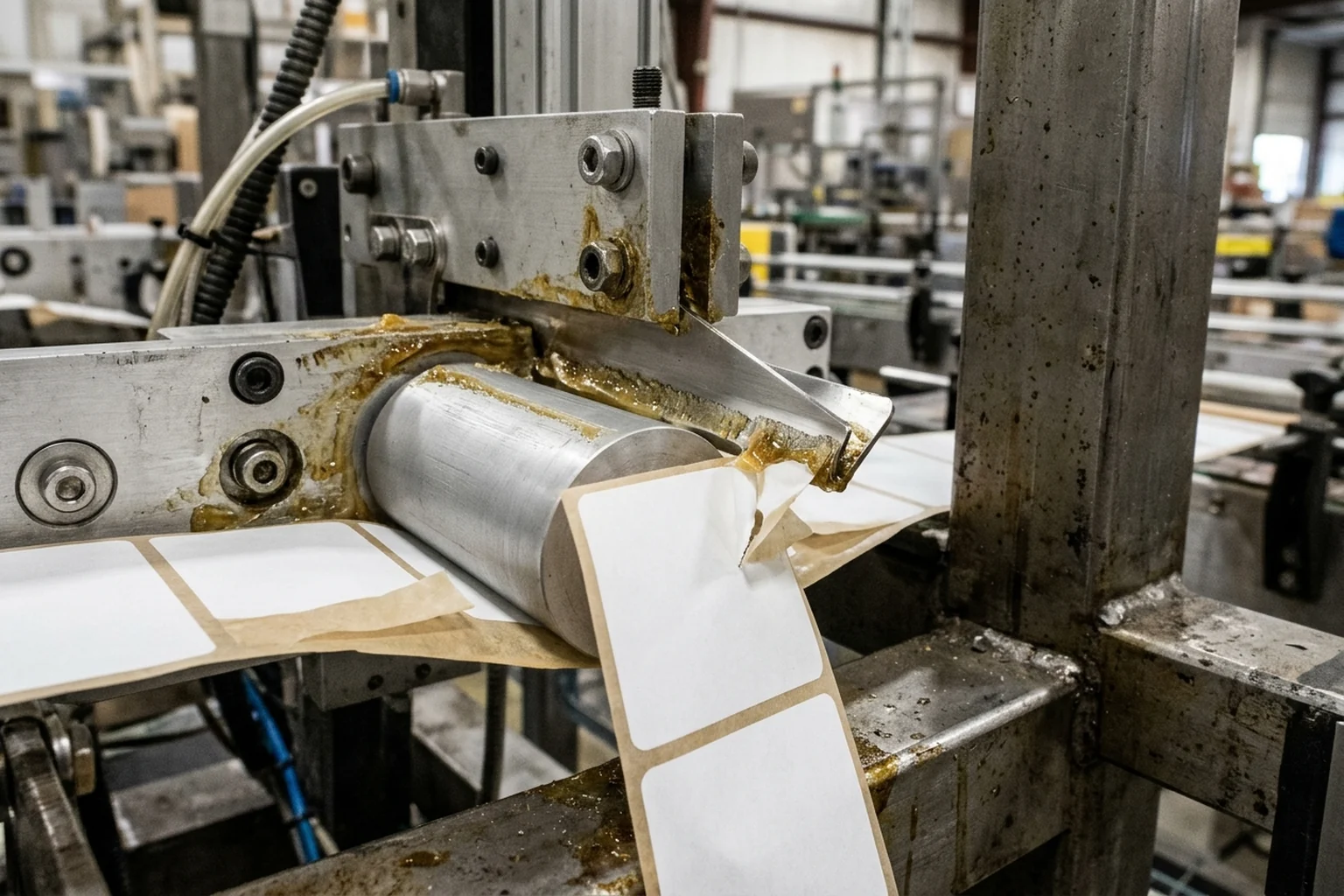
Lamatek states that most pressure-sensitive adhesives are designed to work best when applied within 60°F to 100°F (16°C to 38°C), and that in high-temperature conditions adhesives may become overly soft or melt, leading to adhesive ooze where edges become sticky or adhesive seeps out from the bond line. Fox IV Technologies reports field failures where pressure-sensitive labels stored in an open, non-temperature-controlled warehouse exceeding 100°F (38°C) failed to peel properly due to adhesive ooze, and another case where a thermometer at the top of a warehouse storage rack read 130°F (54.5°C). For unwind chart positions, core sizing, and liner release checks on automatic applicators, consult the custom roll labels unwind direction and core sizing guide.
Roll storage temperature, relative humidity, orientation, and acclimation limits
Compare the published storage temperature, relative humidity, and shelf-life conditions below across label material and equipment documentation.
| Source document | Specified storage temperature | Specified relative humidity | Stated shelf life and storage condition |
|---|---|---|---|
| Avery Dennison Europe PDS AL297 | 20-25°C (FINAT) | 40-50%RH (FINAT) | Two years from date of manufacture; prolonged storage outside these conditions might reduce shelf life |
| Mactac Roll Label Performance Guide TN1701 | 72° F | 50% R.H. | One year shelf life on a 0.0024 +/- 10% inch (TAPPI T-411), 40 +/- 10% lbs (TAPPI T-410) semi-bleached supercalendered kraft liner |
| Mactac Roll Label Performance Guide LTC03190 | 72° F | 50% relative humidity | One year from date of manufacture on a 45# blue glassine liner with 0.0026 +/- 10% inch caliper (TAPPI T-411) and 45 +/- 10% lbs basis weight (TAPPI T-410) |
| cab Produkttechnik (standard label rolls) | 15° - 25° Celsius | 40% - 55 % | Store flat one upon the other away from direct sunlight and heat radiation |
| cab Produkttechnik (plastic labels with easy-flowing adhesives) | About 10° to maximum 18° Celsius | Not condensing, packed in plastic bags | Leave shrink-wrapped rolls in films until use and repack partly used rolls in plastic bags to avoid humidity absorption |
Avery Dennison’s Graphics Material Storage technical bulletin specifies that storage temperature has to be around 20°C, warning that prolonged exposure to higher temperatures can potentially have a negative effect on adhesive properties, printability, and face-film finish (mottling). Avery Dennison’s Graphics Material Storage technical bulletin also specifies that storage relative humidity has to be around 50 to 55%, noting that prolonged storage at lower humidity may dehydrate the backing paper, causing the film to tunnel when unwound and making the backing paper more susceptible to tearing. The same bulletin states that the period of warranty is one (1) year from the date of shipment unless expressly provided otherwise in the product data sheet, and products exceeding the stated shelf life are not covered by warranty.
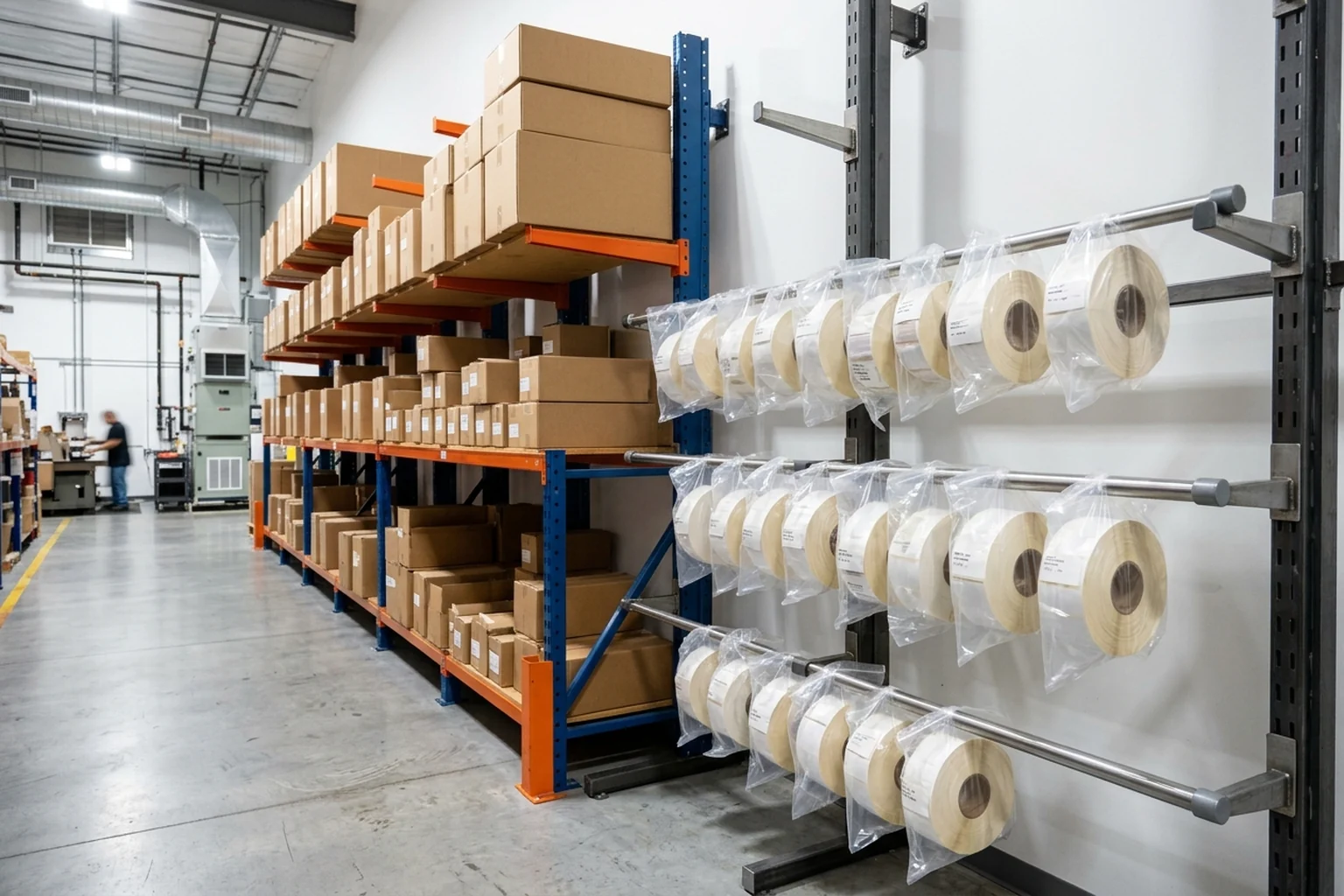
Avery Dennison’s Graphics Material Storage technical bulletin instructs elevating rolls and always avoiding placing rolls directly on the floor to prevent dust and debris attraction, upright roll tipping damage, and temperature variations or dampness penetrating upwards through the floor. If self-adhesive materials are not stored under conditions similar to the production area, Avery Dennison’s Graphics Material Storage technical bulletin recommends acclimatising materials in the same room or conditions as the processing area for at least 24 hours prior to production. It also advises monitoring storage climatic conditions outside working hours (evenings, nights, weekends and holidays when climatic controls are often switched off) using a thermo-/hygrometer with a memory function. When post-application defects appear on containers, compare the bottle label bubbles, wrinkles, and lifting guide.
Roll specification and incoming inspection checklist
Use the verification items below to record adhesive, converting, and storage parameters:
- Adhesive chemistry and temperature ratings: In Avery Dennison’s Select Solutions Cold Temperature Labelling portfolio, most adhesives are designed for application in ambient (+5ºC) conditions, alongside grades for deep-freeze (down to -20ºC) and chilled (0 to +8ºC, including +4ºC) conditions, while service temperature generally lies within -40ºC to +80ºC.
- Coat weight and static shear test methods: FINAT Test Methods define FTM 8 (Resistance to shear from a standard surface), FTM 9 (Loop tack measurement), and FTM 12 (Adhesive coat weight) alongside FTM 1, FTM 2, FTM 3, FTM 4, and FTM 5.
- Dynamic shear, die strike, and bleed-through test methods: FINAT Test Methods define FTM 18 (Dynamic shear), FTM 23 (Die strike), FTM 24 (Mandrel hold), FTM 25 (Evaluation of silicone coverage of coated papers by use of a water based stain test), and FTM 28 (Evaluation of bleeding through paper).
- Rewind tension and taper tension control: In the rewind tension zone, proper tension control (the tensioning device is usually an electric clutch or a variable speed motor drive) prevents starred ends, telescoping, or offset edges of the finished wound roll, and taper tension gradually reduces controller output as the roll builds to reduce the incidence of telescoping and starred rolls.
- Pre-production conditioning: If self-adhesive materials are not stored under conditions similar to the production area, Avery Dennison’s Graphics Material Storage technical bulletin recommends acclimatising materials in the same room or conditions as the processing area for at least 24 hours prior to production.
- Off-hours climate logging: Avery Dennison’s Graphics Material Storage technical bulletin advises monitoring storage climatic conditions outside working hours (evenings, nights, weekends and holidays when climatic controls are often switched off) using a thermo-/hygrometer with a memory function.
Sources
- Solventum — Pressure Sensitive Adhesive Basics Whitepaper
- Chemsultants International — Pressure Sensitive Adhesive Information
- Avery Dennison — Technical Bulletin Graphics Material Storage
- Avery Dennison — Select Solutions Cold Temperature Labelling Portfolio
- Avery Dennison Materials Group Europe — Product Data Sheets for Self-Adhesive Label Constructions
- Mactac — Roll Label Performance Guides
- cab Produkttechnik GmbH & Co KG — Storage and Handling of Labels and Ribbons
- FINAT — FINAT Test Methods Overview
- Packaging Strategies and Dover Flexo Electronics — Tension Control: Zone by Zone
- Lamatek — Whitepaper on Temperature Effects on Pressure Sensitive Adhesives
- Cattie Adhesives — How to Solve Pressure Sensitive Adhesive Problems
- Fox IV Technologies — Proper Label Storage