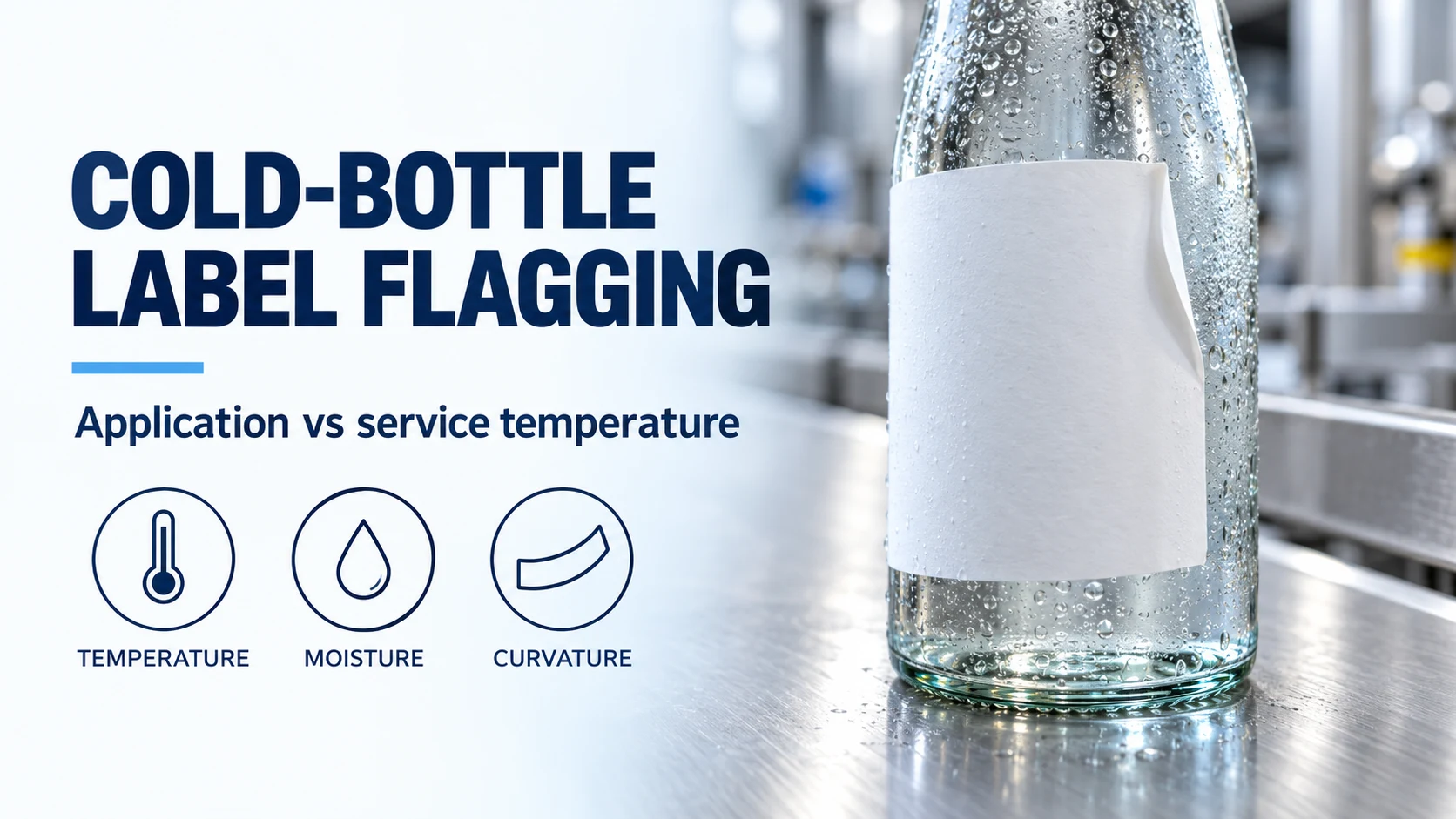
Label minimum application temperature (MAT) is the lowest temperature specified for forming the initial bond of a pressure-sensitive adhesive. Service temperature describes the applied label’s later operating range, after adhesion has developed. A label rated for freezer service can still lift at the edges when applied to a cold, damp bottle.
For cold-bottle edge flagging, check three conditions together: bottle-wall temperature at application, water where the adhesive first contacts the bottle, and the finished label’s ability to follow the curve. Start with the exact construction’s MAT, then check moisture and contact before changing materials. A low service-temperature rating answers the later-use question; cold-fill labeling also needs a suitable initial bond on the actual bottle surface.
Use the label materials hub for the broader construction choices. The checks below narrow the cold-bottle problem to conditions you can record and compare.
Minimum application temperature vs service temperature
Compare the bottle-surface temperature at the labeling point with MAT. Compare subsequent storage and handling temperatures with the service range. Keep the period in which adhesion develops between those two stages.
| Stage | What to establish | What the information tells you |
|---|---|---|
| Initial application | Bottle-wall temperature, label conditioning and the exact construction’s MAT | Whether the specified conditions for making the bond are met |
| Bond development | Required time and conditions before the first cold or wet exposure | How the applied label should be conditioned before service |
| Later service | Temperature range and wet exposure of the labeled bottle | Whether the developed bond and finished label suit the intended use |
Avery Dennison’s Cold Temps Affect VI Adhesive Performance (March 2015), in its “Understanding Minimum Application Temperature” section, distinguishes application from service after adhesion has developed. It also explains that cold can make an adhesive firmer and reduce its initial tack—the immediate grip needed when the label first touches the surface.
A named data-sheet example makes the distinction concrete. Avery Dennison Europe’s AF229, TRANSFER PE HD S8032-rBG40BR FSC, issued September 2026, gives these typical values:
| Field on the AF229 data sheet | Published temperature | How to read it |
|---|---|---|
| Minimum application temperature | 0°C | Initial application limit for this named construction |
| Service temperature | −40°C to +70°C | Temperature range for the label in use after bonding |
AF229 is a tracking-label construction. Its two temperature fields illustrate how to read a TDS; a bottle specification additionally needs the intended substrate, moisture condition and finished-label performance. For this construction, the −40°C service limit does not replace the 0°C application limit.
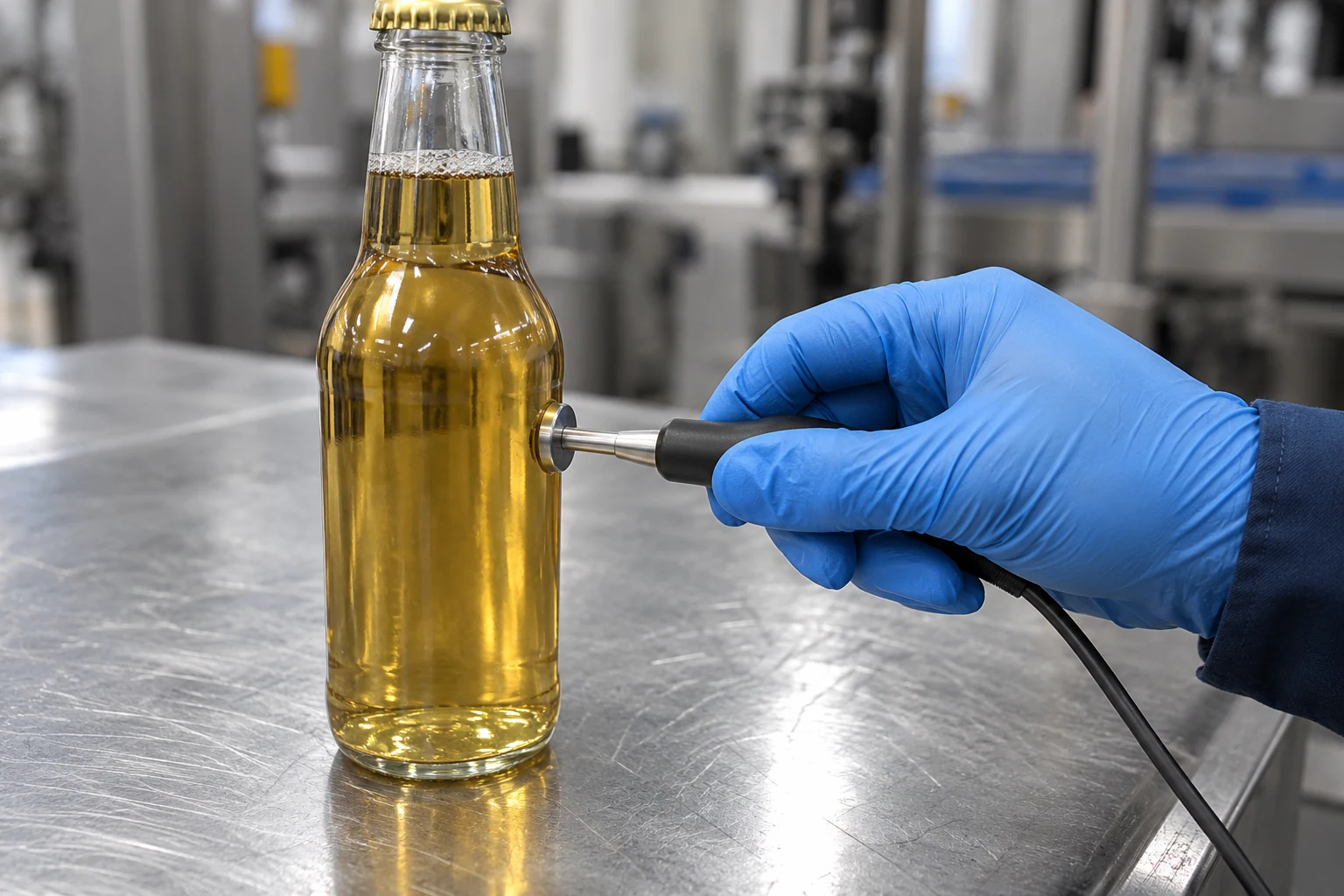
If the bottle wall is below the specified MAT, first bring the application conditions within that specification or qualify a construction for the colder application. Record the label-roll conditioning separately. Meeting MAT clears the temperature check; moisture and surface compatibility still need to pass their own checks.
Why condensation interferes with the first bond
Water on the bottle can interrupt adhesive contact even when the temperature meets MAT. Inspect the surface immediately before the label reaches it, especially if bottles travel through a warmer, humid room after cold filling.
Condensation comes from water vapor in the surrounding air. When air next to a cold surface cools below its dew point, water condenses on that surface. NOAA explains this cold-glass mechanism in “Learning Lesson: Sweatin’ to the Coldies.” Record ambient temperature and relative humidity or dew point alongside the bottle-surface temperature to understand when moisture may re-form.
Avery Dennison’s Z3338 Adhesive — Application Recommendations (February 2014, sections 2 and 6) treats cold and surface water as separate challenges. It describes a purpose-built cold/wet adhesive with finite tolerance for surface moisture: excessive water can leave a label sliding instead of gripping.

The bulletin describes removing water with an air knife close to application and a pre-squeegee before label contact. The diagnostic question is whether the bottle reaches the label with a surface condition the adhesive can handle. Check that outcome at each labeling station, because condensation can return between stations. Equipment changes should follow the established setup procedure for the line and label construction.
Why curvature and the finished label matter
A curved bottle asks the adhesive to hold a label that may tend to flatten again. When initial contact is weak, a stiff finished label can make edge lifting harder to control.
Avery Dennison Europe’s Neck Label Application guide (2023, printed pages 2–4) describes the memory effect of paper neck labels: paper wrapped around the neck tends toward its original flat shape, and smaller neck diameters increase that lifting risk. The guide also identifies moisture, dust and finishes that stiffen the label as relevant factors.
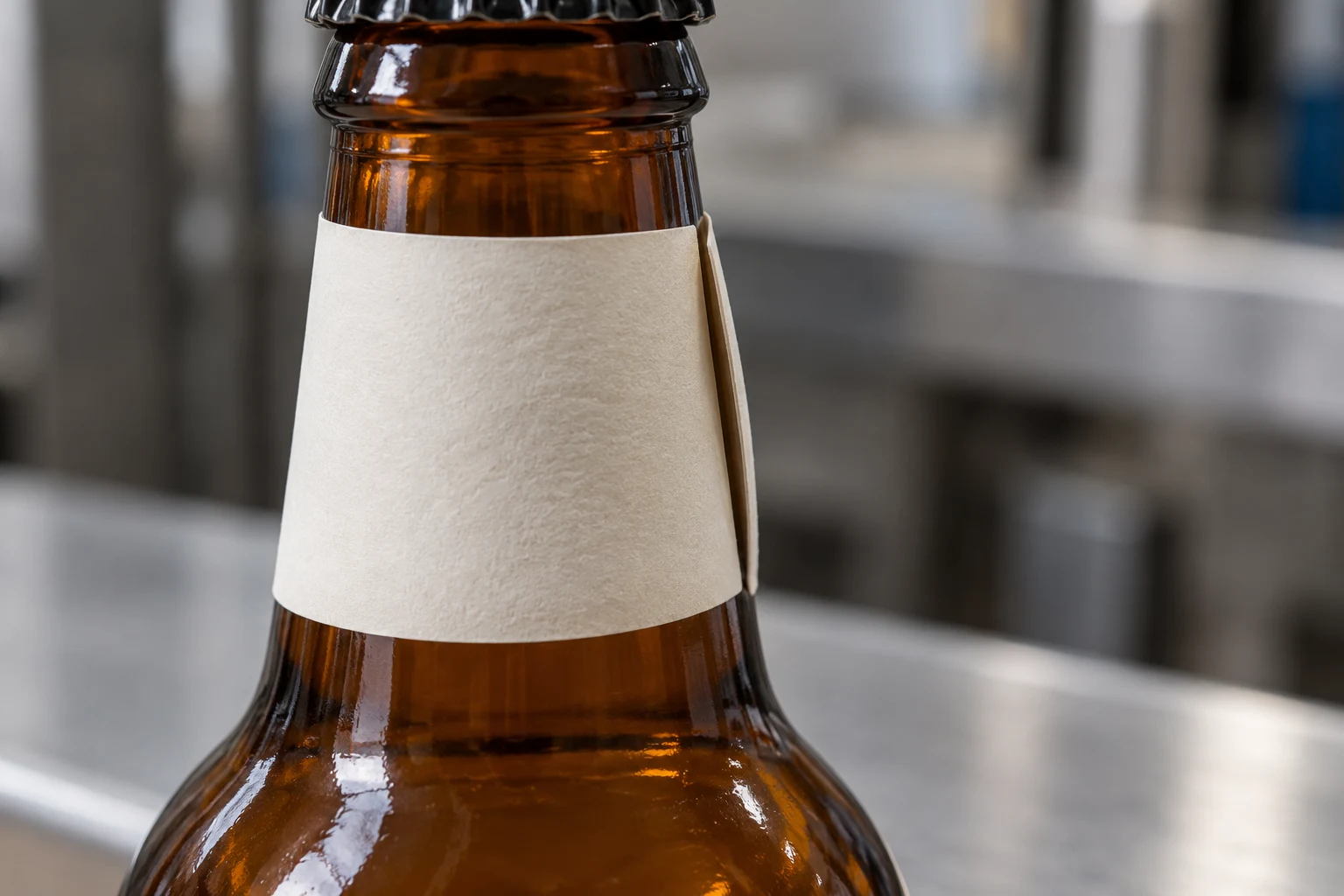
The Z3338 bulletin’s material guidance likewise favors flexibility and warns that overlamination can stiffen a construction. Evaluate the printed and finished label on the actual bottle diameter, including varnish, ink and laminate. A change that improves face durability may also change how readily the label follows the curve.
Record face material, caliper or grammage, and stiffness data where available. Compare those properties within the actual construction rather than treating paper weight and film thickness as interchangeable measures. For broader bubbles, creases and lifting symptoms, use the bottle-label defect guide.
Is freezer-grade adhesive the same as cold-fill adhesive?
Specify the application and service conditions separately, even when a supplier describes a label as freezer grade or suitable for cold fill. The useful comparison is what the complete construction is qualified to do at each stage.
| Requirement | Label applied before chilling or freezing | Label applied to an already cold bottle |
|---|---|---|
| Application temperature | Compare MAT with the surface temperature before cooling | Compare MAT with the cold bottle wall at the labeling point |
| Moisture at application | Establish the actual surface condition at contact | Check condensation and suitability for the remaining moisture |
| Bond development | Establish conditions before the first cooling or wet exposure | Establish how adhesion develops under the intended process conditions |
| Service | Check later temperature and wet exposure | Check later temperature and wet exposure independently of initial tack |
| Finished construction | Qualify face, adhesive and finish on the container | Qualify the same components, including their behavior on the cold bottle curve |
Avery Dennison’s Cold temperature labelling portfolio guide (SSA, 2019) distinguishes application from service and calls for testing the complete construction for its intended use. Pair that temperature information with wet-application guidance when condensation is present. A freezer rating alone leaves the surface-water question unanswered.
For film flexibility, face durability and later wet use, continue with the waterproof bottle-label film and adhesive guide.
What to check before replacing the label stock
Start with when lifting appears, then work through temperature, water, contact and construction. Use the observations to choose the next comparison; a lifted edge alone cannot identify one cause.
| Observation | First check | Next action |
|---|---|---|
| Leading edge fails to anchor at first contact | Bottle-wall temperature against MAT; moisture at the contact point | Resolve an out-of-spec temperature or unsuitable wet surface before comparing adhesive candidates |
| Label slides or skews during application | Water remaining on the bottle and how first contact is established | Check moisture removal and the approved contact setup together |
| Edge rises after the label has been wiped down | Full edge contact, local curvature and finished-label stiffness | Compare a matched construction or finish change on the same bottle |
| Label holds initially, then lifts after chilling or wet handling | Bond-development conditions and the actual later exposure | Evaluate that exposure sequence against the construction’s service requirements |
For the Z3338 cold/wet application described in the bulletin, leading-edge anchoring and complete wipe-down are both important. Pressure has to establish contact while avoiding label movement: too little can leave poor tack or lifted edges, while too much can make a wet label slide. Simply increasing pressure is therefore an incomplete response to flagging.
Keep the bottle, label outline and observation conditions matched when comparing candidates. Change one relevant input at a time and record the exact point at which the edge starts to rise. Include images at first contact, after wipe-down and after the specified service exposure. This connects the symptom to a process stage and makes a change in outcome easier to interpret.
Cold-bottle label parameter checklist
A useful trial record connects the exact label construction to measured application conditions and the required service sequence. Agree on inspection timing and acceptance criteria before comparing results.
- Construction identity: face, adhesive and liner codes; supplier TDS revision; printed finish, varnish or laminate; label and bottle lot identifiers.
- Application temperature: measured bottle-wall temperature in the label zone, measurement location and time, specified MAT, and label-roll conditioning.
- Surface moisture: water visible immediately before contact, ambient temperature and relative humidity or dew point, and condition after each water-removal step.
- Bottle and curvature: substrate, coating or surface treatment, diameter at the label zone, label outline and edge position relative to the neck or shoulder.
- Face and finish: material, caliper or grammage, available stiffness information, relevant paper orientation, and the complete printed/laminated construction.
- Initial contact: whether the leading edge anchors, whether the label moves during wipe-down, which edges lift and when lifting first appears.
- Bond development and service: required development conditions, actual time before chilling or wet handling, exposure temperatures and durations, and sample observations against the agreed acceptance criteria.