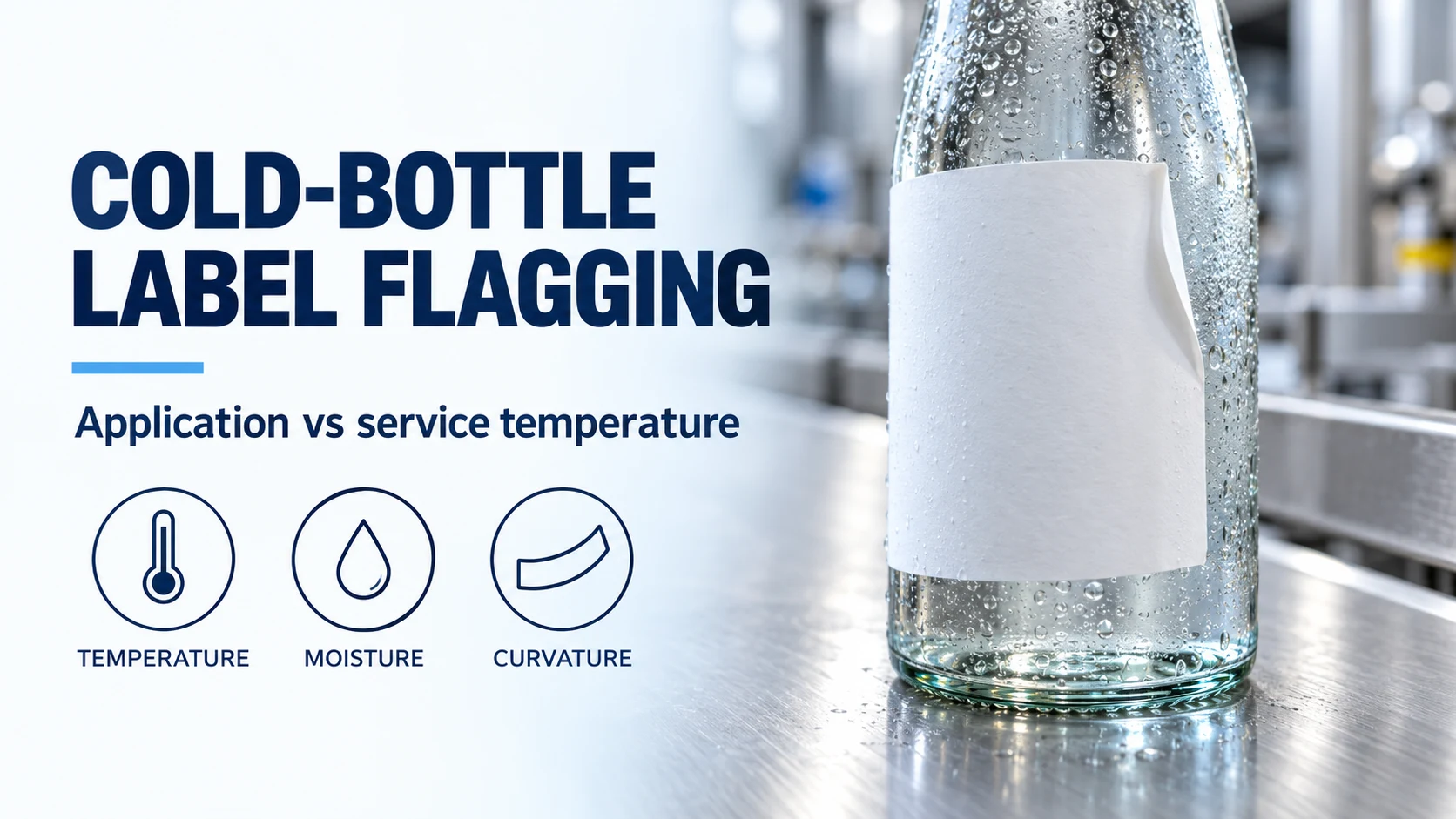
A water-resistant film can still leave a bottle with a detached label if its adhesive was chosen without the application and wet-service conditions. Choose waterproof bottle labels as a complete construction: a face that follows the bottle wall, a bond suited to that surface and exposure, and a protected printed finish.
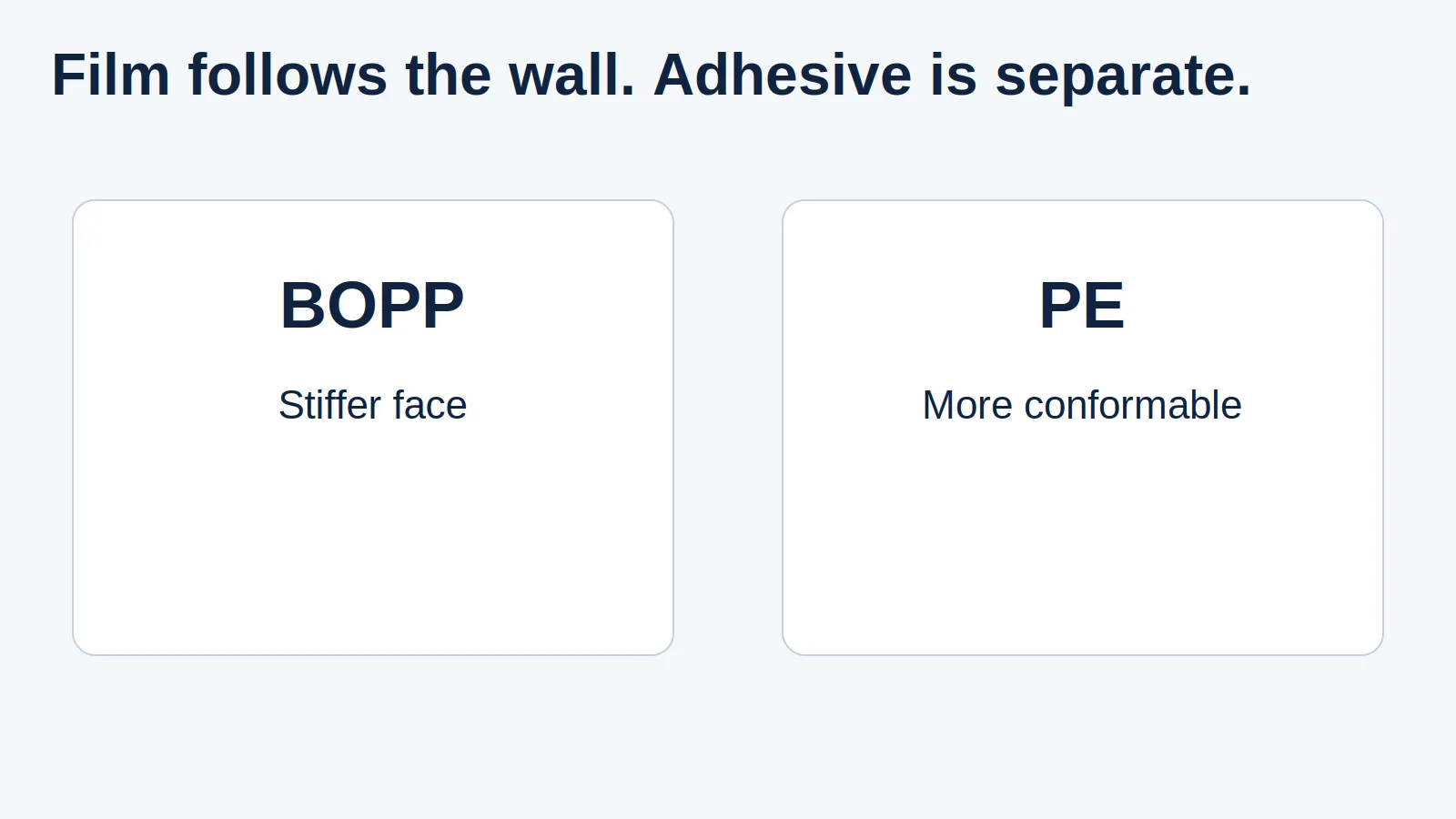
Start with BOPP for a rigid bottle with a simple curve; consider a conformable PE grade when the wall moves or is squeezed. Neither film name establishes ice-water adhesion. Compare the adhesive’s minimum application temperature, bond-development requirements and wet-service suitability separately. Condensation during labeling and condensation after a bond has formed are different conditions. The useful specification identifies the film grade, adhesive, bottle surface, print and finish, then names the actual water exposure those components must withstand.
| Face candidate | Bottle condition to start from | What remains to qualify in wet service | Dominant Failure Mode & Prevention |
|---|---|---|---|
| BOPP, biaxially oriented polypropylene | Rigid wall with flat or simple curves | Exact adhesive, application conditions, water contact and printed finish | A rigid face resisting wall movement can stress the bond; use it within its conformability scope and compare the finished sample. |
| PE, polyethylene | Wall movement or squeezability requiring a conformable face | Exact PE grade, converting behavior and the same bottle-bond requirements | A flexible face can still detach with an unsuitable bond; qualify the adhesive and film together on the intended bottle. |
These are starting conditions, based on Avery Dennison’s film selection guide, rather than a ranking of waterproof performance. The guide describes films as water and moisture resistant and places PE toward the conformability end of its spectrum; it gives no universal ice-water soak result for either family.
When does PE offer a useful difference from BOPP?
PE becomes relevant when deformation of the container makes face flexibility part of the job. A bottle that remains rigid in storage can behave differently during squeezing and handling. Include that movement when comparing candidates; a static bottle on a desk does not represent it.
Keep bottle polymer and label polymer in separate fields. A PE bottle does not automatically require a PE label, and choosing PE as the face does not establish adhesion to a low-surface-energy bottle. Identify the actual bottle material, finish and treatment alongside the supplier’s film and adhesive references.
Use the materials section for the wider construction choices. Here, the decision is narrower: which candidate can follow this bottle through its specified wet use? Film thickness stays a grade-specific input, rather than a generic BOPP-versus-PE rule.
Which adhesive behaviors matter in condensation and ice water?
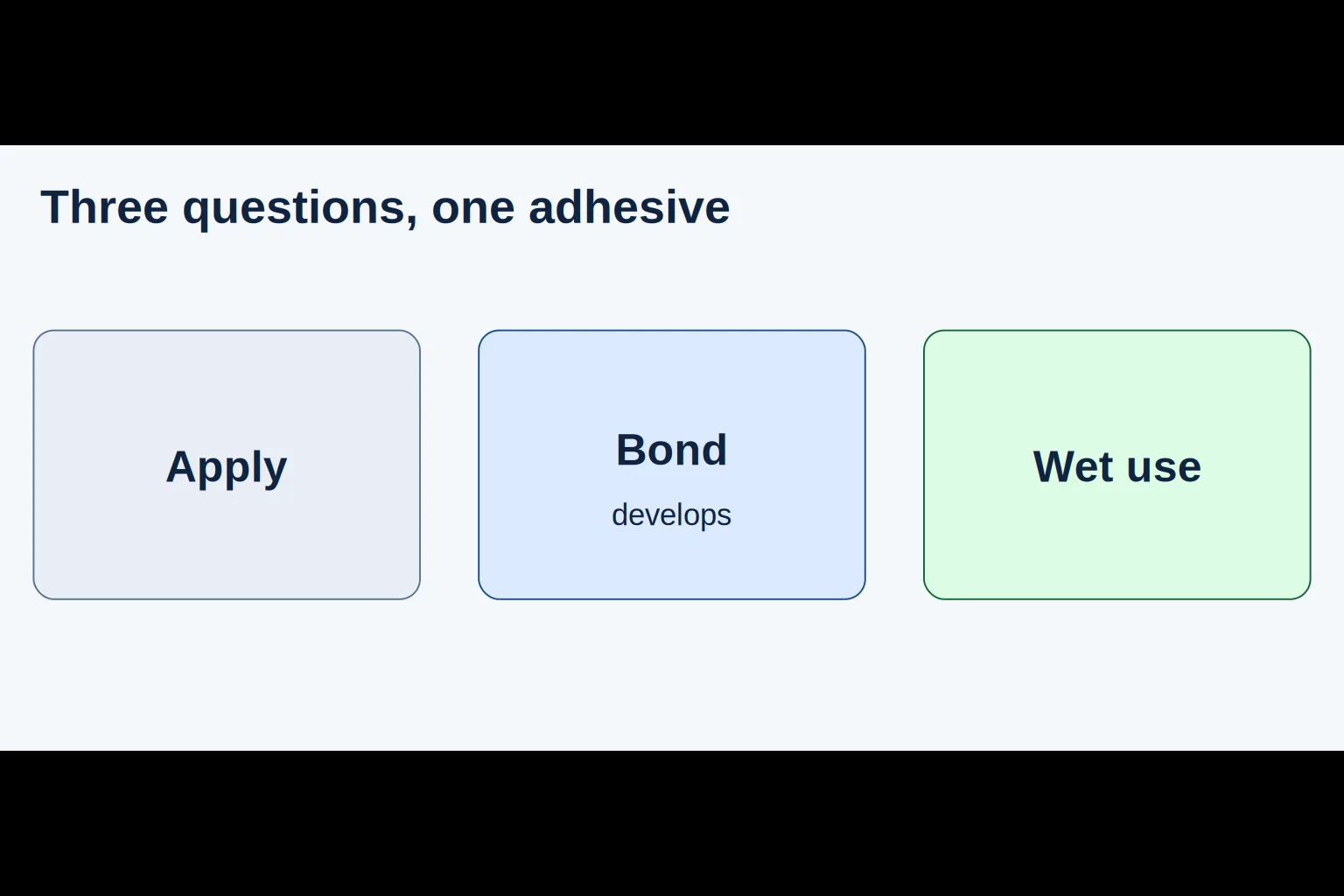
Separate the moment the adhesive first grabs from its later holding performance. Initial tack is the immediate grip; bond development is the progression toward ultimate adhesion. An apparently secure label at the applicator exit has answered only the first question.
| Stage or requirement | Information to request | Decision it supports |
|---|---|---|
| Application | Bottle-surface temperature, dry or damp condition, contamination and exact adhesive scope | Can this construction form the intended bond on the incoming bottle? |
| Bond development | Supplier instructions and actual interval before chilling or water contact | Does the process allow the specified bond to develop? |
| Condensation in service | Cold-to-warm sequence, droplet contact and handling | Does the established construction remain attached and usable? |
| Ice-water service | Waterline, liquid temperature, exposure duration and handling sequence | Is the adhesive qualified for that exposure on this bottle? |
| Appearance of the adhesive | Water-whitening requirement where relevant | Can its appearance change even while the label remains attached? |
Avery Dennison’s adhesive guide lists water-whitening resistance and ice-bucket resistance as distinct properties of named adhesives. Preserve that distinction in the approval record. A readable face, an unchanged adhesive appearance and a retained bottle bond each need their own acceptance requirement.
Check the filling-to-labeling handoff when the incoming surface condition is uncertain. A construction approved for later water contact still needs the specified conditions when it is applied.
What temperature threshold belongs in the specification?
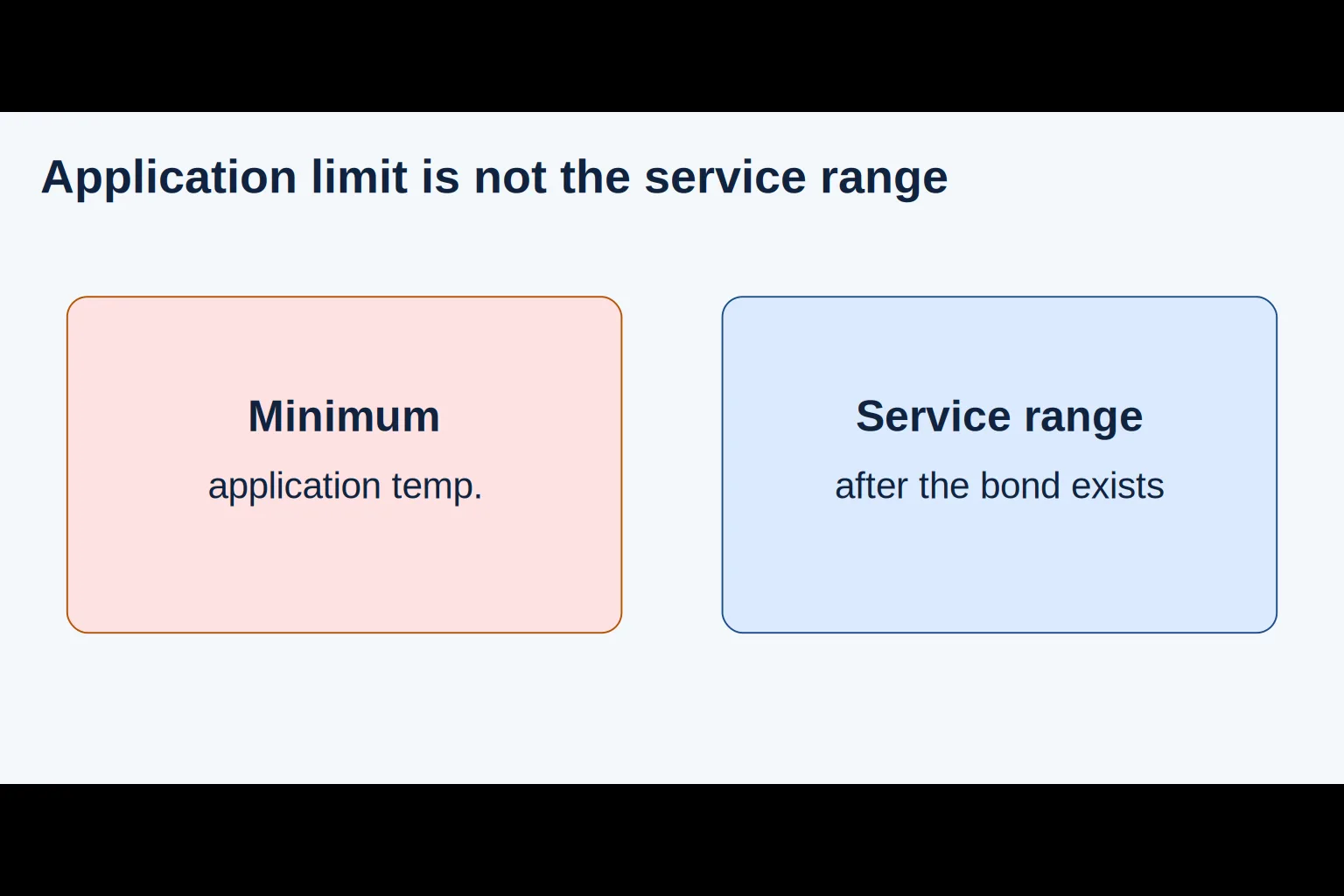
Rule of thumb: if the measured bottle-surface temperature is below the exact adhesive’s minimum application temperature, change the conditions or select a construction qualified for them before labeling. A service-temperature range describes a label already applied; it does not replace the application limit.
For a concrete catalog example, the June 2020 European adhesive guide lists S2047N, a permanent rubber-hotmelt adhesive, at +5°C minimum application temperature and −30°C to +70°C service temperature. The same row describes ice-bucket resistance. Those are historical, named-grade figures retrieved October 19, 2026; obtain the current finished-construction data before using them for an order. They do not establish damp-surface suitability or a soak duration for every film carrying that adhesive.
Calculate a screening margin with the application value:
Temperature margin, ΔT = measured bottle-surface temperature − specified minimum application temperature.
Illustrative example: ΔT = +8°C − (+5°C) = +3°C.
The +8°C bottle is hypothetical. The positive margin answers one temperature question; it does not approve surface moisture, adhesive pairing or later immersion. Record the bottle surface temperature rather than substituting room air temperature.
How do you compare the finished constructions fairly?
Keep the bottle, label outline, artwork and exposure sequence matched while comparing candidates. Give each film/adhesive combination a separate construction ID, and record what changed when a finish or overprint is added. This makes the comparison useful without assigning an unsupported family-wide winner.
An approval record should contain:
- Film and adhesive codes, liner reference and current supplier document revision.
- Bottle material, finish, surface preparation and application temperature.
- Actual interval between application and the first wet exposure.
- Condensation or immersion conditions, including temperature, duration, waterline and handling.
- Separate outcomes for bond retention, face condition and print usability against agreed requirements.
Use the waterproof printed-label proof guide for the print and finish part of that review. Keep exposure limits tied to the identified construction; extend the approval only when the evidence covers the additional use.
Compare total operating cost alongside stock cost. The record should include discarded labels, bottles requiring relabeling, line interruptions, extra inspection and any finish added to meet the requirement. A lower roll price loses its advantage when the application needs recurring rework. Use actual counts and costs from the production review; there is no supported universal saving for BOPP or PE.
Method and sources
This comparison combines Avery Dennison’s North America film guide and June 2020 European adhesive guide, retrieved October 19, 2026, with an editorial specification checklist and an illustrative temperature calculation. Supplier values retain their named-grade and regional scope. No original durability test, universal film gauge or immersion time is reported. The next decision is a documented construction-and-bottle comparison under the intended application and service conditions.