A security label that peels off whole, and leaves the package looking untouched, has failed the job even when the peel number matches the sheet.
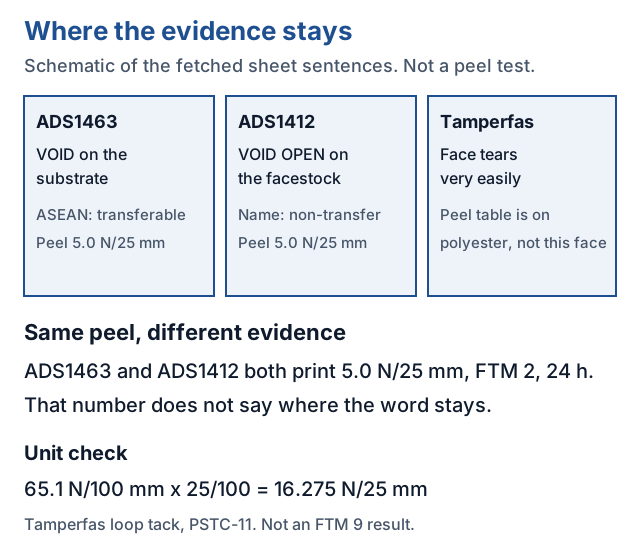
The peel figure does not say where the evidence stays. Avery Dennison’s 2025 ASEAN tamper-evident overview defines transferable void as an irreversible message on the substrate when the label is detached, and non-transferable void as an irreversible message on the facestock that leaves no residual on the package. ADS1463 and ADS1412 both print 5.0 N/25 mm for a 24 hour, 90 degree peel under FTM 2. One sheet puts the word on the substrate. The other puts VOID OPEN on the facestock. Destructible vinyl is a third mechanism: the face tears. Start from the face, adhesive, and liner lines in the pressure-sensitive construction record.
| Construction | What the fetched sheet says happens | Dominant failure mode | Prevention |
|---|---|---|---|
| ADS1463, named Transferable Permanent | The pattern release leaves the word VOID on the substrate. Excellent tear strength. | Treating the shared 5.0 N/25 mm peel as proof the word stays on the carton | Read the facestock sentence, then apply it to the real surface |
| ADS1412, named Non-Transferable Permanent | VOID OPEN appears on the facestock. The adhesive line says no residual on the affixed surface. Excellent tear strength. | Expecting the carton to keep a mark after this label is gone | Use it when the evidence has to travel with the label |
| ADS1438, listed by ASEAN under transferable void | The July 2017 sheet says the word VOID stays on the label facestock itself. The construction name still says Transferable Permanent. | Trusting the portfolio column after the sheet sentence disagrees | Hold the sheet that will be purchased, not only the overview list |
| Tamperfas vinyl, spec 41100 | Fragile face tears very easily. Peel table was run on 2 mil polyester because this face could not take the test. Not recommended for automatic application. | Copying the polyester peel table onto the vinyl, or sending the roll to an automatic applicator | Keep the polyester numbers in their appendix and follow the automatic-application line |
Where the word stays
The ASEAN overview, retrieved 20 October 2026, sorts void films in two sentences. Transferable void leaves an irreversible message on the substrate. Non-transferable void leaves an irreversible message on the facestock and no residual when the label is detached. The overview also lists films that are destructible on removal. Those are separate bullets. A custom void text is offered. The overview does not print a peel value.
ADS1463, issue date July 2018, is a 25 micrometer gloss black polyester. Caliper tolerance is ±10 percent by ISO 534. Basis weight is 36 g/m² ±10 percent by ISO 536. The facestock sentence says the pattern release layer leaves the word VOID on the substrate. The top coat has excellent tear strength. The construction name is Transferable Permanent. Typical data, in N/25 mm: loop tack 7.0 by FTM 9, 24 hour 90 degree peel 5.0 by FTM 2, minimum application temperature 0 °C, service range after 24 hours from −20 °C to +90 °C. The sheet lists over-the-counter drugs among the uses. It tells the buyer to test under end-use conditions. FINAT’s public method index describes FTM 2 as 90 degree peel adhesion at 300 mm per minute, and FTM 9 as loop tack. The index does not name the panel. The ADS sheet does not name the panel either.
ADS1412, issue date July 2016, is a 38 micrometer matte red polyester, basis weight 52 g/m² ±10 percent. The facestock sentence says removal yields the words VOID OPEN on the facestock. The adhesive sentence says non-transferable permanent, with no adhesive residual on the affixed surface. Tear strength is described as excellent. The typical block prints the same two figures as ADS1463: loop tack 7.0 FTM 9 and 24 hour 90 degree peel 5.0 FTM 2, with the same 0 °C minimum application temperature and the same −20 °C to +90 °C service range. Shelf life on both sheets, unless the sheet says otherwise, is one year at 23 °C ± 2 °C and 50 ± 5 percent RH.
The matching peel is the point.
5.0 − 5.0 = 0 N/25 mm
A difference of zero cannot choose the substrate message over the facestock message. The words in the facestock paragraph do that job.
ADS1438, issue date July 2017, is the conflict to write down rather than smooth over. The ASEAN overview places code ADS1438 in the transferable-void list. The construction name on the sheet is Transferable Permanent. The facestock paragraph says the pattern release leaves the word VOID on the label facestock itself. Caliper is 50 micrometers ±10 percent, basis weight 76 g/m² ±10 percent. Typical data: loop tack 8.0 FTM 9, 24 hour 90 degree peel 7.0 FTM 2, minimum application 0 °C, service after 24 hours from −20 °C to +90 °C. Excellent tear strength is stated here too. A buyer who stops at the overview list will file this code with ADS1463. A buyer who reads the facestock sentence will file it with a message that stays on the label. Keep both sentences on the sample row until the purchased roll’s own sheet is the one in the file.
Rule of thumb: if two constructions print the same 5.0 N/25 mm FTM 2 value, do not pick the security behavior from that value. Read whether the sheet puts the word on the substrate or on the facestock. At a difference of 0 N/25 mm, the peel column is silent.
The unit itself still has to be handled in one width. The reported peel is a force per 25 mm of width. For a label whose tested width is 50 mm, the proportional force at the ADS1463 figure is:
F = 5.0 × (50 / 25) = 10.0 N
That 10.0 N is the unit scaled to 50 mm. It is not a measured 50 mm label, and it is not a result on glass, polypropylene, or a food carton. The sheets say to test the real surface.
When the face has to tear
Spec 41100, Fasson Tamperfas vinyl with adhesive S730 and a 50#SCK liner, describes a matte white cast vinyl made for security labeling. Facestock caliper is 0.0022 inch, stated as 55.88 micrometers, by ASTM D1000. The features line says the fragile facestock tears very easily for tamper evidence. The appendix says the peel table was obtained with the adhesive on 2 mil polyester, because those tests could not be run on the Tamperfas face. Using the aluminum, steel, ABS, or polyolefin rows from that appendix as the vinyl’s peel invents a number the sheet refused to measure.
The adhesive block, which is not the face test, lists loop tack on stainless steel by PSTC-11 as 59.2 oz/inch, stated as 65.1 N/100 mm. Minimum application temperature is 50 °F (10 °C). The adhesive service range is −40 °F to 300 °F. A note limits the facestock to 225 °F even though the adhesive line goes to 300 °F. The sheet is not recommended for automatic application. Standard shelf life in the features section is amended to 6 months from purchase when stored at 70 °F and 50 percent RH, and the roll should be converted and applied within 6 months of purchase. A later shelf-life line says one year at 72 °F and 50 percent RH unless the document specifies otherwise. The features section does specify otherwise.
Convert the loop-tack unit before anyone sets it beside an FTM figure in N/25 mm:
65.1 × (25 / 100) = 16.275 N/25 mm
16.275 is still a PSTC-11 result for the adhesive, reported against stainless. It is not FTM 9, and it is not a result on the fragile face. ADS1463’s loop tack of 7.0 N/25 mm is FTM 9 on that VOID construction. The two numbers sit in different methods. The conversion only stops a unit mix-up. It does not rank the vinyl against the polyester.


Rule of thumb: if the sheet says excellent tear strength, do not expect the Tamperfas failure, which is a face that tears very easily. ADS1412, ADS1438, and ADS1463 all use the excellent-tear-strength sentence. Spec 41100 uses the fragile-face sentence. Peel force does not cross that line, because the vinyl sheet did not measure peel on its own face.
A 25 mm strip at the converted loop tack is not a dispensing force. The sheet gives no applicator speed. It does say automatic application is not recommended, and it warns that the die configuration has to be qualified for stripping. Up to 15 splices per 1,668 yards can appear because of manufacturing. A splice is a stop or a waste cut on a converting press. The sheet does not give the length of each splice, so a waste percent is not available from that sentence.
What the wrong evidence costs
The hidden cost is a seal that cannot show the event you needed, plus a roll that ages out before it is applied.
If the carton must keep a mark after the label is gone, ADS1412’s sentence does not give that mark. The words VOID OPEN stay on the facestock, and the adhesive line says the affixed surface is left without residual. Relabeling is the correction. The sheet does not price the relabel. It does say the buyer has to test the real surface, including the over-the-counter drug packs named in the use list. A food-delivery carton, grease, or a chilled dwell is not in these four sheets. Leave those cells empty.
If the label must leave in pieces, a VOID polyester with excellent tear strength can peel away whole and still show a word. That is a different proof. Sending spec 41100 to an automatic applicator contradicts the sheet’s own line. The 6 month window is the other account: a roll bought and held past the amended shelf life is the shrinkage case the sheet describes, where facestock shrinkage or liner growth can make the product unusable. Storage in the features line is 70 °F and 50 percent RH. The VOID polyester sheets use one year at 23 °C ± 2 °C and 50 ± 5 percent RH. Those clocks are not interchangeable.
The easy-peel and removable page is about which bond lets go on purpose. A tamper-evident face is the opposite intent: the bond or the face has to make removal visible. Film family names for ordinary bottle labels stay on the BOPP, PET, and PE comparison. They do not select ADS1463 or spec 41100.
Where these sheets stop
FINAT’s index confirms the names of FTM 2 and FTM 9 and the 300 mm/min rate for FTM 2. It does not include the panel, the dwell, or the pass-fail limit inside those methods. The full handbook was not the file retrieved here. ASTM D3330 is a peel method for tapes. It was not the method named on these Avery sheets, so it is not used as their limit.
ADS1438’s portfolio class and its facestock sentence disagree. This page does not pick a winner. The roll’s own sheet, read on the day it is purchased, is the row that should be copied onto the spec. Typical values on every one of these sheets are marked as typical, not as a specification limit.
No food-contact migration figure, no grease dwell, and no destructible-vinyl tensile in a reliable metric unit are stated in the passages used above. The Tamperfas tensile cells in the facestock table did not convert into a usable metric value on the file retrieved here, so they are left out. The photographs show blank film. They are not the grades named in the tables.
Method and sources
Message location comes from the Avery Dennison ASEAN tamper-evident overview (2025) and from the facestock paragraphs of ADS1463 (July 2018), ADS1412 (July 2016), and ADS1438 (July 2017). Peel, loop tack, temperatures, calipers, and shelf-life lines come from those same sheets. FTM names come from the FINAT test-method index, retrieved 20 October 2026. Spec 41100 supplies the fragile-face sentence, the polyester-coupon limitation, the PSTC-11 loop tack, the 10 °C application minimum, the 225 °F facestock cap, the automatic-application line, the 6 month amendment, and the splice count. The 0 N/25 mm difference, the 10.0 N width scaling, and the 16.275 N/25 mm conversion are arithmetic on those printed figures.