Untreated polyolefin films may have surface energies as low as 29–31 dynes/cm, while most inks require at least 38–42 dynes/cm to adhere reliably. A coating cannot level on a substrate it does not wet; when a coated web shows pinholing, crawling, or fisheyes, substrate surface treatment level (dyne level) should be checked before suspecting the engraved roll.
Good ink wetting requires the substrate surface energy to exceed the dynamic surface tension of the ink by 8 to 10 dynes/cm. Dyne level indicates surface wettability but does not by itself guarantee adhesion; molecular entanglement, ink/coating compatibility, migration of surface additives, and process variables after treatment also govern final bonding. Use the printing and application section alongside the label materials section and the BOPP, PET, and PE bottle label construction guide to align film surface preparation with press coating and curing specifications.
| Narrow-web control parameter | Published press and laboratory specification |
|---|---|
| Untreated polymer surface energy baseline | Untreated polyethylene (PE) has a surface energy of 31, untreated polypropylene (PP) is 29, and untreated polyester (PET) is 43. |
| High-speed dynamic surface tension shift | At surface ages below 100 milliseconds—the timeframe relevant to high-speed printing—dynamic ink surface tension can be 8-10 dynes/cm higher than the static equilibrium lab value. |
| Flexo anilox coating transfer efficiency | Depending on the rheology of a coating, in the flexo process the amount of coating transferred to a substrate is only 19% to 24% of the anilox engraved cell volume. |
| Direct gravure coating transfer efficiency | Coating transfer efficiency doubles to 42% for direct gravure process application where coating transfers directly to a substrate and no plate or blanket is involved to split a wet coating film. |
Corona surface treatment, dyne level, and dynamic ink surface tension on polyolefin films
Corona treatment is confined to the outermost molecular layer (around 0.01 microns), so bulk properties and appearance of the material remain unchanged while surface energy increases. Primary corona treatment is applied immediately after extrusion, whereas secondary (bump) treatment is applied in-line just before converting, printing, laminating, or coating to restore dyne level. Slip agents, antiblock, and antistatic compounds in polymer films can interfere with corona treatment and cause dyne levels to decay faster over time.
Water-based inks have a static surface tension of 28-45 dynes/cm, and at press speeds their dynamic surface tension climbs even higher as water and co-solvents evaporate. UV-curable inks have a static surface tension of 30-35 dynes/cm, but their dynamic surface tension at press speeds can reach 45-55 dynes/cm. Because UV-curable inks have no solvent evaporation and cure in place, initial wet-out on the treated film surface determines final ink adhesion. Solvent-based inks have a static surface tension around 23 dynes/cm and naturally dissolve slip agents on film surfaces, though consistent corona treatment still improves wet-out and ink anchorage.
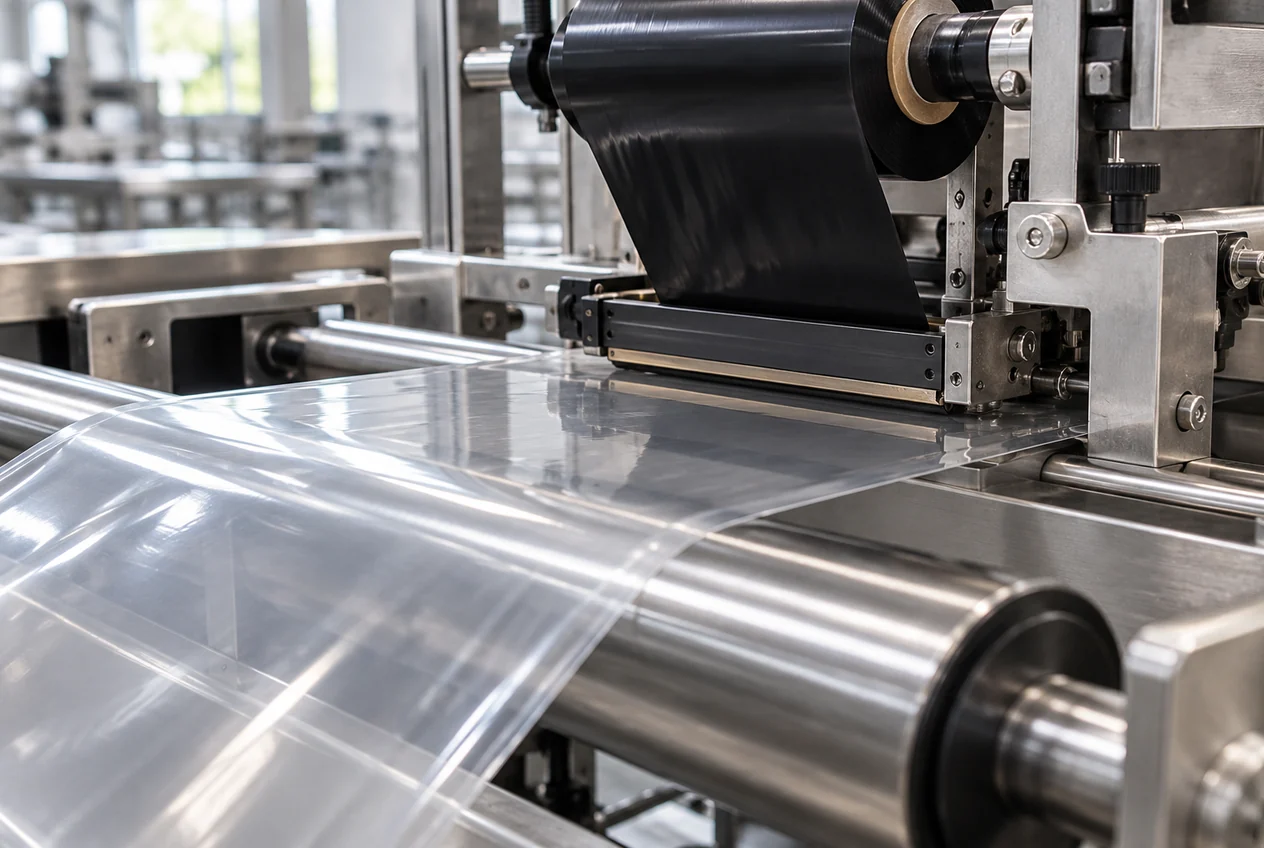
Corona treating systems apply a given level of power over a certain period of time to the surface, and this power/time parameter is measured in watt density. Watt density is calculated as Power Supply Output (watts) divided by (Web Width × Line Speed × Number of Treat Sides). Raising treated BOPP or high-slip treated LDPE from an incoming 34–36 to a desired 40–42 typically requires a watt density of 2.5 to 3.5, whereas treated BOPET from 40–42 to 54–56 requires 0.9 to 1.5.
Measuring film wetting tension with cotton swabs, Mayer rods, and dyne pens
ASTM D2578-17 is the recognized industry standard test method for wetting tension of polyethylene and polypropylene films. In the cotton swab wetting tension method, the solution is spread lightly over approximately one square inch of the test material, and if the wetting solution stays intact for two seconds, the treat level is at least as high as that solution. The Mayer Rod Method (TAPPI Test Method T 552) is the most accurate of the dyne surface energy measurement tests for polymeric films and coated surfaces.
Standard wetting tension solutions composed of Ethyl Cellosolve and Formamide (as well as dyne test pens) have a shelf life of around six months and should be dated at time of use (pens when first used) and replaced at expiration to prevent false dyne readings. Press-side dyne pens are subject to tip contamination from repeated contact, but provide a fast check for treatment level, treated-side verification, and unintended backside treatment (back-treat). FINAT defines FTM 12 for Adhesive coat weight, FTM 13 for Low temperature adhesion, FTM 14 for Dimensional stability, and FTM 15 for Surface tension of plastic films.
Factory topcoated BOPP vs corona-treated PE and MDO label facestocks
Avery Dennison states that its print-receptive topcoat (such as TC-2000) bonds UV-curable, water-based, and solvent-based inks directly to the film facestock without on-press corona treatment or press-applied primer; converters should still verify ink anchorage on each ink set with a cross-hatch tape test. Avery Dennison classifies label film flexibility into Rigid (BOPP for bottles with flat or simple curves), Semi-conformable (MDO for bottles with slight compound curves and squeezability), and Fully Conformable (MDO for complex label and packaging shapes).
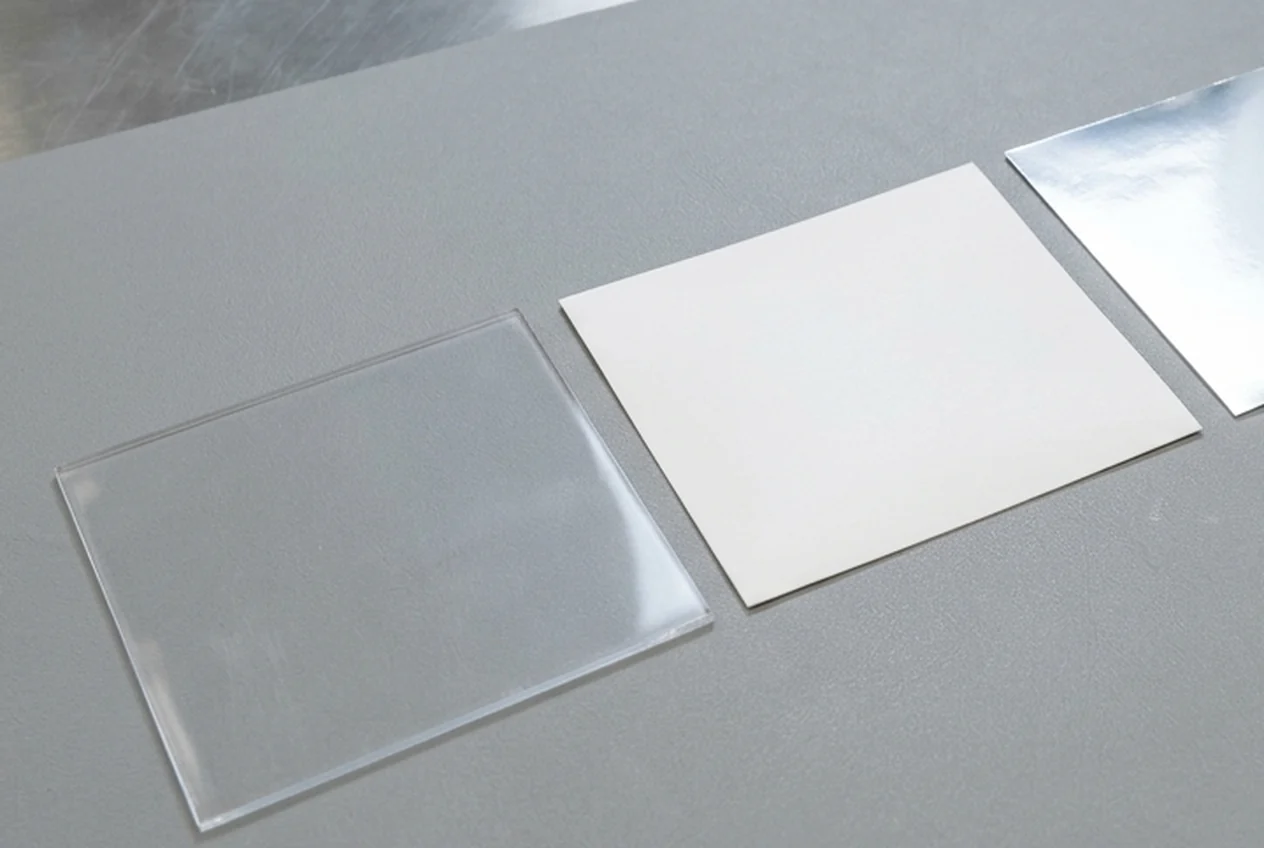
| Label film construction attribute | Published Avery Dennison technical specification |
|---|---|
| Corona-treated white polyethylene film physicals | The corona-treated white polyethylene film facestock has a basis weight of 78 g/m² (ISO 536), caliper of 79 µm (ISO 534), and density of 0.988 g/cm³ (ASTM D792). |
| Corona-treated polyethylene print and corona guidance | UV, water-based, and solvent-based inks can be used on the corona-treated polyethylene face material, and on-press corona treatment is recommended for optimal ink adhesion. |
| Corona-treated polyethylene heavy ink load watchout | Heavy UV ink laydowns can embrittle corona-treated PE facestock; specify a flexible UV ink grade when printing labels for squeezable containers. |
| Topcoated white BOPP film physicals | The white biaxially oriented polypropylene film with a print-receptive topcoat has a basis weight of 56 g/m² (ISO 536) and a caliper of 57 µm (ISO 534). |
| Topcoated white BOPP print and corona guidance | UV, water-based, and solvent-based inks can be used on the print-receptive topcoat, which is designed for optimum ink adhesion, and on-press corona treatment is not advised. |
| FINAT shelf life and storage climate window | To obtain optimal performance, use the film label product within two years of the date of manufacture under storage conditions defined by FINAT (20-25°C; 40-50%RH). |
Fasson Global MDO Next Generation has a corona-treated print surface designed for on-press corona treatment to achieve superior ink wet-out and anchorage with water-based flexo, UV flexo, and UV inkjet ink systems. Printed Global MDO Next Generation film surfaces should be over-varnished with a low-friction, compatible, minimal-shrinkage varnish to protect ink and film from scuffing while preventing label curl and label lift. Artwork on MDO film labels should be designed so that printed areas—especially heavy ink and varnish laydowns—are not crossed by the die-cut line, preventing ink chipping at die-cut edges and localized die wear. Compared to paper liners, PET film liners are susceptible to static buildup during converting, which can cause print defects, dust attraction, and registration errors unless anti-static equipment is installed on press. When comparing metallic or specialty print finishes on paper and film constructions, review the Stahl Senoprint metallic coatings guide.
Anilox and gravure roll BCM volume, transfer efficiency, and dry coat weight math
Anilox manufacturers differentiate between thick-film coatings, those requiring more than 12.5 billion cubic microns per square inch (BCM) anilox volume, and thin-film coatings. The 60-degree hex pattern allows 15% more cells to be engraved into an anilox than a 45-degree pattern allows, enabling thinner-walled, shallower, bowl-shaped cells. Dividing the required applied coating volume of 3.0566 BCM by a 0.21 flexo transfer rate yields about 14.56 BCM of anilox volume (3.0566 ÷ 0.21); a 15.28 BCM figure would imply ~0.20 transfer (3.0566 ÷ 0.20)—keep the transfer-rate assumption and the BCM result consistent.
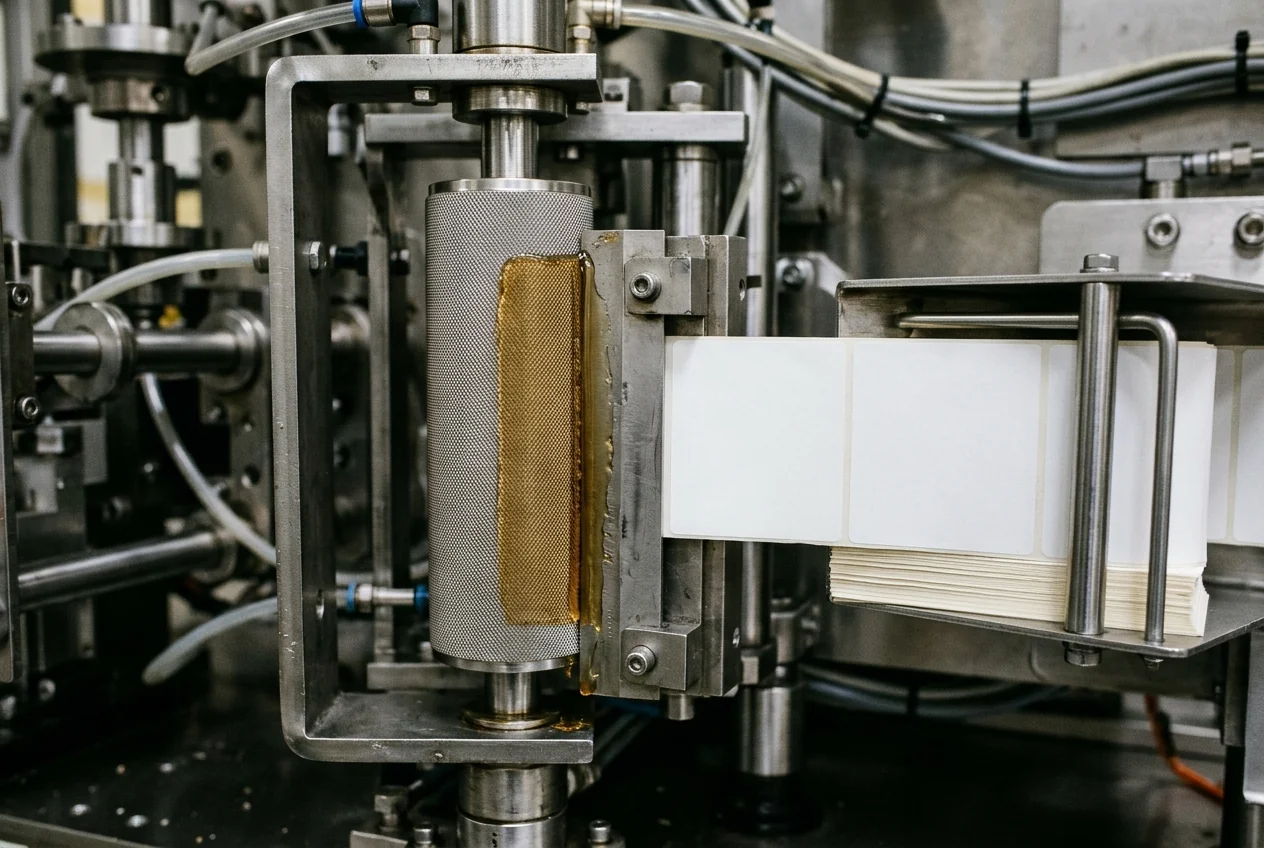
1 BCM equals 1.55 cm³/m², which equals 1.55 microns theoretical wet film at complete transfer. Dry coat weight in g/m² is calculated as Cell Volume (BCM) × 1.55 × Transfer Efficiency × Density (g/cm³) × Solids Fraction. Required cell volume (BCM) equals Dry coat weight divided by (1.55 × Transfer efficiency × Density × Solids fraction). For a 3.0 dry coat weight with 1.05 density and 0.45 solids, the wet film required is 3.0 ÷ (1.05 × 0.45) = 6.35 µm, and the cell volume required at 0.45 transfer efficiency is 6.35 ÷ (1.55 × 0.45) = 9.1 BCM (≈ 14.1 cm³/m²). Cell volume loss is invisible: a roll that has lost twenty percent of its capacity looks identical to a new roll under ordinary inspection lighting.
Cross-cut tape adhesion testing and UV ink anchorage troubleshooting
UV-curable inks are 100% solids with no water or solvents involved, curing only when exposed to UV or EB radiation and remaining open on the press during stoppages. Test Method A is primarily intended for use on coatings and coating systems over 5 mils (125 µm), while Method B is generally used on coating systems less than 5 mils thick. For coatings up to 2 mils thick, eleven incisions are made that are spaced 1 mm apart, whereas for coatings between 2 mils and 5 mils thick, six incisions are spaced 2 mm apart. Section 10.1 of the Standard (applying to Test Method B) describes the cutting tool as a sharp razor blade, scalpel, knife, or other cutting device having a cutting-edge angle between 15 and 30°.
The pressure-sensitive tape should be removed within 90 +/- 30 seconds of application by seizing the free end and pulling it off rapidly (not jerked) back upon itself at as close to an angle of 180° as possible. The adhesion rating scale ranges from 0 (Removal beyond the area of the incisions) to 5 (No peeling or removal), with an A included after the numerical value when Method A is used, such as 3A. Generally, adhesion ratings of 4 and 5 are considered good, adhesion values of 2 and 3 are considered marginal, and adhesion values of 0 and 1 are considered poor. FINAT specifies standard self-adhesive label ink adhesion test methods FTM 21 for Ink adhesion (basic) and FTM 22 for Ink adhesion (advanced). FINAT defines UV ink durability test methods including FTM 29 for Scratch resistance of an UV ink film on different print materials and FTM 30 for Measurement of the UV drying of UV inks and white print colours.
Use the press-side diagnostic sequence below when printed film labels exhibit ink pick-off or cross-hatch tape failure, and pair it with the waterproof bottle label print proof checklist before releasing production rolls:
- Low film treatment level remedy: When a printed film label fails a tape adhesion test due to low film treatment level, converters should check dyne level with dyne pens, verify material age, and apply in-line corona treatment.
- Surface contamination remedy: When a tape adhesion failure is caused by surface contamination of the film, converters should repeat the tape test on other printed areas, check with another material batch, and apply an appropriate primer before printing.
- Expired or under-cured UV ink remedy: When a tape test failure stems from expired or improperly cured UV ink, converters should replace the ink with fresh stock, inspect UV lamp settings, and increase UV power intensity.
Sources
- Vetaphone — Why Do We Need Corona Treatment and How Does It Work
- QC Electronics — Corona Treatment for Printing and Labeling Applications
- Enercon Industries — Can You Use Watt Density to Predict Dyne Levels
- Enercon Industries — Buddy Can You Spare a Dyne
- Enercon Industries — Using Dyne Solutions and Dyne Pens to Measure Surface Energy on Non-Porous Substrates
- Avery Dennison — Film Materials Technical Guide North America
- Avery Dennison — Label Converting and Printing Watchouts
- Avery Dennison — Fasson Global MDO Next Generation Technical Guide
- Avery Dennison — Product Data Sheet for Corona-Treated White Polyethylene Film
- Avery Dennison — Product Data Sheet for Topcoated White BOPP Film
- Cork Industries — Determining Coating Transfer Efficiency from an Anilox Roll
- Precision Roll Solutions — Engraved Roll Specification for Web Coating
- KTA-Tator — Measuring Adhesion by Tape Test per ASTM D3359 Issues and Challenges
- FINAT — Overview of the FINAT Test Methods