Choosing a bottle label by a plastic abbreviation can cause rework when the compared constructions were never intended for the same container. Compare the exact BOPP, PET or PE label construction against the bottle’s wall geometry and movement, then record the supplier evidence and sample observations.
BOPP, PET and PE identify film material families, not complete bottle-label performance. This comparison compiles public definitions and Avery Dennison’s North American Film Materials Technical Guide into a project record. It is not our own test. Start with the actual bottle, then compare identified face, adhesive, liner, print and finish combinations; an unknown grade remains an unresolved field.
| Input or item | Typical value or source | Why it matters |
|---|---|---|
| Bottle identity | Supplier drawing and physical sample | Establishes the wall being labeled |
| Wall geometry | Actual flat, curved or compound-shaped area | Defines the shape the label must follow |
| Bottle movement | Intended rigid, flexing or squeezed condition | Establishes what the sample should demonstrate |
| Label construction | Exact supplier construction code | Links evidence to a specific label |
| Guide scope | Document title, region, revision and grade | Prevents portfolio guidance becoming a universal rule |
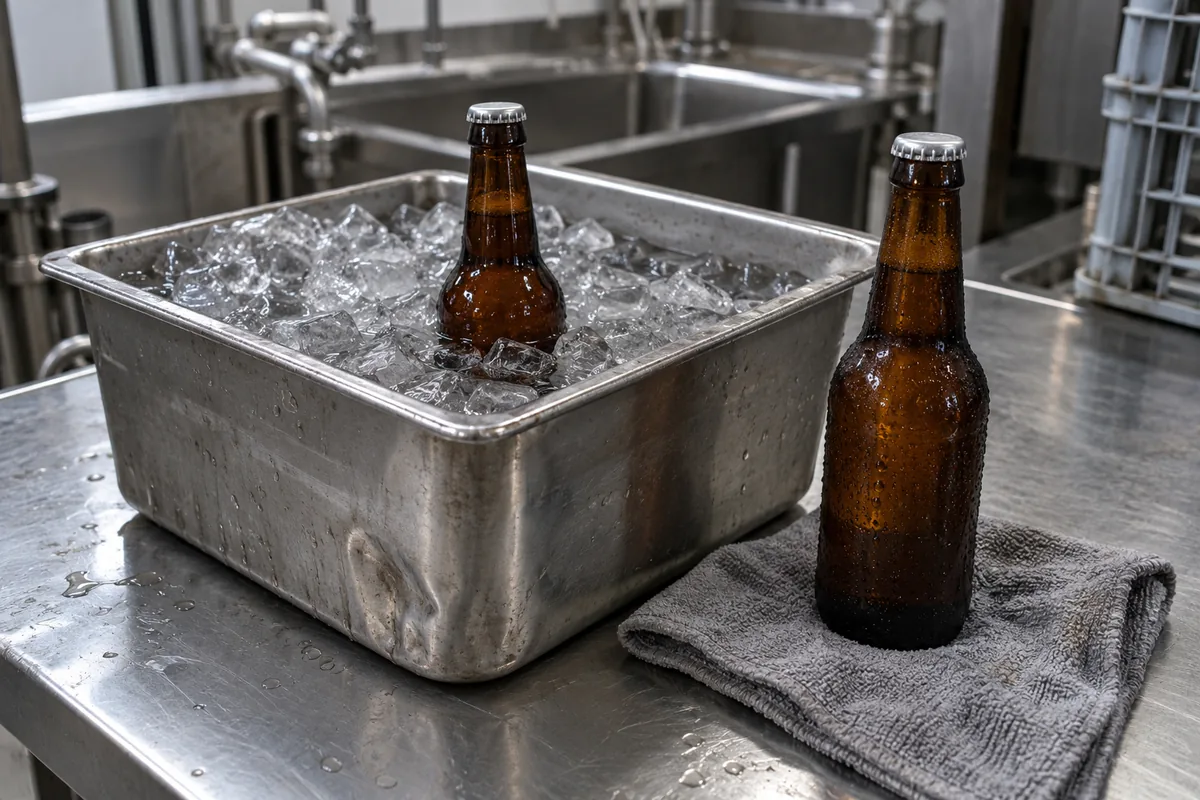
Images on this page are generated editorial photos for illustration, not actual packages, test records or performance evidence.
Define the material and the complete construction
Keep the abbreviation and complete construction in separate fields. Avery defines PET as polyethylene terephthalate and BOPP as polypropylene film stretched in both machine and transverse directions. The guide uses PE-designated film families, including PE85; this record does not infer their complete construction from that designation. Those names do not identify an adhesive, liner, coating or finished-label behavior on the bottle being considered.
| Material field | What the name establishes | Complete-record fields still needed | What remains unknown without grade evidence |
|---|---|---|---|
| BOPP | Biaxially oriented polypropylene film | Exact face grade, adhesive, liner, print and finish | Behavior on this wall and in the intended use |
| PET | Polyethylene terephthalate film | The same construction fields | Behavior of this particular label construction |
| PE | PE-designated film family in the supplier guide | The same construction fields | Whether this construction follows this bottle’s movement |
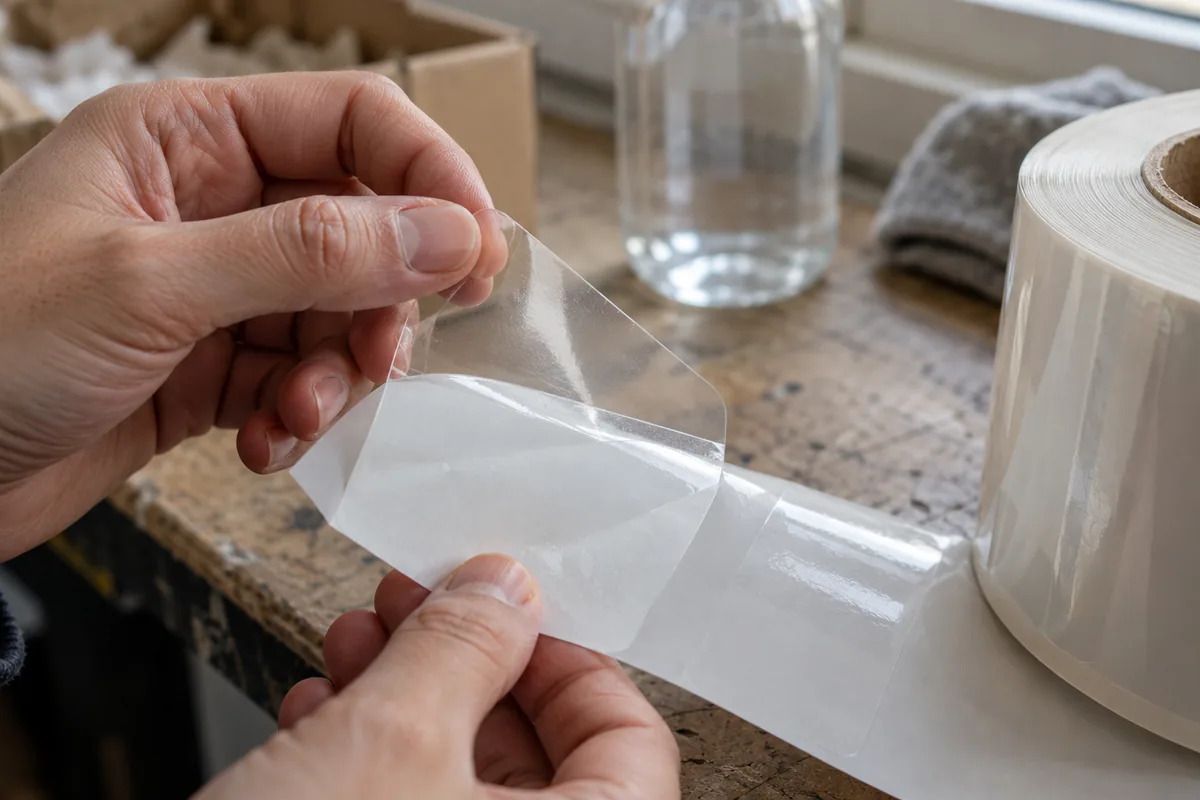
Illustrative photo — generated editorial image, not a test record, customer package or performance evidence.
A polymer abbreviation is one field within a complete construction record.
Use the pressure-sensitive layer record to keep these components together. The materials section separates that introductory structure task from the conditional comparison here.
Common mistake: Treating a film family’s name as evidence that every label using it is suitable for a squeezable container.
Takeaway: A material definition is the start of the record, not its suitability conclusion.
Let bottle movement set the next question
Start the comparison from the observed or intended container behavior. Avery Dennison’s guide separates rigid, semi-conformable and fully conformable choices within its portfolio. Our decision route uses that distinction to decide what evidence to request; it does not prescribe one polymer for every bottle in a category.
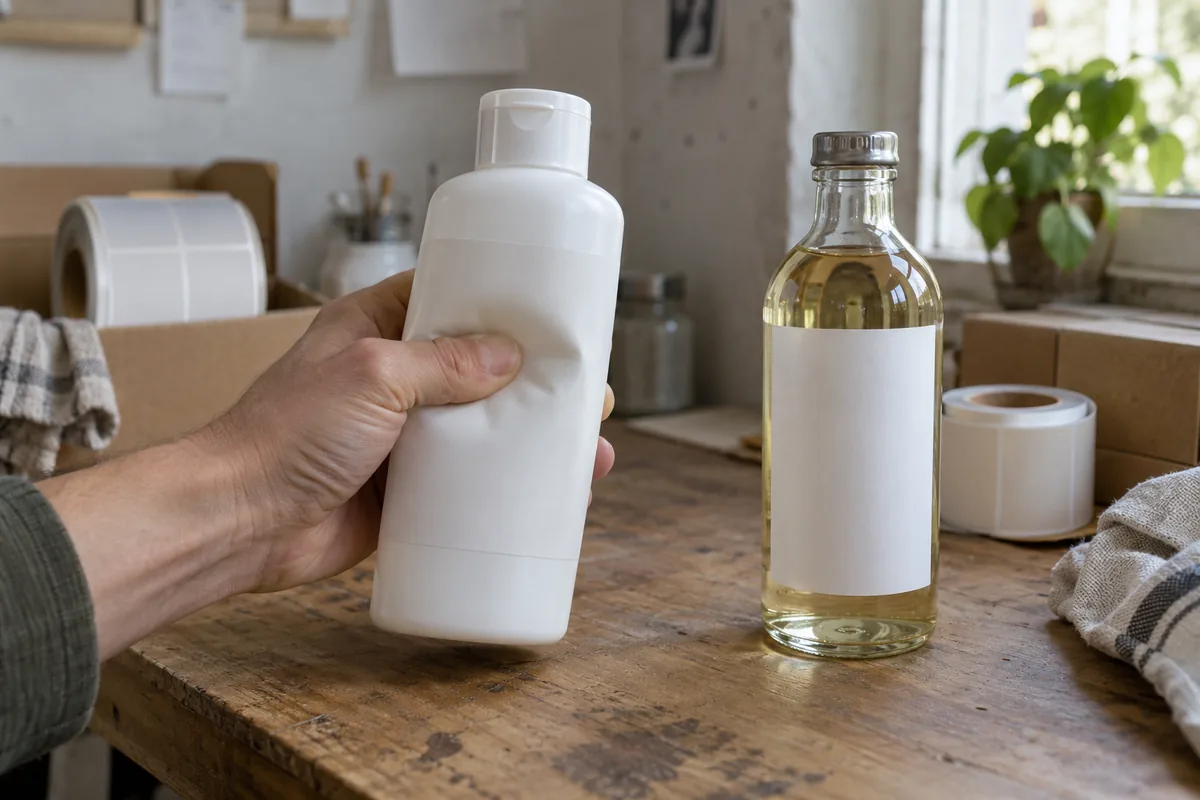
Illustrative photo — generated editorial image, not a test record, customer package or performance evidence.
This is an editorial evidence route, not an automatic material selector. At a glance: Bottle movement · Rigid wall · Squeezed wall · Wall geometry: flat or simple curve, or complex wall · Supplier scope · Sample review.
| Container observation | Next evidence question | Sample observation to record |
|---|---|---|
| Rigid wall with flat or simple curve | Which exact construction is documented for this wall and surface? | Applied contour and edge condition on the identified bottle |
| Slight compound curve or intended movement | What conformability scope does the supplier state for this grade? | Label behavior on the intended wall and movement |
| Bottle intended to be squeezed | What finished construction has evidence for that use? | Applied label before, during and after the agreed sample handling |
| Complex wall or uncertain usable area | Which contour and construction should be evaluated together? | Where the proposed outline contacts, bridges or leaves the usable wall |
Follow this editorial branch order:
- Identify bottle material, surface and wall geometry. If any is unknown, stop selecting a construction and obtain that package evidence.
- Record whether intended use deforms or squeezes the wall. If yes, carry that requirement forward; a complex curve can remain relevant at the same time. If no, retain the measured wall geometry as the requirement.
- Check the exact candidate’s documented scope against those requirements. If scope is absent or does not cover them, stop and request a construction-specific document or supplier review.
- Review the identified sample against the project’s stated criteria. If an observation does not meet them, return to the recorded requirement and candidate evidence; if it meets them, preserve the conditions supporting that project decision.
When the shape itself is unresolved, the small bottle and jar label-zone checklist provides an area record. For the connection to application handling, use the inline and rotary container-requirement matrix. Neither substitutes for a construction-specific sample.
Takeaway: Define wall shape and intended movement before asking the supplier to justify a grade.
Keep the supplier guide inside its scope
Read the Avery Dennison guide as a map of its named film constructions. In the October 2025 North American guide, page 3 places rigid BOPP alongside flat or simple curves and describes MDO options for other defined conformability needs. Page 4 relates particular PE, MDO and BOPP constructions to listed container characteristics.
The page 4 matrix gives a concrete example of why a construction name and a container characteristic must stay together:
| Guide entry, October 2025 North America | Guide’s container column | What remains unknown for this project |
|---|---|---|
| PE85 WH / PE85 CL among the listed products | HDPE; conformable | Current exact construction, adhesive/liner, project scope and sample outcome |
| GCX / Global MDO / BOPP among the listed products | HDPE, PP or PET; semi-conformable and rigid | Which actual grade is proposed for this specific bottle |
| BOPP and MDO film families | Glass; rigid and conformable | Exact construction and observed behavior on the identified glass package |
These are limited examples from the supplier’s matrix, not exclusive recommendations or confirmation of current availability. PET in a container column means the bottle material; it is not evidence for a PET label face. This page 4 matrix does not provide an equivalent PET-facestock mapping. A PET-label candidate needs its own grade document.
That is evidence about the supplier’s portfolio guidance, not proof that all BOPP labels suit all rigid bottles or all PE labels suit all squeezable bottles. MDO means machine-direction oriented in this guide; it is not a synonym for every PE construction. Keep the actual grade and document scope beside any selection note.
| Guide entry to preserve | Why it belongs in the comparison |
|---|---|
| Named construction or product family | Identifies what the supplier actually discussed |
| Container material and characteristic | Preserves the application boundary in the matrix |
| Region and revision | Identifies the document used |
| Exact grade document | Supplies the next level of construction detail |
| Supplier’s suitability disclaimer | Keeps a recommendation separate from a guarantee |
An appearance choice still needs an assembled clear-versus-white proof. A historical material description, such as the Ethos clear-label account, supplies context about a reported package rather than evidence for a new grade.
Takeaway: Cite the guide’s actual construction and container boundary, then obtain the current grade record.
Compare grade records rather than generic rankings
A useful comparison sheet makes missing evidence obvious. Enter the exact construction and relevant document for each candidate before comparing conclusions. Use “to be confirmed” where a field has no evidence, and identify who can resolve it. A blank technical field cannot support a material ranking.
Unknown fields remain unresolved until an identified document or sample supports them. At a glance: Construction ID · Bottle ID · Face grade · Adhesive · Liner · Documented field · Unknown field · Request evidence.
| Field to compare on the same basis | Candidate BOPP construction | Candidate PET construction | Candidate PE construction |
|---|---|---|---|
| Exact construction code/revision | To be confirmed | To be confirmed | To be confirmed |
| Face, adhesive and liner identities | To be confirmed | To be confirmed | To be confirmed |
| Print and finish represented | To be confirmed | To be confirmed | To be confirmed |
| Intended bottle and usable wall | Enter the same project reference | Enter the same project reference | Enter the same project reference |
| Bottle material and surface/coating | Enter the same identified project input | Same input | Same input |
| Actual application conditions | Enter actual surface and package state | Same basis | Same basis |
| Supplier’s stated construction scope | To be confirmed from grade document | To be confirmed from grade document | To be confirmed from grade document |
| Observation time, conditions and photo/document ID | ___ | ___ | ___ |
| Project criteria and unmet/unresolved item | ___ | ___ | ___ |
| Intended movement/use observation | Enter sample ID and actual observation | Enter sample ID and actual observation | Enter sample ID and actual observation |
| Unresolved issue and next evidence | Record the responsible party and document/sample | Record the responsible party and document/sample | Record the responsible party and document/sample |
This is a blank editorial record, not a comparison of measured results. If the sample develops lifting or wrinkles, retain its identity and use the defect observation log. If upstream conditions changed, record them in the bottle handoff checklist before blaming the film.
If a food-label project is also considering a paper face, use the Asendo 80 construction-and-trial checklist to evaluate that proposal on its own documented scope rather than extending this film comparison.
Takeaway: Compare only conclusions backed by an identified construction and the same project requirements.
When this does not apply
The matrix cannot supply a uniform temperature range, oil resistance, UV resistance, price or recycling conclusion for an entire polymer family. It does not establish bag-film properties or compliance for a bottle package. Supplier grade documents and the intended finished sample are the next evidence, not a universal ranking of plastics.
Stop the comparison when candidates do not represent the same bottle task or when a changed adhesive or finish is hidden by the material name. Restore the missing component and conditions to the record before drawing a preference.
Takeaway: Leave unsupported performance fields unresolved rather than filling them from the abbreviation.
Method and sources
Compiled from Avery’s PET/BOPP definitions and Avery Dennison’s Film Materials Technical Guide, North America, dated October 2025, reviewed October 8, 2026. These are supplier sources. The container matrix and disclaimer were read in the cached full PDF text; the product-family guidance remains limited to its stated scope. The comparison sheet and sample route are editorial suggestions, not original measurements.
Version record: October 8, 2026 — new construction-level comparison and visible unknown-data fields.
Takeaway: A historical supplier matrix organizes questions; the current grade document and project sample support the actual choice.