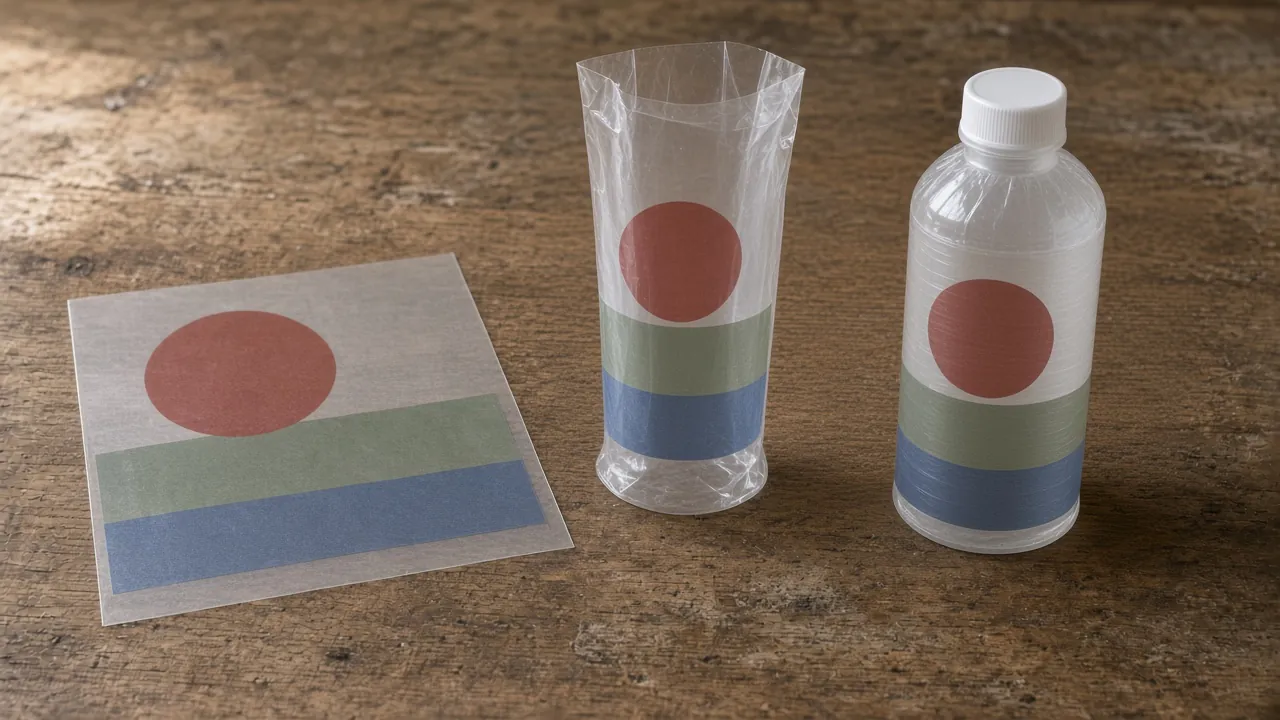
A bottle label that stays intact but loses its printing still fails its purpose. To waterproof bottle labels, choose a label construction and compatible printing process specified for the intended water contact, then check the finished printed label on the actual bottle before approving it.
Waterproof stock alone does not establish the performance of the finished printed bottle label. For self-printing, keep the exact stock and printer/ink combination together. For purchased printed labels, keep the converter’s construction and finish revision with the proof. This guide provides a four-part evidence matrix and a dry-versus-exposed sample record for that approval decision.
Define the water contact before choosing a label
Start with what happens to the bottle: condensation after refrigeration, occasional splashes, wet handling, or a label sitting below a waterline. Avery’s waterproof versus water-resistant guide separates light moisture from prolonged contact and immersion when describing its options. Use those descriptions to screen candidates; obtain the scope for the exact product you intend to print or buy.
| Intended use | Put this in the sample brief | Evidence needed before approval |
|---|---|---|
| Chilled bottle with condensation | Storage sequence, where droplets form, handling while wet | Printed sample evaluated through that sequence |
| Occasional splash or wipe | Liquid, contact area, wiping method and frequency | Appearance and print-transfer observations after that contact |
| Ice bucket or immersion | Waterline, contact duration, temperature and actual handling | Construction-specific evidence covering that exposure |
| Repeated washing | Cleaning product, temperature, cycle and bottle reuse | Separate documented support for that cleaning process |
These are brief fields, not prescribed test settings. Leave unknown duration, temperature or cycle entries blank until the intended use and applicable instructions are established. A splash-only check does not answer an immersion question. Likewise, use a separate approval brief for dishwasher cleaning rather than treating the word waterproof as dishwasher permission.
Trace the four parts of the printed construction
Keep the following record beside the artwork proof. An artwork approval can identify what should be printed; this record identifies what will carry it through use. If the basic component names are unfamiliar, start with the pressure-sensitive label construction guide.
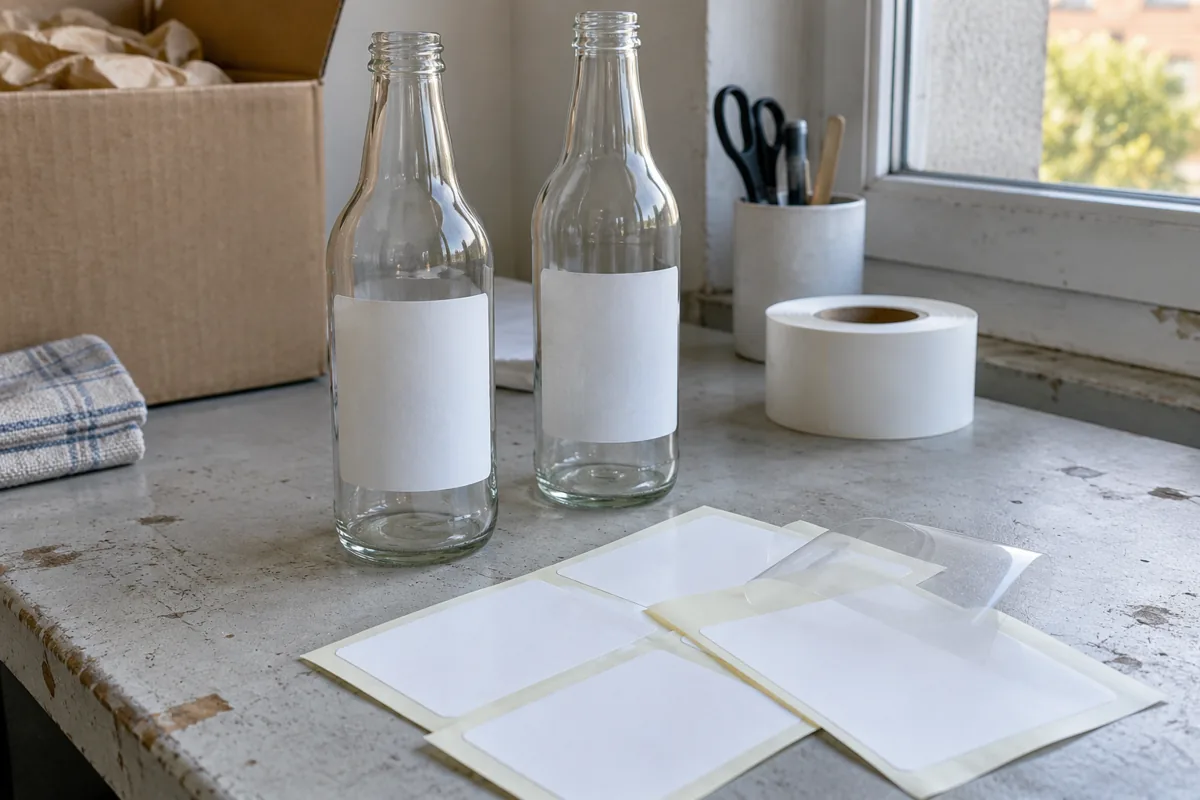
Blank label samples, release paper and transparent film beside labeled bottles.
| Part to identify | Copy into the proof record | Question the supporting document must answer |
|---|---|---|
| Face material | Supplier, product code, face material and revision | Does the water claim cover this exact face construction? |
| Printing | Printing process, printer model where relevant, ink/toner reference and recorded settings | Is this combination supported on this stock for the intended exposure? |
| Surface protection | Coating or laminate reference, or explicitly none; converter’s finish revision | Is the claimed performance for this finished printed version? |
| Adhesive and bottle | Adhesive reference, bottle material/finish, label shape and application instructions | Does the evidence cover this bond on this container under the specified conditions? |
A missing reference is an open question. Write Unknown / verify on the unit for an unrecorded printer setting; do not fill the cell with a typical value. Where a converter cannot disclose a component formulation, retain its traceable finished-construction reference and written application scope instead.
Avery’s waterproof material category contains different films and adhesives, and explicitly lists Outdoor Waterproof White Film as laser-only. That is a useful reason to read the individual material entry before ordering a blank stock. For a broader face-material decision, the BOPP, PET and PE comparison supplies a separate construction checklist; a polymer name by itself does not complete this approval record.
Check the printer claim before adding protection
The printer can change the scope of a material’s water claim. In its blank-label help page, Avery describes Durable White Film as waterproof with pigment-based inkjet or laser printing, but water-resistant to accidental splashes with standard dye-based inkjet printing. This is a statement about that named material, not a rule that every pigment ink, toner or inkjet label has the same performance.
For a self-printed proof, check the label’s product instructions against the actual printer and ink supply. For a professionally printed proof, ask which finished construction the water claim describes. Keep any variable data or later overprint in scope too: record which process produced each part of the visible information.
If the supplier recommends a laminate or coating, record it as a construction change and evaluate the finished version. Do not approve a protected sample and then order an unprotected revision under the same proof identity. This guide does not prescribe a DIY sealant or establish that adding a surface layer resolves an unverified print or adhesive combination.
Compare the exposed sample with a retained dry reference
Use matched printed samples from the intended construction on the intended bottle. Retain a dry reference so that later observations have a starting point. The record below is an editorial planning aid; agree the exposure conditions and acceptance requirements with the responsible packaging reviewer before running a check.
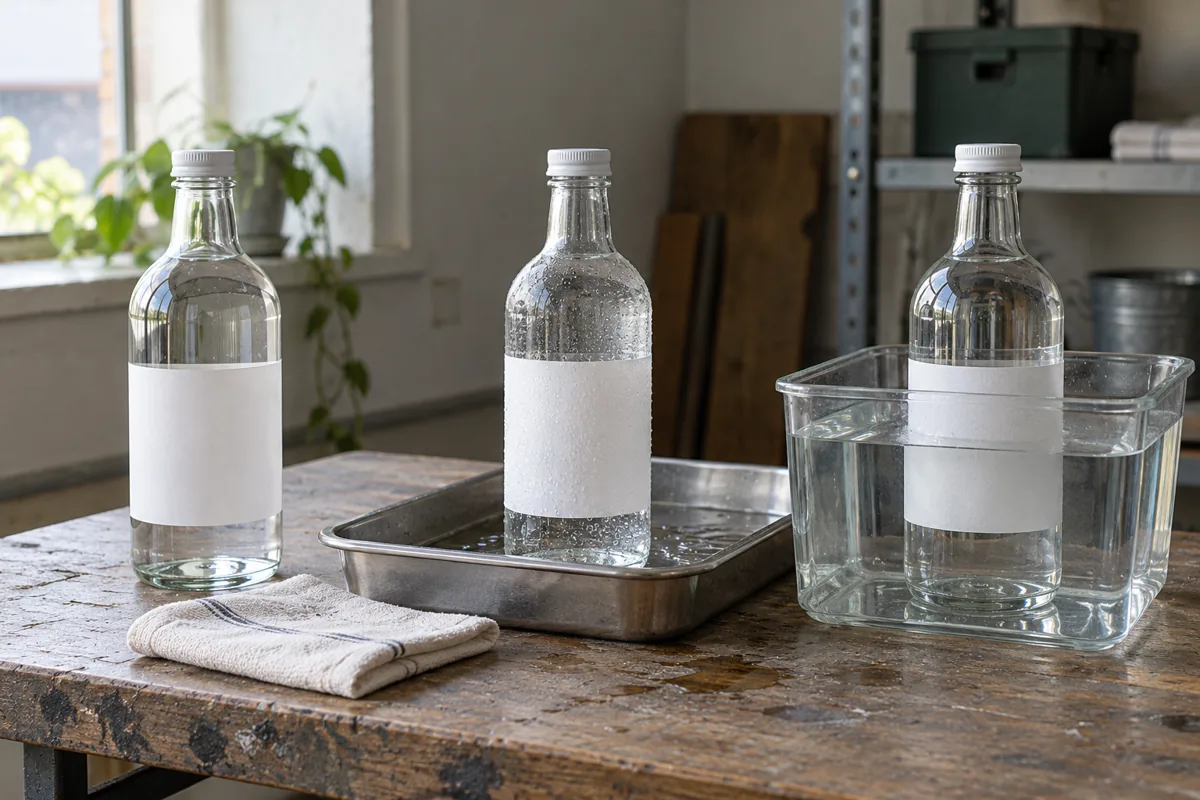
A dry bottle, a bottle covered with droplets and a bottle standing in water.
Avery’s application guidance calls for a dry surface free of residue and explains that moisture can interfere with adhesive contact. Keep application conditions separate from later water exposure. Follow the exact label and bottle instructions for preparation and bonding time, and record the actual interval rather than adopting one waiting period for every construction.
| Record field | Dry reference | Exposed sample |
|---|---|---|
| Sample ID and construction revision | ___ | ___ |
| Bottle material, finish and batch | ___ | ___ |
| Artwork/print revision, including later overprint | ___ | ___ |
| Surface preparation and application time | ___ | ___ |
| Time between application and exposure | Not exposed; record reference timeline | ___ |
| Exposure details | Dry storage conditions | Liquid, waterline/contact area, temperature, duration, repetitions |
| Handling | Record any handling | Wiping material, action and sequence, if applicable |
| Before-condition record | Photo IDs and observation time | Photo IDs and observation time |
| After-condition record | Photo IDs and observation time | Photo IDs; inspect while wet and after drying if relevant |
| Acceptance requirement and outcome | Baseline appearance | Requirement reference; observation; unresolved issue |
Copy the table into your sample record and fill it with actual observations. Keep the original specimens and link each photograph to its sample ID. If changing the print, finish or adhesive, assign a new revision and retain the earlier comparison. An unrecorded condition remains unknown; it is not a passed check.
Record print, face and bond separately
Avoid a single box marked “waterproof: yes.” It can hide which part of the package was actually checked. Inspect the same identified sample for each observation below, without assigning a cause from appearance alone.
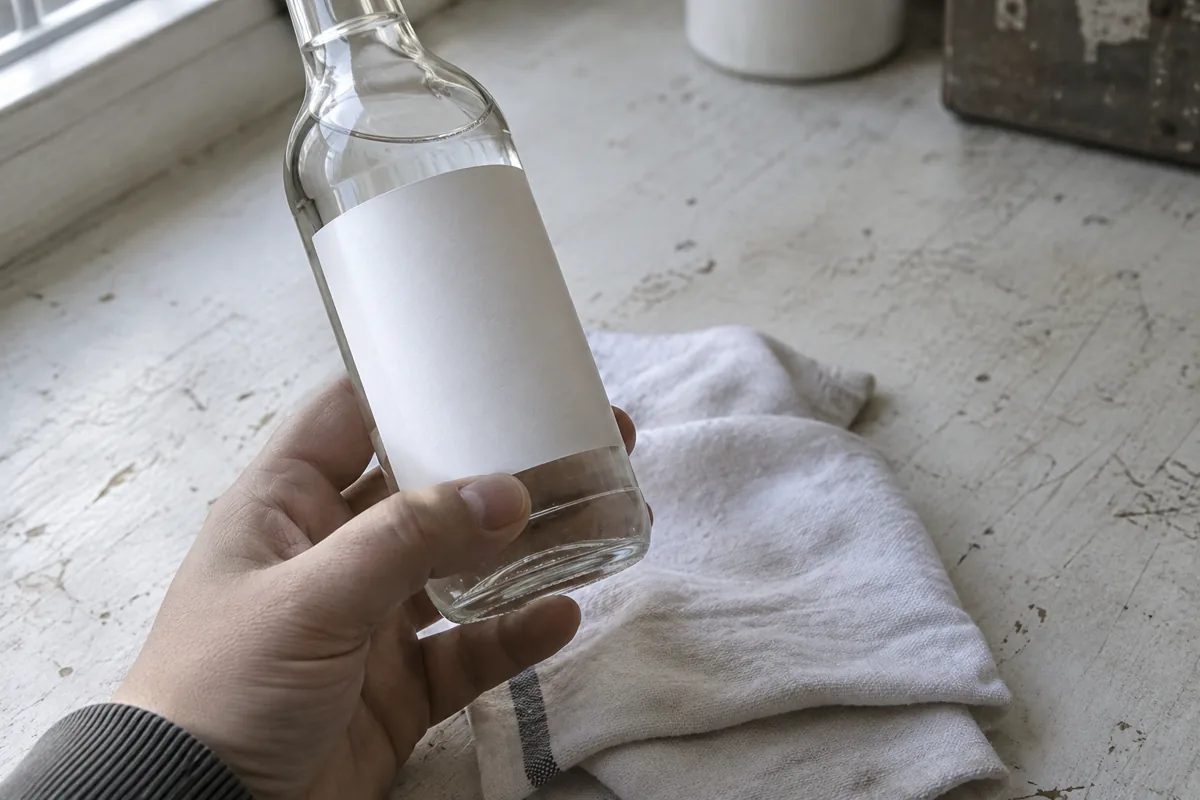
A bottle held near its label edge beside a white cotton cloth.
| Observation area | What to record | Approval question |
|---|---|---|
| Print and legibility | Color change, blur, missing detail or visible transfer to the wiping material | Does the required information remain usable under the agreed conditions? |
| Face and finish | Changes in surface appearance, tearing, coating damage or separation | Does this match the agreed appearance and integrity requirement? |
| Bond and position | Lifted edge, movement or detachment, with its location and timing | Is the label still held as required on this bottle? |
For example, an intact face with smeared printing leaves the print requirement unresolved; a readable label with a lifted edge leaves the bond requirement unresolved. These are decision examples, not reported test outcomes. If a defect is already present and needs investigation, use the bubbles, wrinkles and lifting record to preserve its timing and sample identity.
Close the proof only against the written requirement for the identified construction, bottle and exposure. A useful approval note records: construction revision ___; bottle ___; exposure record ___; accepted requirements ___; remaining exclusions ___. Keep a narrower claim if the evidence covers only a narrower use. A sample comparison does not certify every bottle, cleaning process or future print revision.
Method and sources
This guide combines Avery’s public material, printing and application guidance, read October 15, 2026, with an editorial evidence matrix and sample record. The exposure guide was updated July 2, 2026; the help and category pages were checked as available on the access date. Supplier statements retain their named-product scope. No original durability tests were performed for this article, and no universal test duration, temperature, pass threshold or certification is assigned here.
Use the printing and application section for the next related proof or handoff question. Our editorial policy explains how source-backed guidance and editorial visuals are handled.
Version record: October 15, 2026 — new printed-construction approval matrix and dry/exposed sample record.