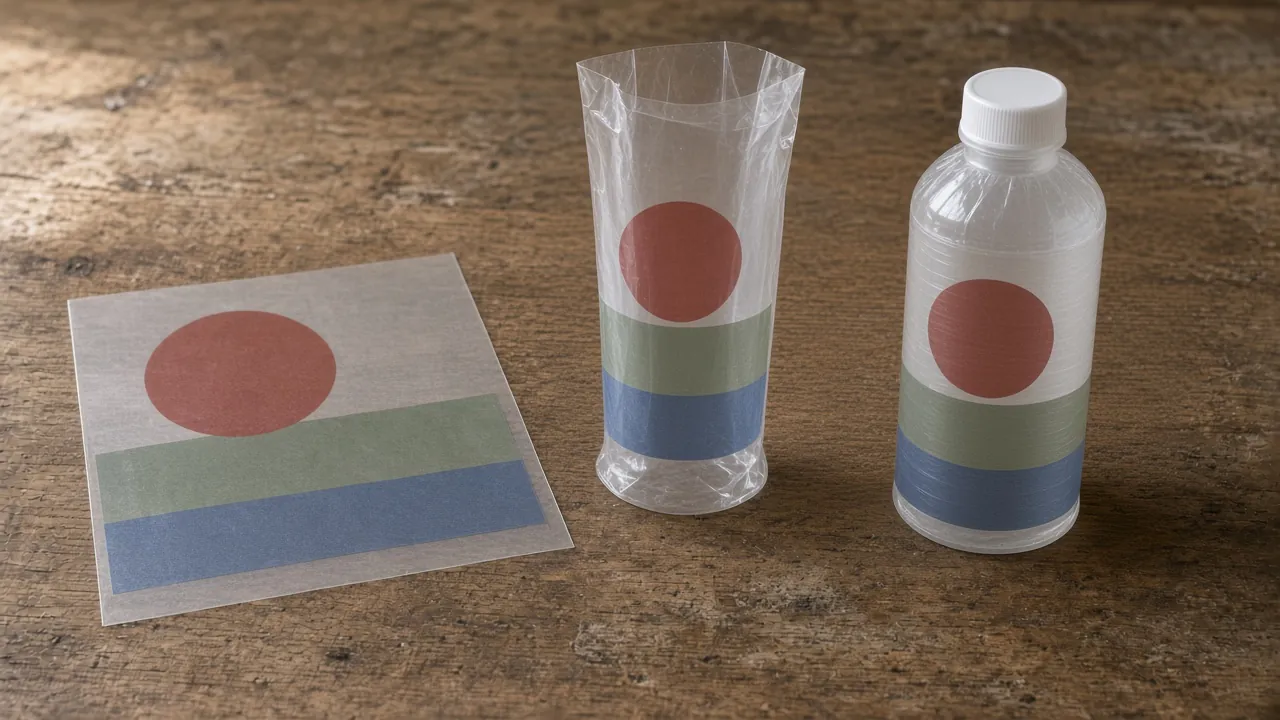
Replacing a finishing route on the strength of a metallic sample can waste a press trial. Assess Senoprint as a specified coating-and-topcoat system on your actual paper label, then compare the finished result with an identified existing foil job.
Stahl announced the global Senoprint portfolio on September 14, 2026, bringing the North American LustreCoat range into a unified brand. For a narrow-web label converter, that announcement starts a specification discussion. It does not establish a drop-in substitute for every cold-foil construction. The useful output is a trial brief that identifies the paper, exact formulation, protective topcoat, print sequence and customer’s acceptance criteria. This publication has not tested the system.
- Keep a current product reference when mapping an old LustreCoat order.
- Use the actual paper label construction, rather than its face material alone.
- Assess the finished surface with its specified topcoat.
- Request application evidence before adopting cost or recyclability claims.
What Stahl announced, and what it leaves open
The announcement describes silver and gold metallic finishes, UV-based and water-based formulations, and a paired protective topcoat. Its substrate scope is paper and board; it names flexo and narrow-web applications among the processes. These are supplier descriptions. The selection task is to obtain the specification for the proposed label job rather than extend the portfolio description to every construction.
| What Stahl describes | What the reviewed sources establish | Evidence for the label job |
|---|---|---|
| Unified portfolio name | Brand consolidation announced | Old-to-current product mapping |
| Paper/board, UV or water-based, paired topcoat | Supplier’s stated system scope | Exact construction and formulation documents |
| Metallic appearance | Supplier’s finish description | Approved sample for the intended artwork |
| De-inking and paper-stream recycling | Supplier claim; no independent report supplied here | Relevant complete-construction test report |
| Design for PPWR, REACH, GIO and U.S. TSCA requirements | Product-page statement, not an independently verified certification | Applicable product and application documentation |
The printing and application section keeps the press task separate from container application. Use the label materials route to organize the construction inputs before assessing a finishing change.
Takeaway: A portfolio name is the start of a job specification, not the specification itself.
Who should evaluate the change?
An existing North American LustreCoat user has a product-reference question; a converter currently using foil has a process-comparison question. Those tasks need different records. The following table is a suggested division of work for a label project, not a claim that the announcement requires every converter to change products or equipment.
| Converter situation | Useful first question | Evidence to keep |
|---|---|---|
| Existing LustreCoat job | Which current reference corresponds to this order? | Written cross-reference and current technical documents |
| Paper label currently finished with foil | What finished-system sample represents the proposed alternative? | Identified existing and proposed constructions |
| New paper-label design | What appearance and handling conditions must the sample meet? | Approved artwork and customer criteria |
| Film-label project | Which exact substrate has application support? | Substrate-specific supplier confirmation before planning a trial |
Keep the broader pressure-sensitive construction record with the coating brief. For a bottle project, the usable label-zone guide helps identify where the customer will actually see and handle the finished label.
For an existing LustreCoat job, use this proposed paired record. “Confirmed” means a written supplier response is attached; it does not mean this publication checked the product.
| Field | Existing order/document | Proposed current item | Confirmed / unresolved and written reference |
|---|---|---|---|
| Product code and grade | Actual record | Supplier proposal | ___ |
| Formulation revision | Actual record | Supplier response | ___ |
| Companion topcoat | Actual record | Supplier proposal | ___ |
| Technical document revision | Actual record | Current document | ___ |
| Regional supply | Current order conditions | Proposed conditions | ___ |
Takeaway: Distinguish a product-reference update from a change in finishing process.
Build a paper-label trial brief
Start the trial request with an identified face paper and the complete intended label. A generic metallic swatch does not identify adhesive, liner, print sequence or package use. Give the supplier enough detail to propose a specific coating system, then retain that proposal with the samples so later comparisons use the same construction.
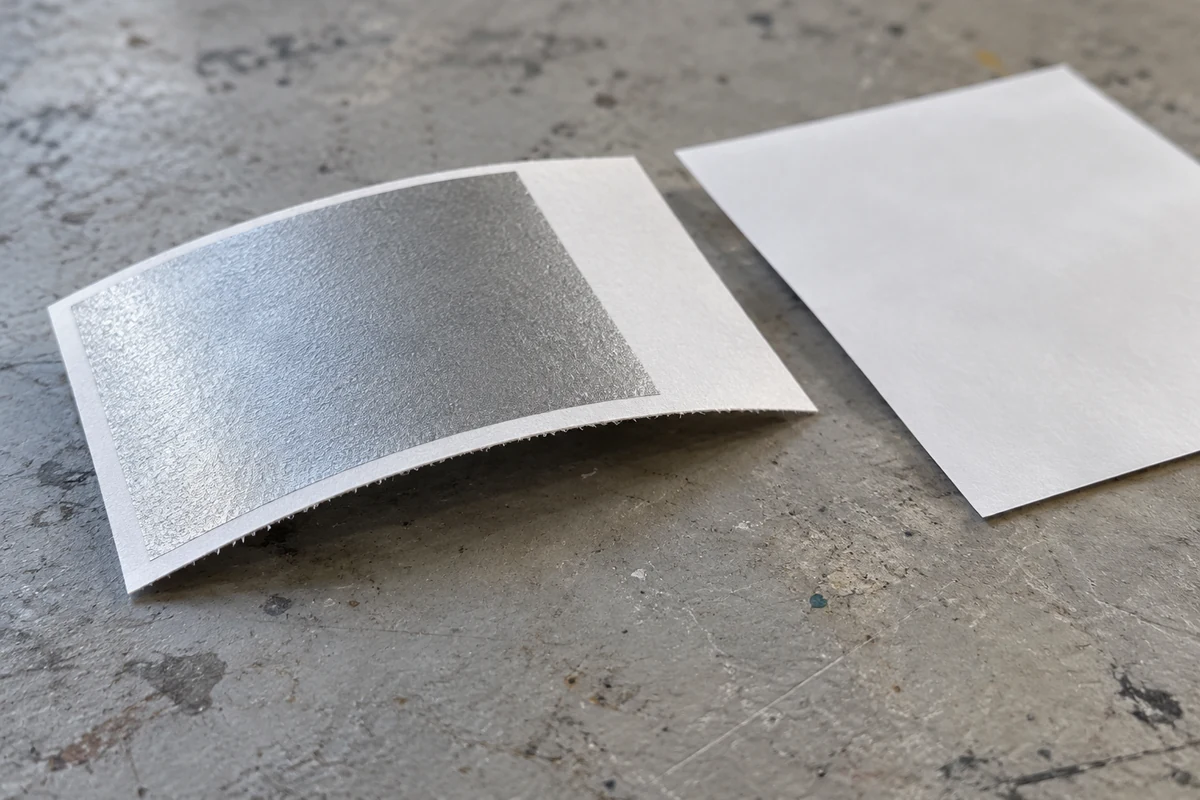
Generated editorial illustration — the paper edge explains substrate identity; it is not Senoprint material or evidence of coating suitability.
| Brief field | Suggested record | Question for the supplier |
|---|---|---|
| Face paper and surface | Grade, sample identity and surface-treatment information | Is this exact surface within the proposed system’s scope? |
| Finished label construction | Adhesive, liner and finishing references | What system details affect the proposed application? |
| Press and print sequence | Proposed process and order of operations | Which formulation and companion topcoat are specified? |
| Artwork | Metallic areas and any overprinted areas | What sample can represent the intended appearance? |
| Package use | Actual container and anticipated handling | What evaluation conditions should the project agree? |
| Existing comparison | Identified foil sample, if replacing a current route | What differences must be recorded between the samples? |
The complete-construction comparison explains why naming one face material is insufficient. Its film examples are background for construction identity, not evidence that this announced paper-focused coating route works on those films.
Takeaway: Give the trial an exact construction and a written system proposal.
Compare the finished label, including the topcoat
Compare the proposed finished system with the actual existing label under agreed project conditions. Keep the topcoat in the sample identity instead of treating it as an optional detail. The comparison below is a record structure; it sets no universal rubbing procedure, pass threshold or predicted saving. Those inputs belong to the supplier proposal and customer’s requirements.
| Comparison item | Existing foil job | Proposed coating system |
|---|---|---|
| Sample identity | Actual construction and artwork revision | Actual construction and artwork revision |
| Metallic appearance | Customer’s accepted reference | Observed result against the same reference |
| Protective finish | Actual current finish | Specified companion topcoat |
| Handling assessment | Agreed conditions and sample observations | Same agreed conditions and sample observations |
| Production scope | Operations and consumables included | Operations and consumables included |
| Remaining difference | Condition that affects comparison | Condition that affects comparison |

Generated editorial illustration — sample handling is an evaluation topic; no abrasion test or result is pictured.
Use the bottle artwork proof record when the appearance judgment depends on the actual container. Preserve visible application problems in the label defect observation log rather than attributing every defect to a finishing change.
Common mistake: Comparing an unfinished metallic coupon with a finished foil label, then treating the difference as a verdict on the production routes.
Takeaway: Compare identified finished samples using the same customer requirements.
When should a converter act?
The launch date is a news date, not a mandatory conversion deadline. Tie the review to an actual product-reference update, design release or planned production trial. Existing users can begin with their old and current specifications; a new-process project can begin with its label construction. Keep sample evaluation and commercial approval as separate decisions.
| Event or checkpoint | Date or trigger | Nature | Suggested action |
|---|---|---|---|
| Global launch announced | September 14, 2026 | Supplier announcement | Open a product or trial reference |
| Existing job reviewed | Your actual purchasing or specification milestone | Project decision | Confirm the current product identity |
| Proposed route compared | Before the project’s finishing approval | Editorial suggestion | Assess the finished samples and production scope |
| Commercial supply confirmed | Written supplier response | Project-specific information | Record grade, region and order conditions |

Generated editorial illustration — connect each loose sample to its roll and specification; no supplied grade is identified here.
For bottle labels, add the label-ready container record when the finished sample will be assessed after application.
Takeaway: Use your job’s approval milestone, not a deadline inferred from the launch.
What remains unresolved?
Stahl describes cost, protective performance and recycling benefits, but a converter needs the evidence applicable to its finished label. Request the relevant system documents and test conditions rather than copy those descriptions into a customer specification. The requests below identify the missing project evidence; they do not assert that an individual sample will fail or pass.
| Claim or scope question | Evidence to request |
|---|---|
| Product continuity after the brand change | Reference mapping and formulation/document revisions |
| Suitability for a particular press or surface | Written scope for the exact formulation and substrate |
| Resistance under actual handling | Test conditions and results for the proposed finished system |
| Cost advantage | Comparable job scope and actual project inputs |
| Recycling or de-inking claim | Test/report scope for the complete relevant construction |
| Indirect food-contact use | Application- and product-specific documentation covering the intended use |
The product page names gravure and offset beyond the processes in the launch announcement. Confirm the proposed application rather than infer that every listed formulation has identical process support. Its indirect food-contact wording is application- and product-specific; other contact scenarios remain a question for the supplier.
Takeaway: Ask for evidence tied to your system, substrate and end use.
When this does not apply
This paper-label evaluation route does not establish plastic-film suitability, certify PPWR compliance or provide a cost or durability ranking. A change of brand name also does not establish unchanged formulation, product code or regional supply. Technical setup and acceptance conditions need the actual supplier documents and project requirements.
Takeaway: Keep the evaluation inside the documented application scope.
FAQ
What is Senoprint®?
It is the name of the metallic-coating portfolio Stahl announced globally. For an existing job, keep the exact product reference as well as the portfolio name. That gives purchasing and production a concrete item to confirm when updating specifications.
What markets and applications do Stahl’s metallic coatings support?
The launch includes paper and board, with narrow-web and flexo among its named applications. A converter should ask which specific formulation and topcoat are proposed for its actual label surface and process. Do not infer film-label suitability from a broad portfolio description.
Does Stahl provide technical support for implementing metallic coatings?
The product page describes supplier technical support. Prepare an identified label construction, process description and required finished appearance before discussing the application. Record what that supplier offers for the particular project; this independent publication does not provide trials or production support.
Method and sources
The event and portfolio descriptions are from Stahl’s launch announcement and product page, linked below. Both are supplier sources, not independent performance verification. The trial brief, comparison fields and timing checkpoints are editorial suggestions for paper-label converters. No cost calculation, press trial or recycling test is claimed.
Takeaway: Use the supplier descriptions to frame a documented application review.