Fitting mandatory drug facts, agrochemical hazard tables, or 15-language cosmetic ingredient declarations onto a single container panel fails when the usable straight wall runs out of area at legal minimum font sizes. Booklet labels and extended content labels (ECLs) multiply readable panel surface area by 3x to 20x on the exact same container footprint, provided the hinge bond, paper grain orientation, small-mandrel flexural stiffness, and applicator peel-plate radius are engineered as a single system.
Specifying booklet labels and extended content labels requires locking four quantitative boundaries before tooling dies: matching construction architecture (2-ply peel-and-reseal at 0.18 to 0.35 mm, plow-fold concertina at 0.35 to 0.85 mm, stitched booklet onsert at 0.80 to 1.60 mm, or 360-degree self-wrap at 0.10 to 0.18 mm) to required page count and container diameter; maintaining at least a 3:1 peel-force differential between the container base adhesive (FINAT FTM 1 >= 14 to 18 N/25 mm) and the resealable closure strip (FINAT FTM 2 = 2 to 6 N/25 mm); aligning 35 to 45 gsm leaflet paper grain parallel to the bottle axis with a 6 to 8 mm self-overlapping skirt on 12 to 25 mm vials; and equipping the labeling machine with an R = 3.0 to 6.0 mm peel beak and a 4.76 mm (3/16 in) ultrasonic gap sensor.
| Engineering subsystem | Quantitative specification window | Primary line or field failure if violated | Qualification test or check |
|---|---|---|---|
| ECL structural architecture & caliper | 2-ply web (0.18 to 0.35 mm); plow-fold leaflet (0.35 to 0.85 mm); stitched booklet (0.80 to 1.60 mm); 360-deg wrap (0.10 to 0.18 mm) | Spine step jams tight secondary folding cartons or exceeds peel-beak bending limit | Measure total micrometer caliper across spine, reading body, and skirt |
| Regulatory panel area & typography | Minimum 6.0 pt body type with >= 0.5 pt leading (21 CFR 201.66); >= 1/32 to 1/16 in INCI height (21 CFR 701.3) | Illegible micro-text rejected by FDA/EPA reviewers or detached paper inserts lost in use | Divide total layout copy area (A_copy) by usable straight-wall panel area (A_panel) |
Small-vial flexural control (d = 12 to 25 mm) |
Paper MD grain vertical (parallel to bottle axis); 35 to 40 gsm pharma paper; 6 to 8 mm self-overlapping skirt | Cubic thickness stiffness (t^3) creates 160x spring-back torque that wings up leading/trailing edges |
7-day FINAT FTM 12 small-mandrel hold check on actual filled container lot |
| Adhesive bond hierarchy (base vs reseal) | Base permanent adhesive: FTM 1 >= 14 to 18 N/25 mm; Top reseal strip: FTM 2 (90 deg) = 2 to 6 N/25 mm; Spine hinge >= 20 N/25 mm | Pulling starter tab lifts the entire label off the bottle wall or tears inner paper plies | Verify >= 3:1 to 5:1 bond ratio across 10 open/reclose cycles on container |
| Applicator peel beak & gap sensor | Radiused peel beak R = 3.0 to 6.0 mm (135 to 150 deg wrap); ultrasonic fork sensor on 4.76 mm (3/16 in) gap; 3 in or 6 in core |
Sharp 1.0 mm beak pops top lamination open (“cover tenting”); optical sensor double-triggers on booklet edge | Run high-speed dispensing trial on PET30 or BG45 liner before production |
ECL structural architectures: 2-ply peel-and-reseal vs concertina fold-out vs stitched booklets
An extended content label is not a single product construction; it is a family of four distinct multi-layer converting architectures designed for different panel counts, container radii, and chemical exposure profiles. In the supplier classifications published by Multi-Color Corporation (MCC) and CCL Healthcare, every ECL builds upon the foundational three-layer pressure-sensitive construction by marrying an upper reading assembly to a pressure-sensitive base web.
| ECL architecture | Layer stack & converting method | Readable panel & page capacity | Total pack caliper (t_total) |
Reseal closure mechanism | Target container & market application |
|---|---|---|---|---|---|
| 2-ply / 3-ply peel-and-reseal (multi-ply web) | Two or three laminated film (50 micrometer BOPP/PET) or coated paper webs; UV silicone deadened reading zone, 4 to 6 mm permanent spine hinge, and 3 to 5 mm pattern-gummed reseal edge | 3 panels (2-ply) up to 5 to 7 panels (3-ply or 4-ply) | 0.18 to 0.35 mm (180 to 350 micrometers) | Dry-peel or microsphere adhesive strip at tab edge (5 to 25+ reclose cycles under FINAT FTM 2) | OTC drug bottles (21 CFR 201.66 Drug Facts), 15 to 50 mL cosmetic bottles, instant-redeem coupons |
| Plow-fold / concertina leaflet (accordion fold-out) | Single 35 to 45 gsm opaque pharma paper sheet Z-folded or C-folded inline, glued to a pressure-sensitive base panel, and sealed under a 20 to 30 micrometer clear BOPP overlaminate | 6 to 24 panels (up to 48 pages folded from a single sheet per CCL Healthcare) | 0.35 to 0.85 mm (350 to 850 micrometers) | Overhanging clear BOPP cover skirt (4 to 6 mm wide) seals onto a varnished landing strip on the base web | Multilingual pharmaceutical cartons and bottles, EU CLP Article 29 chemical packs (<= 125 mL), clinical trials |
| Multi-page stitched or spine-glued booklet (onsert) | Pre-folded, spine-glued or saddle-stitched litho booklet (40 to 50 gsm paper) robotic-onserted onto a base label under full clear BOPP/PET lamination | 16 to 64+ pages | 0.80 to 1.60 mm (800 to 1,600 micrometers at spine) | Perimeter lamination seals booklet until first opening; resealable film flap re-locks cover in field use | FIFRA / EPA 40 CFR Part 156 agrochemical jugs (crop tables, PPE, WPS), veterinary dosing manuals |
| 360-degree+ self-overlapping wrap (piggyback wrap) | Single thin film or paper web (50 to 60 micrometers) cut to L = 1.5 * pi * d to 2.5 * pi * d; permanent adhesive at leading anchor and dry-peel reseal adhesive along overlapping tail |
3 to 5 panels across 1.5 to 2.5 circumferential turns | 0.12 to 0.22 mm on roll; 0.10 to 0.18 mm stacked on vial | Label wraps onto its own release-varnished back surface with an integrated starter tab | Small-diameter (10 to 22 mm) parenteral vials, ophthalmic droppers, syringes, lip gloss and mascara tubes |
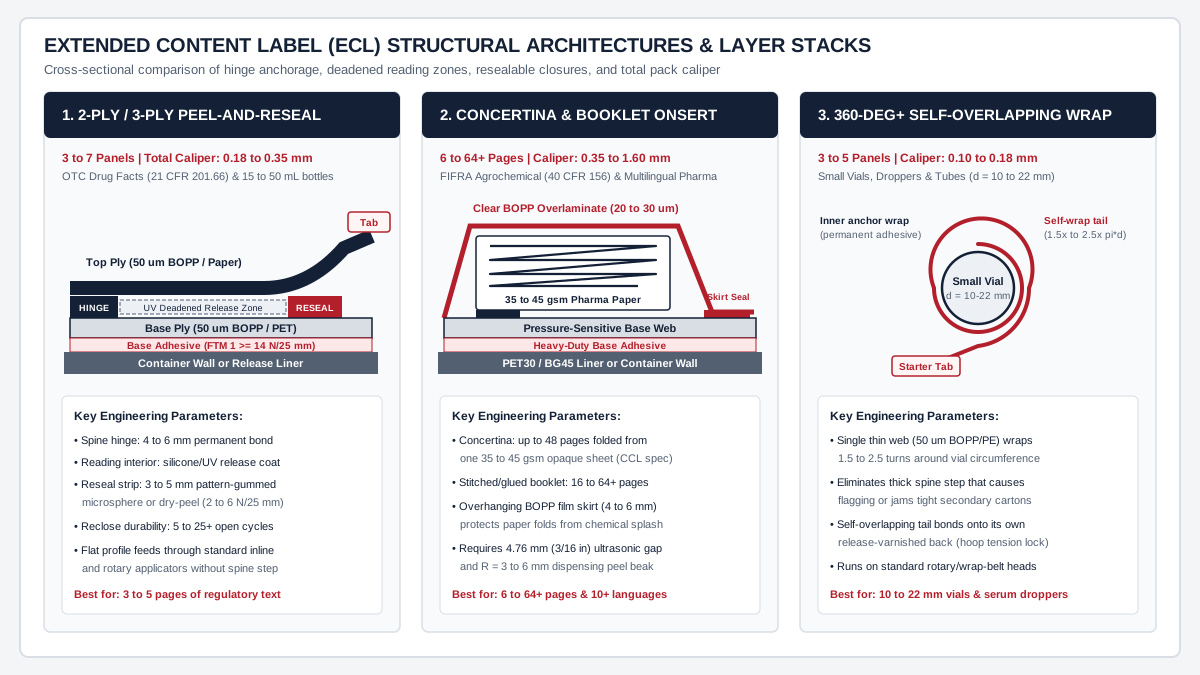
Selecting the wrong architecture creates immediate downstream packaging conflicts. A 2-ply peel-and-reseal label maintains a flat, uniform cross-web thickness (0.18 to 0.35 mm) because both the top ply and base ply span the full die-cut footprint. That flat profile feeds smoothly through standard inline and rotary labeling heads without snagging carton flaps. However, laminating more than three full-thickness pressure-sensitive webs together drives bending stiffness past the threshold that small cylindrical walls can hold.
When a specification requires 8 to 48 pages of multilingual instructions, converters switch from full-web lamination to an overlaminated plow-fold concertina or robotic booklet onsert. In these constructions, only the thin inner leaflet (35 to 45 gsm opaque pharma bible paper) folds multiple times, while a single 20 to 30 micrometer clear BOPP overlaminate encapsulates the stack and extends 4 to 6 mm past the leaflet perimeter to seal against the base label. Once the structural type is chosen, verify the physical opening sequence, panel reading order, and reclose behavior on the container using the extended content label opening proof record within the printing and application section.
Takeaway: Use 2-ply peel-and-reseal webs for 3 to 5 panels of flat copy, overlaminated plow-fold or stitched booklets for 6 to 64+ pages, and 360-degree self-overlapping wraps on tight 10 to 22 mm vials where a stepped booklet spine would flag or jam cartons.
Regulatory copy and panel-area math: FDA 21 CFR 201.66, EPA FIFRA, EU CLP, and cosmetic INCI lists
Packaging engineers rarely add booklet labels for decoration; statutory font minimums and mandatory container-attachment rules make single-ply labels mathematically impossible when copy volume grows or bottle geometry shrinks. Four primary regulatory frameworks govern ECL sizing across pharmaceutical, agrochemical, chemical, and personal-care lines:
| Regulatory standard | Mandatory typography & graphical minimums | Small-container trigger & statutory ECL rule | Typical required copy area (A_copy) |
|---|---|---|---|
| US FDA 21 CFR § 201.66 (OTC Drug Facts) | Minimum 6.0 pt body type with >= 0.5 pt leading; >= 7.0 pt subheadings; >= 8.0 pt title; 0.5 pt hairlines and 2.5 pt barlines; no touching letters | Under 21 CFR 201.66(d)(10), containers too small to fit the Drug Facts box on one outer panel at 6.0 pt minimum must use peel-back or fold-out panels rather than shrinking body copy below 6.0 pt | 3,500 to 6,500 mm2 for single-active or multi-symptom OTC tables |
| US EPA 40 CFR Part 156 & Label Review Manual (FIFRA Pesticides) | Minimum 6.0 pt type across Directions for Use, First Aid, Precautionary Statements, PPE, Worker Protection Standard (WPS) box, and Storage/Disposal | Full Directions for Use booklet must remain permanently affixed to the immediate pesticide container throughout field service; loose case leaflets do not satisfy container labeling rules | 15,000 to 85,000+ mm2 across crop-by-crop application rate tables |
| US FDA 21 CFR Part 701 / MoCRA & EU Reg. 1223/2009 (Cosmetics) | US 21 CFR 701.3: INCI ingredients at >= 1/16 in (1.59 mm) type height, or >= 1/32 in (0.79 mm) when available labeling area is < 12 in2 (7,742 mm2); EU Article 19: indelible INCI + 26+ fragrance allergens | Permits tightly attached peel-back, fold-out, or wrap-around panels on small cosmetic bottles, droppers, and tubes where straight-wall area cannot hold INCI plus EN/FR/DE/ES warnings | 4,000 to 9,500 mm2 for 25 to 40 INCI ingredients plus 4-language cautions |
| EU CLP Regulation (EC) No 1272/2008 Article 29 (Small Chemical Packs) | GHS hazard pictograms (>= 10 x 10 mm minimum, 16 x 16 mm standard), signal word, and H/P statements in every destination Member State language | Article 29(1) authorizes fold-out labels on packages <= 125 mL or shaped so tightly that standard hazard blocks cannot sit on the outer wall; front cover must carry GHS pictograms, signal word, ID, and fold-out icon | 8,000 to 25,000 mm2 for 6 to 15 European languages |
To calculate the minimum number of readable panels N_panels required on any cylindrical bottle, first determine the usable straight-wall height H = H_wall - E_upper - E_lower using the measurement protocol in the small cosmetic bottle and jar label zone guide. On a wrap-around label of total length L_base, subtracting the unprintable permanent spine hinge width w_hinge (typically 4 to 6 mm), the resealable closure strip and starter tab width w_tab (5 to 8 mm), and perimeter bleed/seal skirts yields the net readable panel area per side:
A_panel = (H - 2 * m_vert) * (L_readable - w_hinge - w_tab)
N_panels = ceil(A_copy / A_panel)
Worked calculation example (15 mL cosmetic serum dropper bottle exported to North America and the EU):
Consider a 15 mL glass dropper bottle with an outside diameter of d = 25.0 mm and a measured usable straight-wall height of H = 35.0 mm (staying clear of the upper shoulder and heel radii). A single wrap around the circumference leaving a 3.5 mm gap measures L_base = (3.1416 * 25.0) - 3.5 = 75.0 mm.
- In the single-ply area budget, reserving
25.0 mmof arc width for the front brand principal display panel (PDP) and allowing2.0 mmtop and bottom vertical margins (H_net = 31.0 mm) leaves a remaining back-panel arc width of50.0 mm. That yieldsA_back = 31.0 * 50.0 = 1,550 mm2of flat back space. - For the required regulatory copy area (
A_copy), a 32-component INCI ingredient declaration, MoCRA responsible-person contact block, PAO jar symbol, and mandatory usage warnings translated into English, French, German, and Spanish requireA_copy = 4,100 mm2at minimum legal type height (0.8 to 1.2 mmletter height with6.0 ptbody copy). Because4,100 mm2 > 1,550 mm2, a single-ply label falls short by2,550 mm2. - In a 2-ply peel-and-reseal layout, converting the
50.0 mmback zone into a hinged construction requires deducting a5.0 mmpermanent spine hinge and a5.0 mmreseal/tab strip, leavingW_net = 50.0 - 5.0 - 5.0 = 40.0 mmof readable width per internal face. Each internal panel providesA_panel = 31.0 * 40.0 = 1,240 mm2. A 2-ply construction supplies 3 readable regulatory panels (outside top cover, inside top ply, and exposed base ply), delivering3 * 1,240 = 3,720 mm2plus450 mm2along the fixed spine border (4,170 mm2total) and fitting the entire 4-language layout without a secondary carton.
Takeaway: Divide total regulatory copy area A_copy by net panel area A_panel (after subtracting 8 to 14 mm for hinges, reseal strips, and margins) to lock the exact ply or fold count before typesetting artwork.
Small-diameter mandrel mechanics: preventing booklet flagging and wing-up on 12 to 25 mm vials
Labels for small cosmetic bottles, ophthalmic droppers, lip gloss tubes, and parenteral vials (d = 10 to 25 mm) suffer from a severe mechanical failure mode known as flagging (or wing-up): hours or days after application, the leading or trailing edge of the booklet peels away from the curved wall and springs outward like a tangent flag. As analyzed in the bottle label bubbles, wrinkles, and lifting diagnostic guide, cylindrical wall curvature equals kappa = 1 / R = 2 / d. When a flat multi-layer laminate is forced around a cylinder of diameter d, plate-bending mechanics govern the elastic restoring moment M (per unit vertical height) that tries to straighten the label back out:
D_flex = (E * t^3) / [12 * (1 - nu^2)]
M = D_flex / R = (E * t^3) / [6 * d * (1 - nu^2)]
In this equation, D_flex is flexural rigidity, E is the effective elastic modulus of the multi-ply construction along the circumferential wrap direction (MPa), t is the total stacked thickness of the label body (mm), d is the container outside diameter (mm), and nu is Poisson’s ratio (approximately 0.3 for paper and film laminates).
Worked arithmetic example (why a 3-ply ECL on a 20 mm serum bottle generates 160x the peel-off torque of a single-ply label on a 50 mm bottle):
Notice that the elastic spring-back moment M scales inversely with bottle diameter (1 / d) and with the cube of total thickness (t^3):
- First, evaluate the cubic thickness multiplier (
t^3). Compare a standard single-ply60 micrometer(0.060 mm) BOPP label against a 3-ply or 4-fold ECL measuring240 micrometers(0.240 mm) in total caliper. Increasing thickness by a factor of0.240 / 0.060 = 4.0multiplies flexural stiffness by4.0^3 = 64 times. - Second, evaluate the diameter curvature multiplier (
1 / d). Moving that construction from a50.0 mmdiameter bottle onto a20.0 mmdiameter cosmetic serum vial increases wall curvature by a factor of50.0 / 20.0 = 2.5 times. - Third, combine both factors. Assuming comparable effective modulus
E, the outward elastic bending momentMprying the label edge off the20.0 mmvial is64 * 2.5 = 160 times higherthan on the single-ply50.0 mmbottle. Under that continuous cleavage stress, standard general-purpose permanent adhesives creep and release within 24 to 72 hours.
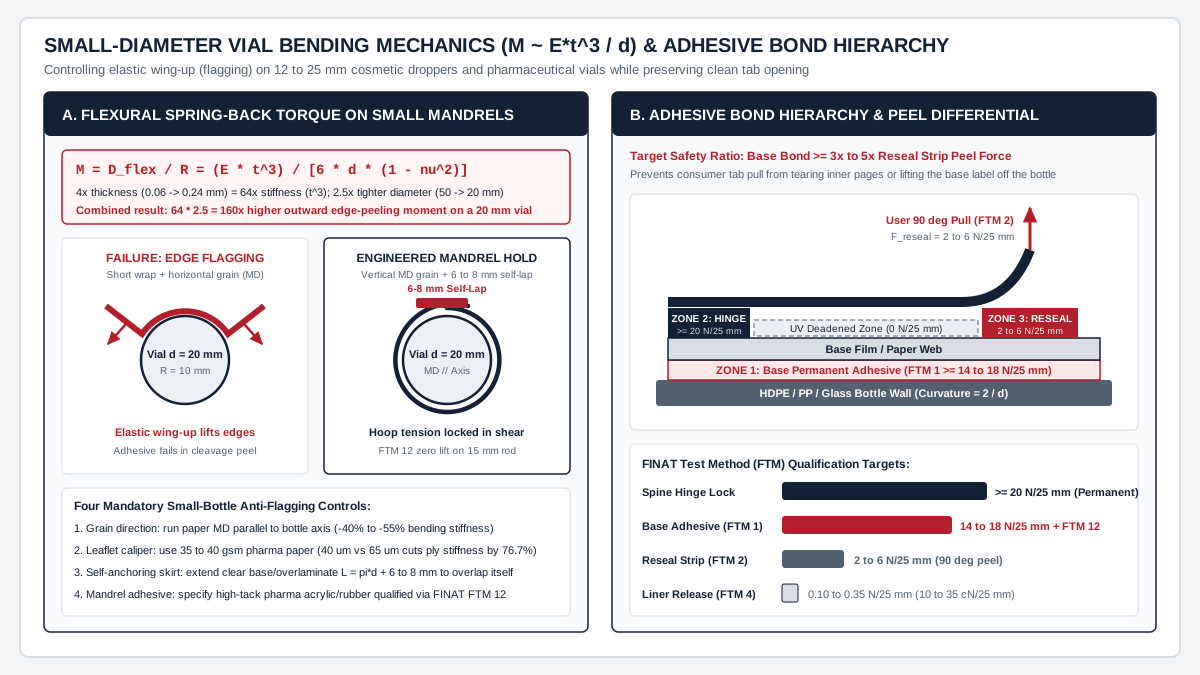
To neutralize that t^3 / d spring-back spike and prevent base lift when the user pulls the starter tab open, packaging engineers enforce four quantitative controls across three container diameter tiers:
| Vial diameter tier | Maximum recommended ECL pack caliper (t) |
Leaflet paper grain & basis weight spec | Base wrap & adhesive specification (FINAT FTM) |
|---|---|---|---|
Micro vials, syringes & lip tubes (d = 10 to 18 mm) |
<= 0.18 to 0.22 mm (use 360-deg self-wrap or thin 2-ply film; avoid thick spine booklets) |
MD grain strictly parallel to vial cylinder axis; 35 to 40 gsm pharma paper if inner leaflet used | Full circumference wrap L = pi * d + 6 to 8 mm self-lap; small-mandrel adhesive qualified via FINAT FTM 12 on 12 to 15 mm rod |
Small cosmetic droppers & OTC vials (d = 18 to 30 mm) |
<= 0.25 to 0.45 mm (2-ply peel-and-reseal or 4- to 8-panel plow-fold concertina) |
MD grain parallel to bottle axis (reduces circumferential bending modulus E by 40% to 55%); 38 to 45 gsm paper |
High-tack permanent acrylic or rubber-resin (FTM 1 >= 14 to 18 N/25 mm); extend clear overlaminate skirt or use full-wrap base |
Medium & large bottles/jugs (d > 30 mm) |
Up to 0.80 to 1.60 mm (multi-page concertina or stitched agrochemical booklet onserts) |
MD grain parallel to fold spine; 40 to 50 gsm opaque litho paper under 25 micrometer BOPP cover | Permanent chemical-resistant base adhesive (FTM 1 >= 16 N/25 mm, static shear FTM 8 > 24 hr); 3.2 to 6.4 mm clearance from shoulder/heel |
Rule of thumb: On any container mustering a diameter under
30 mm, orient the paper leaflet’s machine direction (MD grain) parallel to the vertical axis of the bottle so the label bends across the grain (CD) around the circumference. Combining vertical MD grain (-45%modulusE) with40 micrometer(35 to 40 gsm) pharma paper instead of65 micrometeroffset paper ((40/65)^3 = 0.233, or-76.7%sheet stiffness) cuts total circumferential spring-back torque by more than 85%.
Equally critical is the adhesive bond hierarchy across the three distinct adhesive zones inside the ECL (compare how bond release targets are separated in the easy-peel versus removable bottle labels guide and how film stiffness behaves in the BOPP, PET, and PE bottle label comparison). When a consumer pulls the starter tab at a 90-degree angle to read the inner panels, the resealable closure strip must release smoothly at 2 to 6 N/25 mm under FINAT FTM 2 without tearing paper fibers. Simultaneously, the permanent container base adhesive (FINAT FTM 1 >= 14 to 18 N/25 mm and FINAT FTM 12 mandrel hold) and the internal spine hinge (>= 20 N/25 mm) must maintain at least a 3:1 to 5:1 peel-force safety ratio over the reseal strip so opening the booklet never lifts the base label off the bottle wall.
Takeaway: Defeat small-bottle flagging by aligning paper grain vertically, stepping down to 35 to 40 gsm pharma paper, overlapping the base skirt by 6 to 8 mm on < 20 mm vials, and enforcing a >= 3:1 peel ratio between the FTM 1 base adhesive and the FTM 2 reseal strip.
Automatic applicator integration: peel-plate radius, ultrasonic gap sensors, and core sizing
A multi-page booklet label behaves differently from a flat single-ply label as it travels through an automatic labeling head. Because a concertina or stitched booklet adds a localized 0.40 to 1.50 mm thickness step in the center of the web surrounded by a thinner 0.075 mm lamination skirt and a 0.030 to 0.070 mm release liner, running a booklet reel on unmodified single-ply machine settings triggers three immediate line stops: photoelectric double-feeding, premature cover popping (“tenting”) at the peel beak, and trapped air blisters behind the booklet step.
Integrate booklet roll parameters with the custom roll labels unwind direction and core sizing specification, the inline versus rotary container requirements guide, and the broader labeling equipment section using the hardware settings below:
| Applicator subsystem | Standard single-ply setting | Booklet & thick ECL setting (t > 0.30 mm) |
Mechanical failure prevented on the packaging line |
|---|---|---|---|
| Dispensing peel plate (beak) tip radius | Sharp knife beak: R = 0.8 to 1.5 mm with 170 to 180 deg liner wrap angle |
Radiused peel plate: R = 3.0 to 6.0 mm with reduced 135 to 150 deg wrap angle (or power-peel roller) |
Prevents high bending shear at a sharp 1.0 mm tip from popping the top overlaminate open or delaminating the spine mid-feed |
Label gap sensor mode & pitch (g_gap) |
Optical photoelectric fork sensor on 3.175 mm (1/8 in) gap |
Ultrasonic or capacitive differential fork sensor on 4.76 to 6.35 mm (3/16 to 1/4 in) gap, or back-side black eye-mark |
Optical beams misfire on the internal transition between the translucent lamination skirt and the opaque paper booklet patch |
| Roll core ID, OD & winding orientation | 76.2 mm (3.0 in) core ID; Wound Out (#3/#4) or Wound In (#7/#8) |
76.2 mm (3.0 in) minimum or 152.4 mm (6.0 in) core ID; strictly Wound Out (Positions #3 or #4) at reduced tension |
Winding thick booklets inside-wound (#5 to #8) or near a tight core buckles the overlaminate and crushes folded spines |
| Release liner grade & caliper | BG40 glassine (50 to 57 micrometers) or PET23 (23 micrometers) |
Heavy supercalendered glassine (BG45 / 50# SCK, 65 to 75 micrometers) or thick polyester film (PET30 / PET36, 30 to 36 micrometers) |
Resists high web-acceleration inertia and prevents liner snapping across the wider gap and heavier booklet mass |
| Container wipe-down & wrap station | Single wiper brush or stationary foam roller | Dual-stage progressive sponge wrap belt or contoured rotary pressure pad with extended dwell | Expels air pockets trapped at the vertical drop-off step where the thick booklet spine transitions to the thin base skirt |
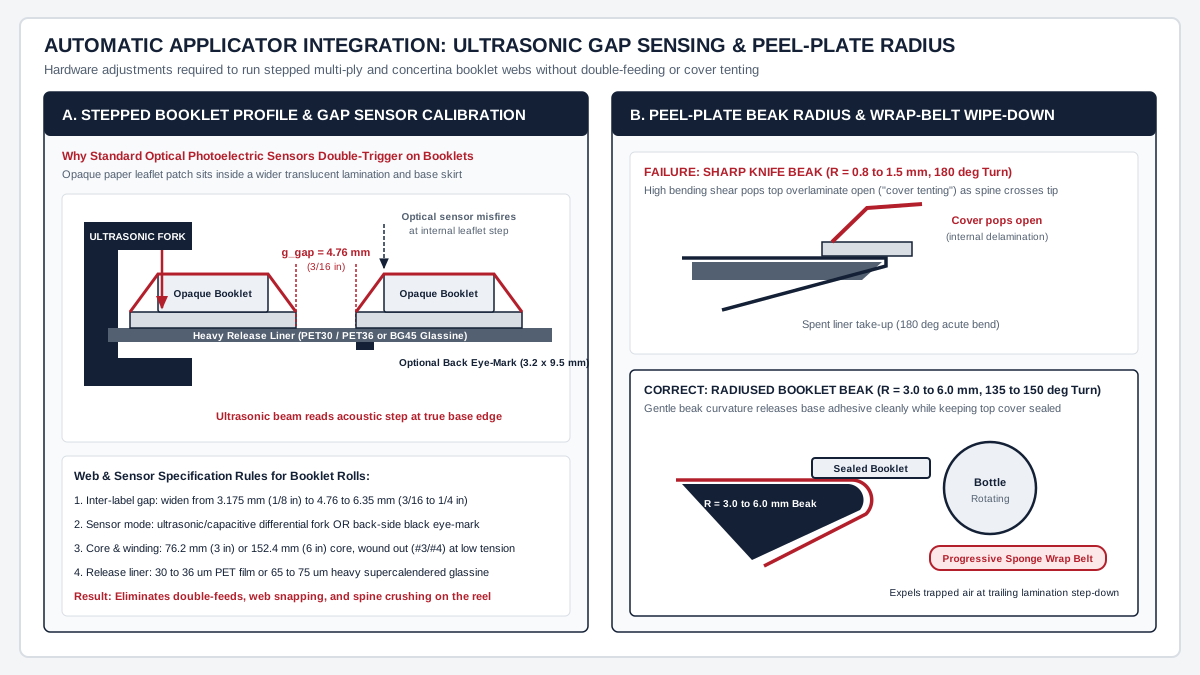
As detailed in the alignment and dispensing guides from CTM Labeling Systems and E-PAK Machinery, two adjustments require coordination between the label converter and the packaging line technician before press cylinders are ordered:
- Widen the die-cut repeat gap to
4.76 mm(3/16 in) so the ultrasonic fork transducer ignores the secondary thickness step where the internal paper leaflet stops and locks exclusively onto the primary release-liner gap, or print a3.2 x 9.5 mmblack registration eye-mark on the back of the liner for single-label optical indexing. - Swap the
1.0 mmknife-edge peel beak for anR = 3.0 to 6.0 mmradius nosebar. On a sharp1.0 mmvertex, the base web bends downward at nearly 180 degrees before the stiffer top cover can follow, shearing the2 to 6 N/25 mmreseal strip apart and sending the booklet onto the bottle with its cover popped open. A3.0 to 6.0 mmradius peel plate reduces the peel angle and lets the base adhesive delaminate from the siliconized liner (FTM 4release force10 to 35 cN/25 mm) without stressing the internal reseal closure.
Takeaway: Run booklet labels Wound Out (#3 or #4) on 3-inch or 6-inch cores with a 4.76 mm (3/16 in) ultrasonic or eye-mark gap, a 30 to 36 micrometer PET or heavy glassine liner, and an R = 3.0 to 6.0 mm radius peel plate.
Booklet and ECL engineering specification checklist
Before releasing artwork to pre-press or ordering rotary dies for a booklet or extended content label, lock the container geometry, regulatory copy area, mandrel-hold mechanics, and applicator hardware tolerances on one shared engineering record. Pair this specification sheet with the label materials category hub to verify chemical and moisture resistance across the base film and overlaminate.
| Specification parameter | Engineering target to lock on PO & dieline | Incoming QC & line qualification check |
|---|---|---|
Container diameter (d) & straight wall (H) |
Exact outside diameter d (mm) and usable straight wall H = H_wall - E_upper - E_lower (>= 3.2 mm clear of shoulder/heel curves) |
Measure 10 container samples with calipers; verify zero encroachment onto transition radii |
| ECL structural architecture & page count | Specify 2-ply/3-ply web, plow-fold concertina, stitched booklet onsert, or 360-deg self-wrap; lock total panels and pages | Verify folded page sequence, language index tabs, and closed/opened/reclosed proof states |
Total pack caliper (t_total) & carton clearance |
Lock nominal caliper & tolerance (e.g., 0.25 +- 0.03 mm for 2-ply; 0.65 +- 0.08 mm for concertina) |
Measure spine, center, and trailing skirt with digital micrometer; test clearance in secondary carton |
| Paper grain direction & leaflet basis weight | MD grain parallel to vertical container axis on d < 30 mm vials; 35 to 45 gsm opaque pharma paper |
Tear-test and bend-test leaflet sample in MD vs CD axes prior to lamination |
| Base adhesive vs reseal strip bond ratio | Base: FTM 1 >= 14 to 18 N/25 mm + FTM 12 mandrel hold; Reseal strip: FTM 2 = 2 to 6 N/25 mm (>= 3:1 differential); Spine hinge >= 20 N/25 mm |
Perform 10 consecutive 90-degree tab openings on conditioned containers at 24 hr and 7 days |
Self-overlapping wrap skirt (if d < 20 mm) |
Base or clear cover film length L = pi * d + 6 to 8 mm overlapping onto release-varnished back |
Inspect overlap seam under 40 deg C / 75% RH aging for zero edge flagging |
| Unwind position, core ID & maximum roll OD | Wound Out Position #3 (right-hand) or #4 (left-hand); 76.2 mm (3 in) or 152.4 mm (6 in) core; max OD per stand |
Unroll leader to confirm leading edge and check inner core wraps for spine crushing |
Inter-label gap (g_gap), sensor & liner grade |
g_gap = 4.76 mm (3/16 in); ultrasonic fork sensor or back-printed black eye-mark; PET30 or BG45 liner |
Verify single-label stop accuracy at full conveyor speed without double-triggering on spine edge |
| Applicator peel beak & wipe-down station | Radiused peel plate R = 3.0 to 6.0 mm (135 to 150 deg turn) + dual-stage progressive wrap belt |
Inspect 50 dispensed bottles for premature cover popping (“tenting”) or trapped air at skirt step |
Takeaway: A complete booklet label specification synchronizes container curvature (2 / d), cubic thickness stiffness (t^3), the 3:1 base-to-reseal adhesive peel ratio, and the applicator’s 4.76 mm ultrasonic gap and radiused peel beak before press tooling begins.
Method and sources
This engineering specification guide compiles regulatory typography and container-attachment rules from the U.S. Food and Drug Administration’s OTC Drug Facts regulation (21 CFR 201.66) and Cosmetics Labeling Guide (21 CFR Parts 701 and 740), the U.S. Environmental Protection Agency’s FIFRA Pesticide Registration Label Review Manual (40 CFR Part 156), and EU CLP Regulation (EC) No 1272/2008 Article 29. Structural ECL classifications and page capacities (up to 48 pages folded from a single sheet in concertina constructions) are drawn from CCL Healthcare and Multi-Color Corporation (MCC). Adhesive peel, reseal, release, and small-mandrel test protocols (FTM 1, FTM 2, FTM 3, FTM 4, FTM 8, and FTM 12) follow FINAT Test Methods, paired with film conformability data from Avery Dennison’s North American Film Materials Technical Guide and applicator hardware recommendations from CTM Labeling Systems and E-PAK Machinery (all sources accessed 25 October 2026). The small-mandrel bending calculation applies cylindrical shell flexural rigidity (D_flex = E * t^3 / [12 * (1 - nu^2)]) to compare a 0.240 mm multi-ply stack on a 20 mm vial against a 0.060 mm single-ply film on a 50 mm bottle.