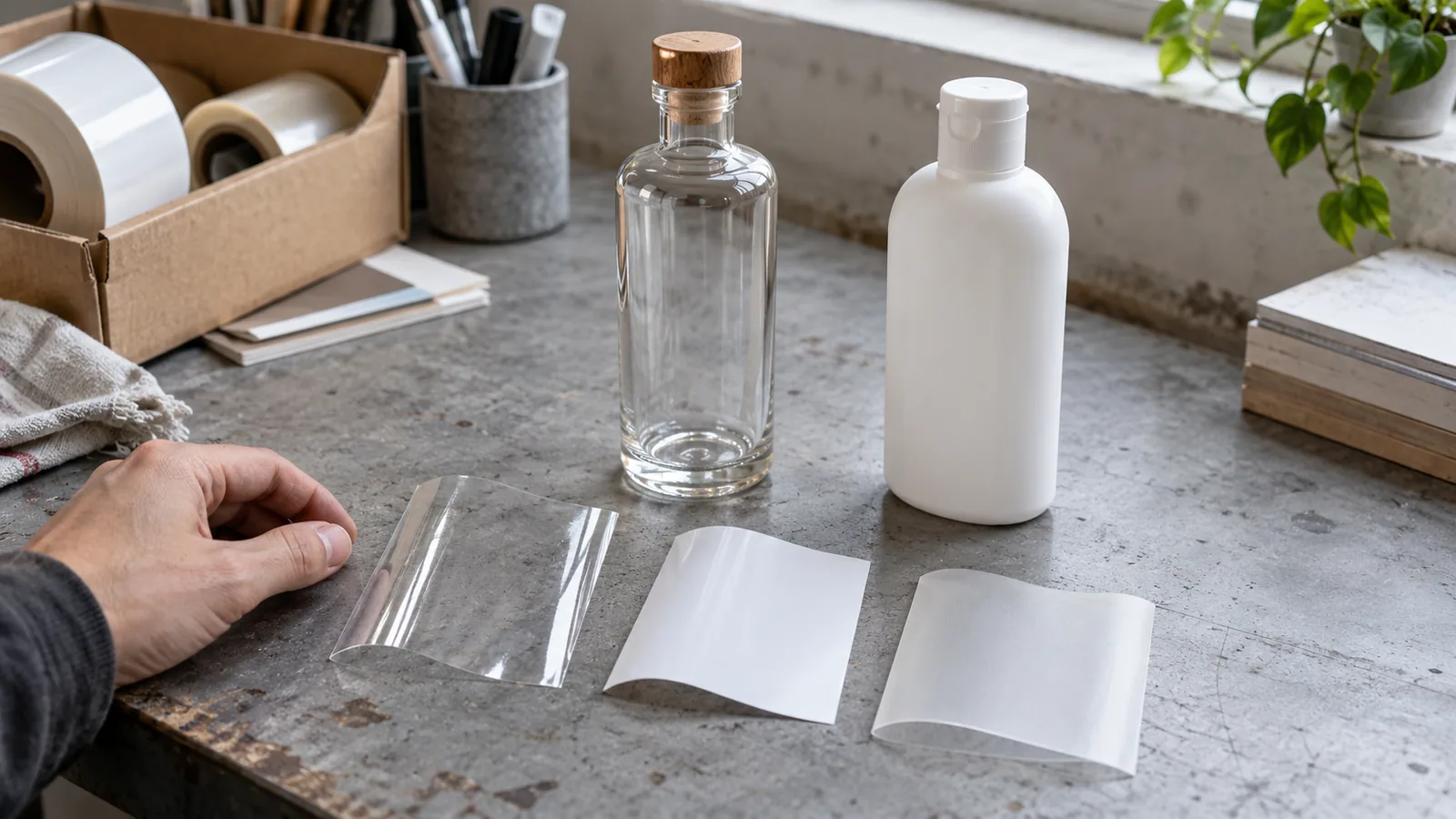
A wrong wash-off label specification fails either in the ice bucket during use or on the bottle wall during washing. When a returnable bottle label has to hold through chilling, condensation, and wet handling and then release during bottle washing, specify the service hold conditions and the approved washing route on separate lines of the project record.
Public supplier pages use the phrase wash off labels across at least four different mechanisms: water-soluble stocks that disperse on contact with water, dry-peel removable labels, plastic-flake recycling adhesives, and returnable whole-bottle wash-off constructions. H.B. Fuller’s May 28, 2019 adhesive blog separates cold-water wash-off on reusable logistics trays from alkali wash-off on beverage bottles that need ice-water resistance. Bostik’s wash-off adhesive page, fetched October 11, 2026, scopes its APR PET-CG-02 validation to PET bottles and trays and states that glass and HDPE offerings are future items. This guide maps the five-stage returnable loop, provides a two-column hold-and-release specification sheet, and lists the written evidence needed from the label supplier, the bottler, and the washing operator.
| Specification input | Source or owner to record | Why it changes the label decision |
|---|---|---|
| Container substrate and reuse loop | Container owner (glass, refillable PET, or crate/tray) | A PET flake-recycling validation does not qualify a returnable glass bottle |
| Service moisture exposure | Bottler brief (dry shelf, condensation, or ice-water immersion) | Eliminates water-soluble or light peelable stocks that release when wet |
| Approved washing route | Bottle-washing operator written process scope | Separates water-only tray rinsing from industrial returnable bottle washing |
| Complete label construction | Label supplier / converter revision (face, ink, coating, wash off label adhesive) | Adhesive release and intact label separation depend on the paired face and finish |
| Post-wash bottle-wall check | Matched sample record before and after the named wash route | Confirms whether label fragments or adhesive ghosting remain on the container |
How do the five stages of a returnable bottle loop split hold from release?
A returnable beverage bottle asks the same adhesive bond to do two opposite jobs at different times in the loop. During filling, cold storage, condensation, consumer use, and crate return, the label must stay anchored and legible. Only when the empty container enters the approved washing stage is that bond supposed to let go cleanly so the intact bottle can be inspected and relabeled.
| Loop stage | What happens to the bottle | What the label construction must do | Failure mode if hold and release are confused | Project entry to record before sample approval |
|---|---|---|---|---|
| 1. Bottling | Bottle is filled, capped, and labeled; wall may carry moisture or surface treatment | Bond to the actual container wall and cure before downstream chill or packing | Label slips or lifts at application if surface moisture or cure interval is ignored | Container material, surface state at labeling, and wait interval before wetting |
| 2. Service (chilling and use) | Refrigerated storage, ambient condensation, wet handling, or ice-bucket immersion | Stay bonded and readable without edge lift, sliding, or paper/film breakdown | Water-soluble stock disperses in ice water; light removable adhesive peels in condensation | Worst-case service water contact (condensation vs. ice-water immersion) |
| 3. Return and sorting | Empty bottles sit in return crates through transport and storage before washing | Remain attached enough to identify the brand/SKU until washing, without welding permanently | Scuffed or torn fragments jam crate sorting, or aged bond resists the washer | Return storage environment and expected interval between filling and return wash |
| 4. Washing | Returned whole bottles pass through the operator’s approved industrial washing route | Release from the bottle wall under the specified wash medium so the label separates cleanly | Permanent adhesive stays stuck, or incompatible face/ink pulps and fouls the wash bath | Written reference for the operator’s approved wash route and label separation mode |
| 5. Inspection and relabeling | Washed bare bottle is checked before refilling and receiving the next label | Leave a clean container wall free of label fragments, haze, or adhesive ghosting | Residual adhesive film builds up across reuse cycles or interferes with the next label | Post-wash visual inspection record and photo ID on the actual container |
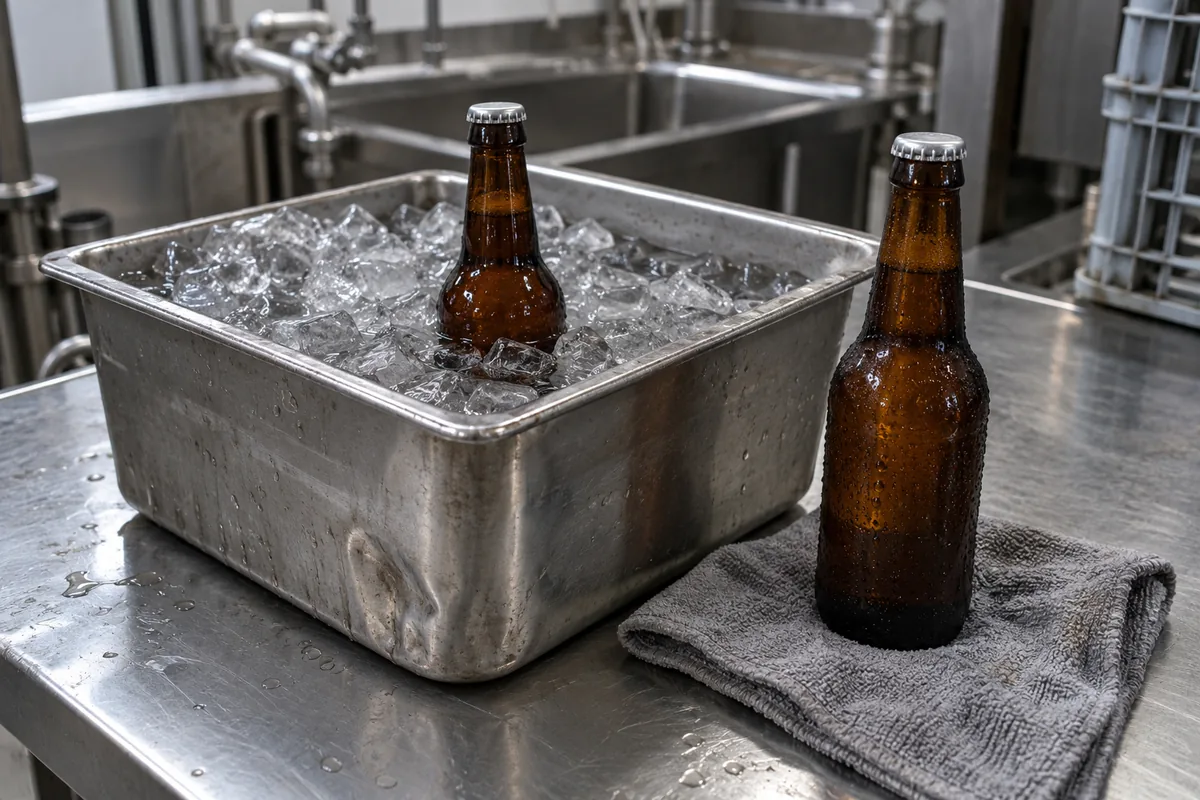
Stage 2 service exposure: a chilled bottle standing in melted ice water beside a bottle carrying cold condensation droplets.
If the project only needs a label that peels off a dry bottle by hand—or a label that leaves its release liner cleanly—use the easy-peel versus removable bond record instead. Once the bottle has to survive wet service and then release in a washer, a single “removable” checkbox no longer describes the loop.
Common mistake: Treating a supplier’s general “wash-off” or “removable” headline as proof that the label will both survive an ice bucket and release in your specific bottle washer.
Takeaway: Map all five stages of the returnable loop first so service moisture stays in the hold column and washer detachment stays in the release column.
Why can’t removable, water-soluble, and flake-recycling claims substitute for returnable bottle wash-off?
Search results for wash off labels and removable and wash off labels mix four different packaging tasks under overlapping names. In its December 19, 2023 guide, Altro Labels places Water-Soluble Labels, Removable Labels, and Temporary Labels under the single heading “Types of Wash-Off Labels,” while noting in its removable section that “there are some risks that labels might come off earlier.” That grouping explains why buyers receive mismatched samples when a brief only asks for a “wash-off” or “removable” label.
| Term found in supplier pages | What the public source actually describes | Why it cannot be copied blindly into a returnable beverage bottle spec |
|---|---|---|
| Water-soluble / dissolvable label | SmartSolve (July 17, 2024) explains that both the dispersing paper-based face stock and the dissolvable adhesive break down completely upon contact with water | A beverage bottle exposed to condensation, wet hands, or an ice bucket cannot use a face stock that dissolves on contact with water |
| Dry-peel removable label | H.B. Fuller (May 28, 2019) notes that a standard peelable adhesive risks labels coming off during refrigeration and condensation; Altro Labels (December 19, 2023) notes early-lift risk | Designed for low-peel removal from a surface, not for holding through iced water and releasing on cue in an industrial bottle washer |
| Cold-water wash-off logistics label | H.B. Fuller (May 28, 2019) describes cold-water wash-off adhesives for supermarket meat and fruit trays that are cleaned only with water before reuse | Cold-water release on a dry-goods or chill-cabinet logistics tray is a different balance from a bottle submerged in ice water during service |
| Plastic-flake recycling wash-off adhesive | Bostik Canada (fetched October 11, 2026) cites APR Critical Guidance (PET-CG-02) for PET bottles and trays in polyester/polyethylene recycling streams; Labeling Advantage (August 31, 2026) describes containers shredded into plastic flakes before washing |
Shredded PET or polyolefin flake washing is a material-recovery process, not a whole-bottle returnable glass washing and relabeling loop |
Two source details illustrate how strictly scope boundaries matter:
- Substrate and recycling stream vs. whole-bottle reuse: Bostik Canada’s wash-off adhesive page describes waterborne acrylic adhesives (
Flexcryl ClearCycle) for PET bottles and trays that passed Association of Plastic Recyclers (APR) Critical Guidance testing (PET-CG-02) for polyester and polyethylene recycling streams, and explicitly adds: “Look for future offerings for glass and HDPE substrates.” A PET flake-recycling recognition cannot be filed as qualification for a returnable glass bottle. - Cold-water tray rinsing vs. alkaline bottle washing: H.B. Fuller’s May 28, 2019 blog post explains that adhesive selection depends on the conditions the container sees in service and in washing—contrasting supermarket meat and fruit trays washed only with water against beer bottles stored in refrigerated or iced-water conditions and later washed in an alkali operation. Because that post is from 2019, treat its distinction between cold-water and alkali wash-off routes as a scoping question rather than assuming its 2019 grade numbers represent current catalog specifications.
Trade media and supplier pages for returnable glass make the same two-stage distinction. Packaging Europe (June 29, 2026) reports that Fedrigoni Self-Adhesives introduced its SH6020 W Plus permanent wash-off adhesive for the wine and spirits industry to combine adhesion across the product lifecycle with clean removal during industrial washing. Avery Dennison’s glass wash-off page, fetched October 17, 2026, similarly states that glass wash-off solutions are built to separate cleanly from glass during the washing process with no adhesive residue so returnable bottles can be relabeled. Those statements define the target behavior for a named product family; they do not replace sample verification on your container and washer.
Takeaway: Separate water-soluble dispersion, dry hand-peel, shredded-flake recycling, and whole-bottle returnable washing before shortlisting any candidate stock.
How do you write the two-column Hold vs. Release specification sheet?
Use a two-column specification sheet so the converter, the bottler, and the washing facility review the hold requirement and the release requirement side by side. Never collapse both columns into a single phrase such as “wash-off adhesive.” And do not invent wash bath chemistry, caustic concentration, bath temperature, or machine cycle settings in a packaging blog brief—obtain the written washing scope from the facility that actually washes the returned bottles and leave unconfirmed cells marked Unknown / verify on the unit.
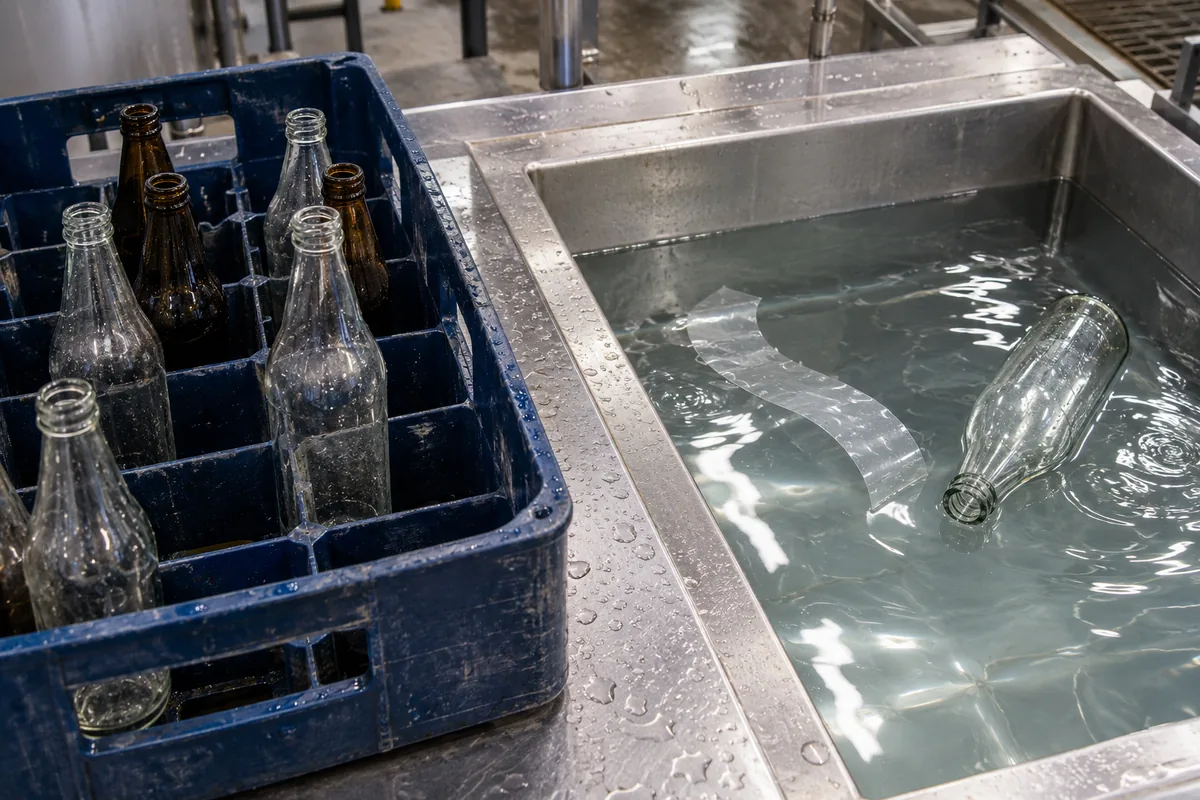
Stages 3 and 4: returned glass bottles in a plastic crate beside a wash basin showing intact label separation from the bottle wall.
| Package or process element | Column A — Service Hold Requirement (Bottling, Chilling & Return) | Column B — Wash Release Requirement (Approved Bottle Washing & Inspection) | Current project entry |
|---|---|---|---|
| Container identity | Material (glass, refillable PET, or rigid crate/tray), wall finish, and existing scuff/coating state | Same container after multiple return cycles; check whether surface wear alters release | ___ |
| Application & pre-exposure state | Bottle wall temperature/moisture at application and required dwell before chilling or wetting | Maximum age / storage exposure of the applied label before the bottle returns for washing | ___ |
| Water and temperature exposure | Exact service condition: dry ambient, post-chill condensation, wet wipe, or ice-water immersion | Operator’s written washing route reference (cold-water rinse vs. approved industrial alkaline/hot wash route) | Unknown / verify on the unit |
| Facestock, ink & overprint | Wet-strength paper or film (BOPP, PET, PE) and print/coating that stay intact and legible when wet |
Construction that detaches cleanly (for example, intact strip separation rather than unscreened pulp or ink bleed, as required by the washer) | ___ |
| Wash off label adhesive | Named adhesive reference scoped by the supplier for the stated container and cold/wet service | Same named adhesive scoped by the supplier to release cleanly in the operator’s written wash route and stay anchored to the label face | ___ |
| Acceptance observation on sample | No edge lift, sliding, bubbling, or print loss after the agreed service sequence | Complete label detachment within the washer’s normal pass and zero visible adhesive ghosting or residue on the dried bottle wall | ___ |
For the service side of the sheet, if the bottle must survive condensation or an ice bucket without ink smearing or face breakdown, pair Column A with the printed waterproof bottle-label proof record. For basic film and layer terminology, see the pressure-sensitive label construction checklist and the BOPP, PET, and PE construction comparison.
Takeaway: Every row on a returnable bottle brief needs both a Column A hold condition and a Column B release condition tied to the same named construction.
What source evidence must the label supplier, container owner, and washing operator provide?
Because a returnable label crosses three operations—converting/application, beverage distribution, and industrial bottle washing—no single party holds all the inputs. Before approving a construction, collect the written source documents below and pair them with a before-and-after sample log on the actual container.
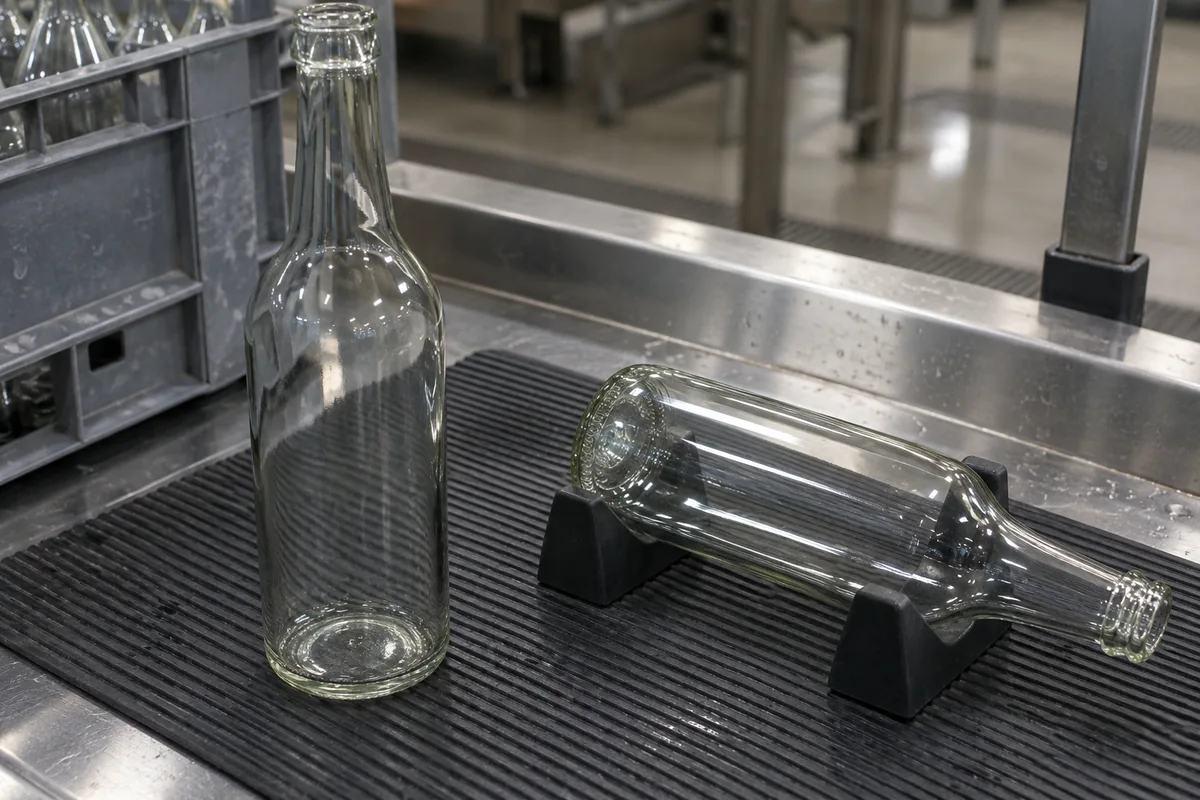
Stage 5 post-wash inspection: checking the bare washed glass wall under direct reflection for adhesive ghosting or unremoved film fragments.
| Party | Written evidence to provide before trial approval | What remains unverified if this document is missing |
|---|---|---|
| Label supplier / converter | Technical datasheet and written application scope naming the complete construction revision (facestock, ink/coating, wash off label adhesive, and liner), the qualified container substrate, the covered service moisture condition, and the wash route category for which clean release is stated | Whether the adhesive claim applies to your container material (for example, glass vs. PET) or to your finished printed construction |
| Container owner / bottler | Container specification (material, external coating or scuff state, geometry), labeling line surface state, dwell interval before chilling, and worst-case service exposure (refrigeration, condensation, ice-water immersion, and return-crate storage time) | Whether the sample check reflects the real moisture and aging the bond experiences before it reaches the washer |
| Bottle-washing operator | Written reference for the approved washing route, how detached labels are separated from the bath (intact screen removal vs. other handling), and the post-wash bottle-wall acceptance criteria before refilling | Whether a label that releases in a bench beaker will separate cleanly and clear filtration in the actual bottle washer |
Sample handoff and inspection log
Copy the fields below into the project approval file when running a matched trial across the hold and release stages:
| Field | Project record entry |
|---|---|
| Sample ID and converter construction revision | ___ |
| Named facestock, print/finish, and wash-off adhesive grade | ___ |
| Container material, surface treatment/wear state, and bottle ID | ___ |
| Application condition and dwell interval before cold/wet exposure | ___ |
| Stage 2 service hold check: exposure sequence, photo ID, and edge/print observation | ___ |
| Stage 3 return interval / aging before washing | ___ |
| Stage 4 washing route reference (per washing operator document) | Unknown / verify on the unit |
| Stage 5 post-wash bottle wall inspection: photo ID, detachment completeness, and residue/ghosting check | ___ |
| Remaining exclusions (containers, print revisions, or wash routes not covered) | ___ |
Keep the label materials section with this record when comparing candidate constructions across a bottle range.
Takeaway: Do not sign off on a returnable bottle label until the converter’s written construction scope, the bottler’s service exposure record, and the washer’s acceptance record are filed under the same sample ID.
When this record stops
This guide structures the specification handoff between service retention and returnable washing release; it is not a laboratory test certificate or a bottle-washer operating manual:
- No caustic recipes, temperatures, or machine operating settings: This page does not prescribe sodium hydroxide concentrations, bath temperatures, dwell times, or washer spray pressures. Those parameters belong to the bottle-washing operator’s documented process and the adhesive supplier’s technical datasheet for a named grade.
- No universal cold-water or resource-saving guarantees: Not all wash-off labels release in cold water, and this page makes no claim that switching label constructions guarantees water, chemical, energy, or cost reductions.
- No cross-substrate or historical grade extrapolation: H.B. Fuller’s 2019 blog post is cited only for the conceptual distinction between cold-water tray wash-off and ice-water-resistant alkali bottle wash-off; its 2019 product names are not presented as current catalog recommendations. Bostik Canada’s
PET-CG-02recognition applies to the PET recycling scope stated on its page and is not evidence for returnable glass bottles.
Method and sources
This guide compiles public supplier, converter, and trade-media documentation read in October 2026:
- H.B. Fuller, “Three good reasons to wash your labels away” (published May 28, 2019; fetched October 11, 2026) — used to distinguish cold-water wash-off on reusable logistics trays from alkali wash-off on beverage bottles requiring ice-water resistance, and to note the refrigeration lift risk of standard peelable adhesives.
- Bostik Canada, “Wash-Off Label Adhesives” (fetched October 11, 2026) — used to show how a supplier scopes waterborne acrylic wash-off adhesives (
Flexcryl ClearCycle) toAPR PET-CG-02PET recycling while explicitly noting future offerings for glass and HDPE. - Altro Labels, “What are Wash-Off Labels? 2024 Guide” (published December 19, 2023; fetched October 11, 2026) — cited as an example of public guides that group water-soluble, removable, and temporary labels under wash-off terminology while noting early-peel risk on removable grades.
- Labeling Advantage, “Wash-Off Adhesive Technology: Improving Plastic Packaging Recycling Efficiency” (published August 31, 2026; fetched October 11, 2026) — used to contrast shredded plastic-flake recycling wash-off with whole-bottle return loops and to note whole-construction compatibility (facestock, adhesive, inks, coatings, and container).
- Avery Dennison, “Wash-off Labels for Glass Reuse and Recycling” (live-fetched October 17, 2026) and Packaging Europe, “Fedrigoni Self-Adhesives introduces permanent wash-off adhesive” (published June 29, 2026; read from the local industry library) — used for supplier and trade-media descriptions of permanent-in-use, wash-off-in-cleaning glass bottle label systems.
- SmartSolve, “Wash-Off vs. Water-Soluble Labels: Which Is Ideal for Sustainable Packaging?” (published July 17, 2024; live-fetched October 17, 2026) — used to separate dispersing water-soluble paper/adhesive constructions from wash-off labels that detach from returnable bottles during washing.
The five-stage loop table, two-column Hold vs. Release specification sheet, and three-party evidence checklist are editorial tools prepared by this site. No original laboratory wash tests were performed. See our editorial policy for how source boundaries and illustrative photographs are maintained.
Version record: October 17, 2026 — initial publication of the returnable-bottle hold-and-release specification guide.