Treating a face-paper announcement as approval of the whole food label can waste a material trial. Evaluate Asendo 80 with the intended adhesive, print system and package use, and request the supporting documents for that identified construction.
UPM announced Asendo 80 on September 15, 2026 as a grease-resistant label face paper with an 80 gsm basis weight. Its no-added-PFAS statement describes paper production; it is not a reported zero-detection result for a converter’s finished label. For a food or oil-sensitive application, first define the label construction and contact conditions, then request samples and evidence for that use. This checklist organizes the evaluation without claiming independent material testing.
- Identify the face-paper grade and sample batch.
- Keep adhesive, liner, inks and finishing in the same construction record.
- Ask for the underlying documents rather than adopt a headline claim.
- Record the sample result and any unresolved application condition.
Read the launch claims at their stated scope
The useful distinction is between what UPM says about the paper and what the converter needs to establish about the finished label. The release names UV Flexo and UV-inkjet, says the paper works with a range of adhesives and describes food-contact requirements. Keep the exact supplier wording and ask for the applicable documents before expanding it to a particular package.
| Supplier wording in the release | Meaning for the evaluation record | Evidence still needed for the job |
|---|---|---|
| 80 gsm basis weight | Mass per unit area, not a thickness or grease-resistance score | Current grade specification |
| No PFAS added during production | Statement about how UPM makes its papers | Relevant analytical report and its scope |
| Grades tested by third-party laboratories | UPM’s description of testing | Report identity, sample, method and result |
| UV Flexo and UV-inkjet | Named processes | Exact ink/process and application guidance |
| FDA and BfR food-contact requirements | Company compliance statement, not FDA approval | Intended-use documents and limitations |
| FSC or PEFC versions available | Stated supply option | Actual order’s certification and supply documentation |
The certification footnote gives scheme references, but a reference in a release does not identify a particular purchased batch. Retain the documents for the actual supplied material. Use the label materials section to keep the material task organized and the pressure-sensitive construction checklist when the intended format includes adhesive and liner.
Takeaway: Match each statement to the material, document and use it actually covers.
Who needs to evaluate the new face paper?
Start with the actual customer’s use and destination market. The launch addresses food-contact and grease-sensitive label applications; a US converter serving an EU customer also needs that customer’s applicable packaging specification. A new paper grade alone does not establish which rules govern the complete pack. The table gives project questions, not a legal conclusion about a market.
| Converter task | Evaluation focus | Evidence to obtain |
|---|---|---|
| Label for an oil-sensitive product | Agreed exposure and appearance requirements | Actual product/package conditions and acceptance criteria |
| Label involving food contact | Intended contact scenario | Supplier documentation for the relevant construction and use |
| Supply to an EU food customer | Customer’s destination-market requirements | Applicable specification and regulatory assessment |
| US-only label project | Actual customer and jurisdiction requirements | Project-specific compliance documentation |
The usable label-zone guide helps record a container surface when that physical task is relevant; it supplies no food-contact determination. The printing and application route separates press suitability from subsequent labeling conditions.
Takeaway: Identify the use and market before asking whether the material fits.
Request samples for an identified label construction
Describe what the face paper will become, not just the roll you want to receive. Give the supplier the intended label format, adhesive, print route and package conditions, with unknown fields left open. UPM’s release offers samples for evaluation under converters’ production conditions. A sample request is therefore a way to begin this review, not evidence that the construction has passed it.
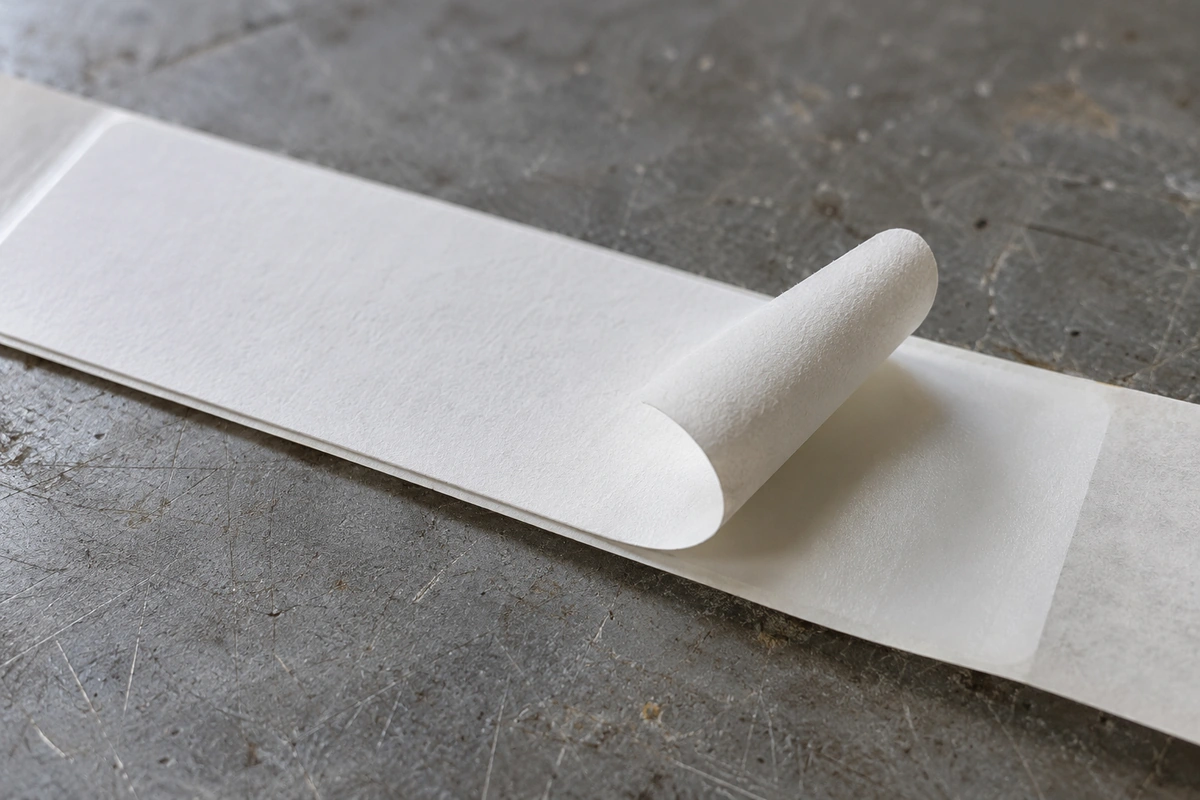
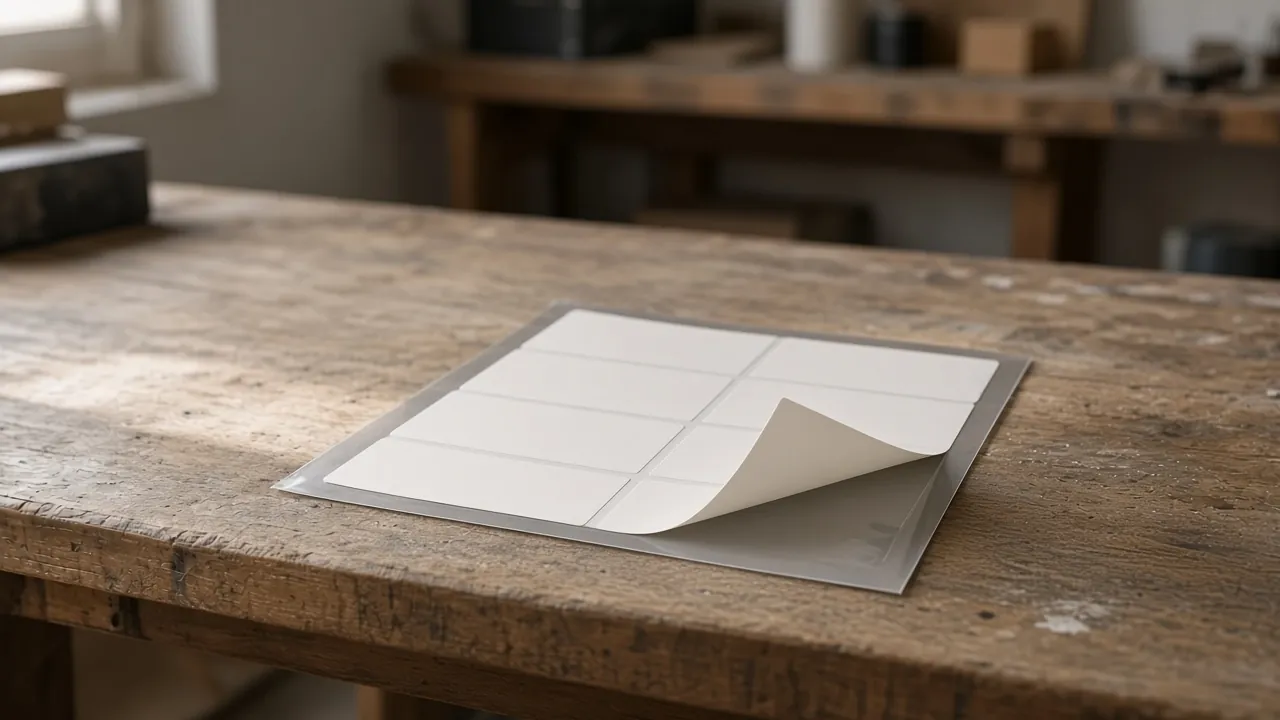
Generated editorial illustration — a face paper is one part of a label construction; no grade or adhesive is identified in this image.
| Sample-request input | What to record | Why it belongs in the request |
|---|---|---|
| Intended label | Format, drawing and use | Defines the actual application |
| Material identity | Proposed face paper and sample/batch reference | Links documents to the sample |
| Adhesive and liner | Actual proposal or open question | Defines the supplied construction |
| Print and finish | Ink identity, process and intended finishing | Defines the production task |
| Package exposure | Actual food/oil, contact arrangement and handling | Defines the evaluation conditions |
| Customer requirement | Agreed criteria and relevant market | Defines the decision the sample must support |
The complete-construction comparison explains how to preserve component identities. Its film examples do not demonstrate this face paper’s properties. For a bottle label, include the arriving container condition if moisture, residue or surface state is part of the proposed use.
Takeaway: Request a sample with a defined end use and a traceable construction.
Plan a trial under your production conditions
Agree the observations and acceptance criteria before running the proposed sample. Keep those criteria distinct from measurements actually obtained. Record the paper, adhesive and print-system identities alongside real operating and exposure conditions. This proposed trial record contains no universal process settings, exposure time, grease score or pass limit; those belong to the project’s specification and supplier guidance.
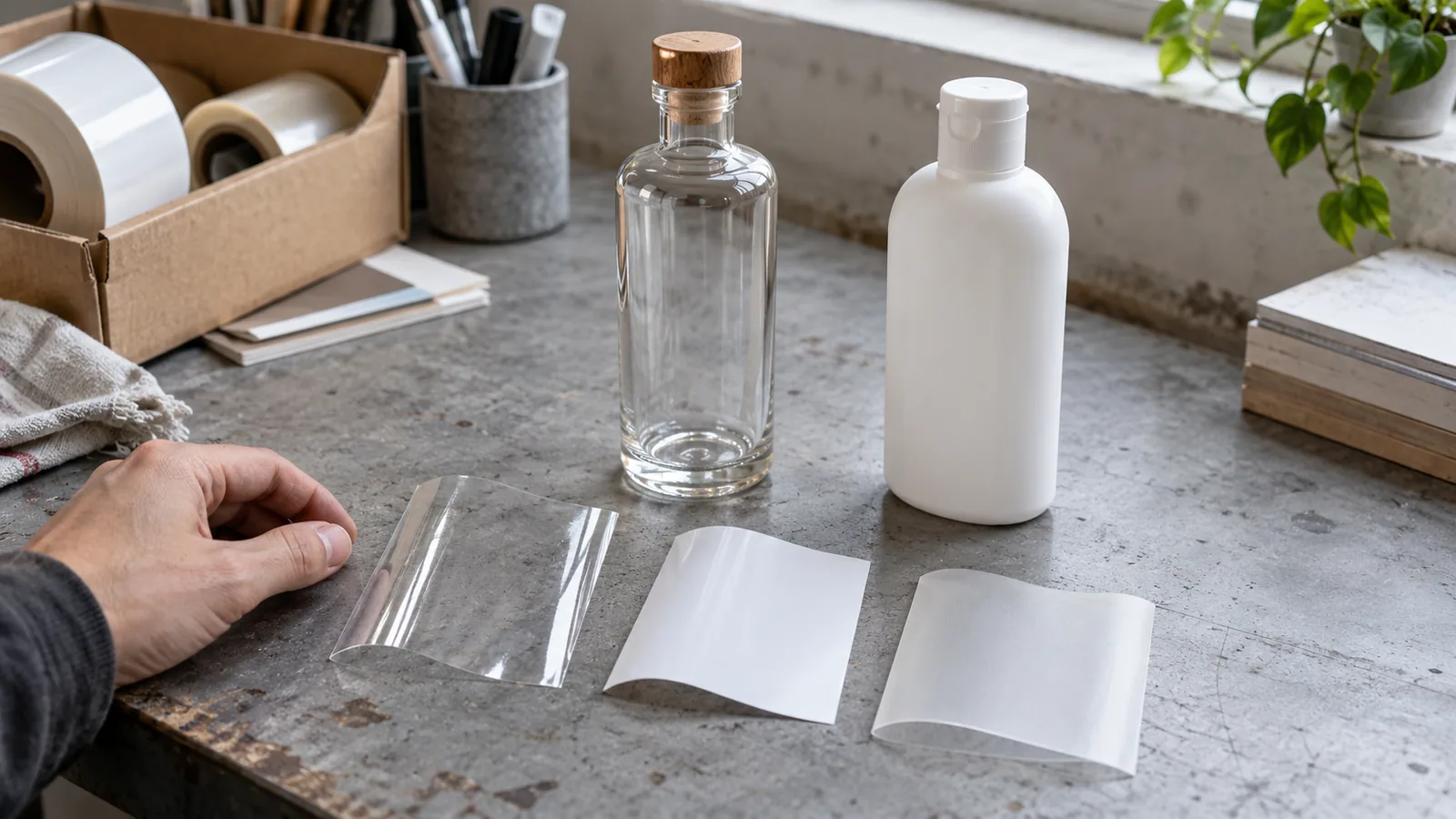
Generated editorial illustration — the objects indicate an intended use to investigate; no grease-resistance test or result is depicted.
Copyable trial record — enter project ___, sample/batch ___ and trial date ___ first. Guidance describes what to collect; blank cells are the project’s actual entries.
| Trial field | Guidance | Planned requirement | Actual observation and document reference |
|---|---|---|---|
| Sample and construction | Identify components and revisions | ___ | ___ |
| Printing | Name process, ink and retained print sample | ___ | ___ |
| Appearance | Use the customer’s approved reference | ___ | ___ |
| Package application | Identify container and surface state | ___ | ___ |
| Oil or food exposure | Agree scenario and method | ___ | ___ |
| Remaining issue | Name evidence provider and next review | ___ | ___ |
If replacing an existing material, keep an identified control label with the same intended use. Record any differences between its construction or trial conditions and the proposed sample. A result on a loose paper coupon should remain a coupon result rather than become a conclusion about a converted label on a bottle.
Use the artwork proof record when a customer must judge the printed appearance on the actual package. If bubbles, wrinkles or lifting appear after application, retain the defect observation log before assigning a material cause.
Common mistake: Turning “no PFAS added” into “the finished label was tested and contains none.”
Takeaway: Keep the planned criteria, actual conditions and observed results in separate columns.
When to act, and which dates are still open
Start an evaluation when the project needs material evidence, using the sample route described in the launch. Keep that route separate from a purchase commitment or a legal deadline. The release links its context to the EU’s PFAS restriction for food-contact packaging; a converter’s regulatory reviewer should establish the applicable legal requirements for the actual supplied pack.
| Event or checkpoint | Date or trigger | Nature | Suggested action |
|---|---|---|---|
| Grade launch | September 15, 2026 | UPM announcement | Open a grade-specific evaluation file |
| Sample evaluation | Request for the intended use | Supplier-described route | Provide the construction and production conditions |
| Customer material approval | Actual project milestone | Customer decision | Resolve the missing material and use documents |
| US commercial order | Supplier’s written offer | Supply confirmation needed | Record availability, order scope and delivery terms |
No US price, order minimum or commercial delivery date is supplied by this release. Ask purchasing to retain the actual offer when available; do not derive order terms from the sample-evaluation statement.
Takeaway: A sample offer starts evaluation; the actual order and legal documents govern the other decisions.
What remains to be documented?
Close the questions that matter to the actual food label instead of asking for an undefined assurance of suitability. Keep the evidence attached to the proposed grade and intended use. A report for another construction or a general company statement can provide background without establishing the converter’s result. Mark what still needs a supplier or customer response.
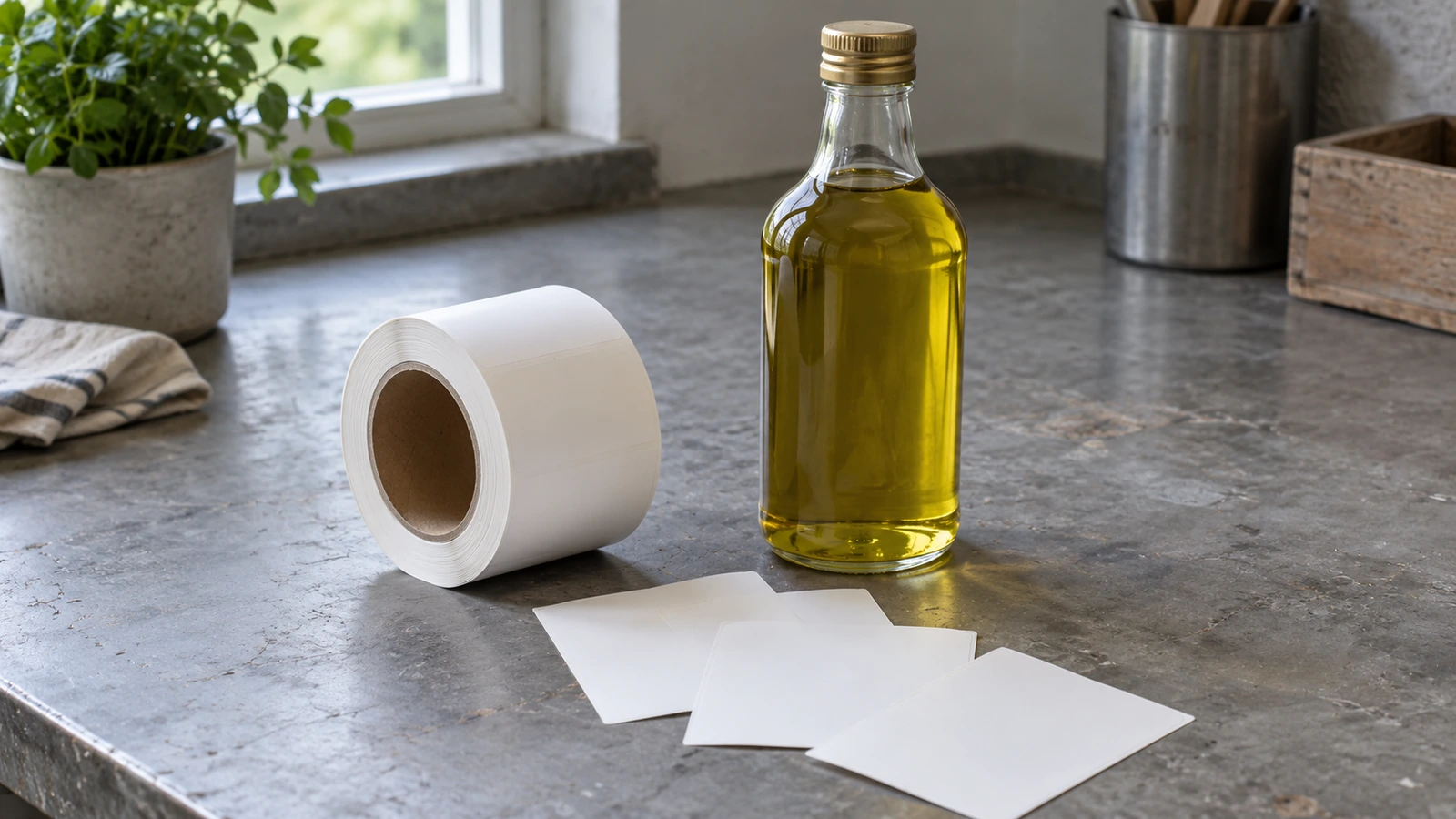
Generated editorial illustration — connect each sample to its documents; the envelopes contain no verified report or certification.
| Open item | Useful document or response |
|---|---|
| Quantified grease performance | Grade-specific result with method and conditions |
| PFAS analytical evidence | Actual report, tested sample and analytical scope |
| Adhesive and ink compatibility | Confirmation for the proposed exact combination |
| Other printing processes | Application-specific scope rather than extrapolation from UV processes |
| Food-contact compliance | Intended-use documentation and its limitations |
| Certified supply | Documents corresponding to the actual order |
| US supply and pricing | Written commercial offer |
Takeaway: Ask for the document that can settle the specific application question.
When this does not apply
This evaluation aid does not approve a whole food package, certify zero PFAS or establish recyclability. It offers no grease-resistance ranking, FDA approval, printing recipe or comparison result. The named face paper and its announced processes are the starting scope; other constructions, contact scenarios and jurisdictions need their own documentation.
Takeaway: Keep a face-paper statement separate from approval of the complete package.
FAQ
What is label facestock?
It is the face material that carries the label’s printed surface. In this launch it is paper. Specifying that face paper does not identify the adhesive, liner, ink or finishing of the supplied label, so keep the proposed components with the sample request.
What does PFAS-free mean?
For this announcement, retain UPM’s precise statement that it does not add PFAS during paper production. Ask for the actual laboratory report and analytical scope before interpreting a result. A production statement and a finished-label detection result describe different evidence.
What are pressure-sensitive labels?
A conventional liner-supported pressure-sensitive label has pre-applied adhesive and attaches by pressure after removal from its liner. An Asendo face-paper sample identifies only the proposed face material. Use the complete construction record to identify the adhesive and liner before evaluating the resulting printed label.
Method and sources
Product statements come from UPM’s September 15, 2026 release, linked below. The original wording describes no added PFAS and company-stated food-contact requirements; these have not been upgraded here to zero detection or FDA approval. The request fields and trial tables are editorial suggestions. No first-hand material trial or analytical review is claimed.
Takeaway: Use the launch to frame a construction-specific sample and document review.