Treating a historical clear-label design as a ready-made specification can waste an artwork revision on an unsuitable outline or unreadable pack. Read the Ethos example as a reported relationship between the bottle, front-and-back graphics and application equipment, then record the conditions your own package needs to prove.
The useful lesson is to evaluate the assembled bottle rather than the transparent label alone. PFFC’s September 9, 2008 report describes clear pressure-sensitive front-and-back labels that could be seen from either side, alongside label-shape development and equipment work. This archive separates those dated statements from our proposed present-day checks. It does not recover the original Flash article or establish the current Ethos packaging specification.
- The historical reports describe a bottle-and-label project, not just a material substitution.
- Front and back graphics were intended to be visible through the package.
- Label outline and application equipment were developed together, according to the reporting.
- Actual dimensions, adhesive grades and production settings remain absent from this record.
Images on this page are generated editorial photos for illustration, not actual packages, test records or performance evidence.
What the historical reports establish
Use the dates to identify the evidence, not to invent a redesign chronology. PFFC supplies an explicit publication date. Packaging Digest’s page displays January 30, 2014, while its text still anticipates a 2010 milestone. That inconsistency prevents treating the displayed date as evidence of a new 2014 design event.
| Record | Source and nature | What it reports | What a new project still needs |
|---|---|---|---|
| September 9, 2008 | PFFC; historical trade-media report, reviewed October 8, 2026 | Clear pressure-sensitive labels with combined screen/flexo printing; front icon and frosted world-map graphic on the back, visible from either side | A new artwork proof on the intended bottle and fill; no historical graphics copied |
| Same PFFC report | PFFC attribution to the historical companies | Spear worked with Krones on label size and shape; PFFC attributes retrofit assistance, labeling software programming and installation/start-up support to Spear | Current bottle drawing, label outline and an application review for the proposed equipment |
| Page displays January 30, 2014; event date unresolved | Packaging Digest; historical trade-media account, reviewed October 8, 2026 | Transparent PET bottle with clear BOPP labels from historical Spear; combination screen/flexo printing and trials using Krones equipment | Exact current construction and project-specific samples |
| January 5, 2009 snapshot | Archived original HTML shell; exact Wayback snapshot linked in Sources | A Flash resource loaded at the old page | Flash text unavailable; no claim to have restored the original wording |

Illustrative photo — generated editorial image, not a test record, customer package or performance evidence.
Publication metadata and event timing are separate fields. At a glance: PFFC report · September 9, 2008 · Packaging Digest · Displayed: January 30, 2014 · Text looks ahead to 2010 · Redesign date: unresolved.
The named companies above belong to the historical reporting. Today’s Spearlabel is an independent reference publication, with its role explained in the editorial policy. Neither report is a test record from this publication, and their similar accounts should not be counted as independent performance verification.
Takeaway: Keep source date, event date and current-project evidence in different fields.
How the front and back graphics relate
The reports say both labels could be viewed from either side of the bottle. That makes the back panel part of the front view, and the front panel part of the reverse view. Our editorial inference is to check both viewing directions together, rather than approving each flat artwork file in isolation.
| Proposed observation | What to record on your sample | Decision supported |
|---|---|---|
| Front view | Visible front artwork, rear artwork seen through the bottle, bottle wall and actual fill | Whether the combined view communicates the intended message |
| Reverse view | Rear copy, front elements behind it and their alignment | Whether the back panel remains readable in the assembled pack |
| Side and turned views | Where graphics overlap as the bottle turns | Whether the relation changes away from the straight-on view |
| Empty versus filled bottle | Sample identity, fill appearance and viewing setup | Whether an empty-bottle approval represents the intended product |
These are proposed observations, not reported Ethos test results. Use the clear-versus-white artwork proof guide for the broader appearance comparison. The printing and application section places that decision alongside sample observation and application evidence.
Common mistake: Approving the front label on a white sheet and assuming it represents the front view through a filled, labeled bottle.
Takeaway: Approve a viewing relationship on a complete sample, not two disconnected artwork files.
From label outline to application requirements
PFFC reports that historical Spear worked with Krones on label size and shape and on existing application equipment. That supports recording outline and handling together. It supplies no label-outline dimensions, bottle-wall geometry or transferable machine settings. A new project needs its own drawing and physical samples before that reported collaboration can inform a practical brief.
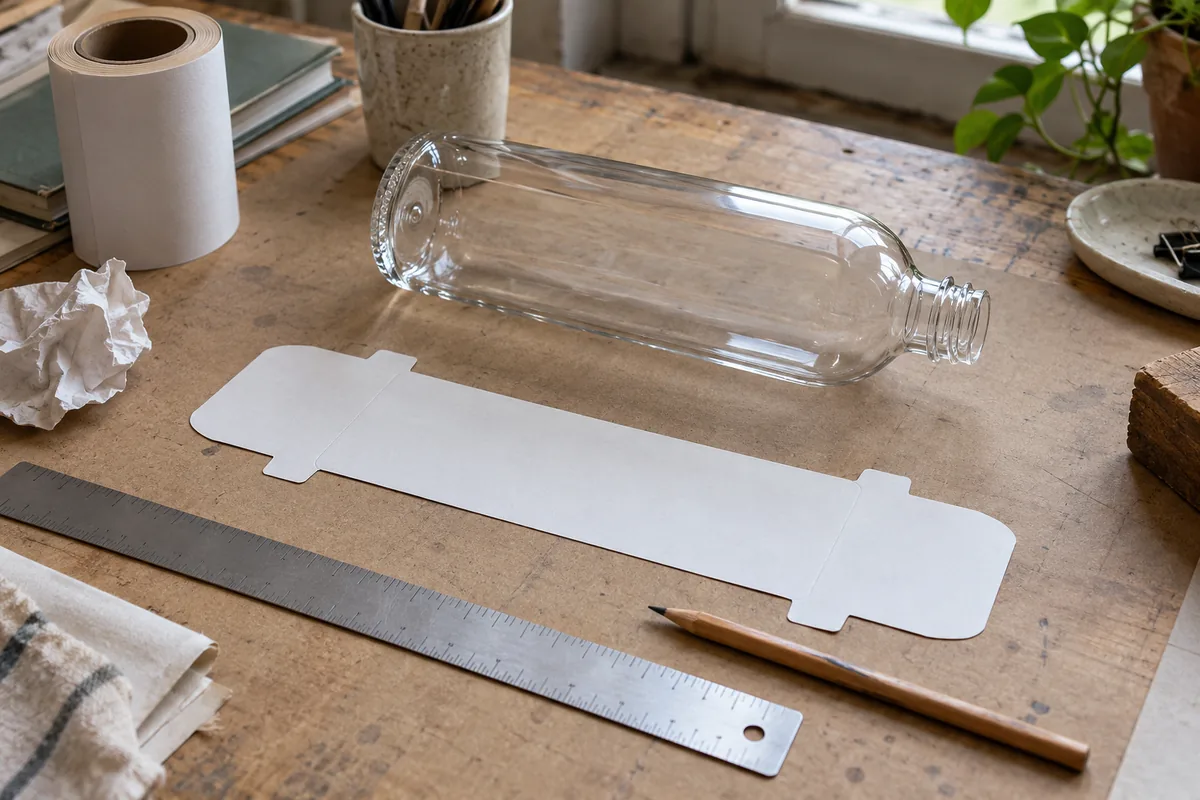
Illustrative photo — generated editorial image, not a test record, customer package or performance evidence.
A measured label outline belongs beside bottle and handling evidence. At a glance: Bottle wall · Label outline · Container drawing · Orientation · Application sample.
| Handoff item | Evidence to prepare | Question to resolve |
|---|---|---|
| Bottle identity and wall | Supplier drawing and identified physical bottle | Which actual wall area receives each label? |
| Front/back outline | Versioned contour with dimensions taken from the intended project drawing | Does the outline fit the intended wall without borrowing historical dimensions? |
| Label construction | Face material, adhesive, liner, print and finish identifiers | Is the sample the complete construction being considered? |
| Viewing relationship | Photos of both views on the actual filled package | Which front/back alignment and transparent areas matter visually? |
| Handling and orientation | Intended contact areas and a marked reference on the sample | Can the application sequence present the required panel? |
| Trial record | Project/sample ID, drawing and construction revision, actual fill, exterior surface state, configuration, application/observation times and linked photo IDs | What was observed under these actual conditions, and what remains to be confirmed? |
| Review decision | Recorded observation, project-defined acceptance basis and responsible party for the next check | What evidence supports the next decision rather than a historical assumption? |
The pressure-sensitive construction checklist explains why a material name cannot replace this structure record. For handling questions, use container requirements for inline and rotary layouts, which concentrates on support and orientation. The label-ready bottle handoff records the upstream surface and posture that arrive at application.
Takeaway: Carry the label drawing and container sample into the same application review.
What transfers to a new bottle project
Transfer the dependencies described by the reports: front/back graphics relate through the bottle, and label geometry relates to application. Do not transfer unreported dimensions, material performance or equipment settings. The following distinction is our editorial interpretation of the public accounts, not a conclusion from reproducing the historical package.
Transfer the questions about relationships, not unreported production settings. At a glance: Reported relationship · Unreported dimensions · Unreported settings · New viewing proof · Confirm on new samples.
| Historical element | Reusable question today | Unsupported transfer |
|---|---|---|
| Clear front/back labeling | What does the opposite panel contribute to this view? | That every clear bottle achieves the same appearance |
| Combined printing process | What process and finish does this artwork proof actually represent? | That the historical screen/flexo process combination is required for a new design |
| Label size/shape development | What usable wall area and contour fit this bottle? | A standard Ethos-derived outline or tolerance |
| Equipment trials and retrofit work | What application evidence exists for the proposed samples? | That an existing labeler needs the same retrofit or software |
If your project starts with a small bottle or jar rather than this historical water-bottle example, use the usable label-zone checklist to establish the area first. The packaging cases section separates such sample preparation from historical accounts.
Takeaway: Reuse the questions that connect components; establish the answers on your own package.
When this does not apply
This record cannot specify a modern label construction, calculate throughput or certify a decoration method. It provides no authorized original package images, and its generated illustrative photos do not depict the actual Ethos bottle, logo or world-map artwork. A present-day defect also needs observation evidence; use the bubbles, wrinkles and lifting record instead of diagnosing from the archive.
The old /2922.html location is retained for an independently written account of the subject linked by PFFC. The original 2009 HTML is a Flash shell; the Flash content has not been obtained. This article therefore makes no original-text restoration claim.
Takeaway: Use this page for historical interpretation, then verify the current package separately.
Method and sources
Compiled from PFFC’s archived Ethos Water Sports Clear P-S Label, published September 9, 2008, and Packaging Digest’s Revised Ethos water bottle builds character. The original HTML was also checked in the January 5, 2009 Wayback snapshot linked in Sources; that is an archive date, not a packaging event date. The PFFC snapshot is dated October 23, 2019. The historical claims are trade-media reporting; the observation and handoff tables are editorial suggestions. Sources were reviewed October 8, 2026. The Packaging Digest page date is recorded as displayed metadata, with the internal 2010 outlook kept as a chronology warning.
Version record: October 8, 2026 — new independent historical account at the preserved original URL, with reported facts and current-project checks separated. No original Flash text or original brand graphics were reproduced.
Takeaway: Keep archive dates separate from packaging-event dates and reported facts separate from new-project observations.